2 (fab meals) in 24 (hours) – Paris

But of course – would anyone expect any less when visiting Paris? Our meals are selected as caefully as the sites we visit and very intentional. A lot of planning and on-line research is done before we got on the airplane for the flight overseas. For this visit, one location was planned, the other was not. But let me stop the talking and get to the experiences.

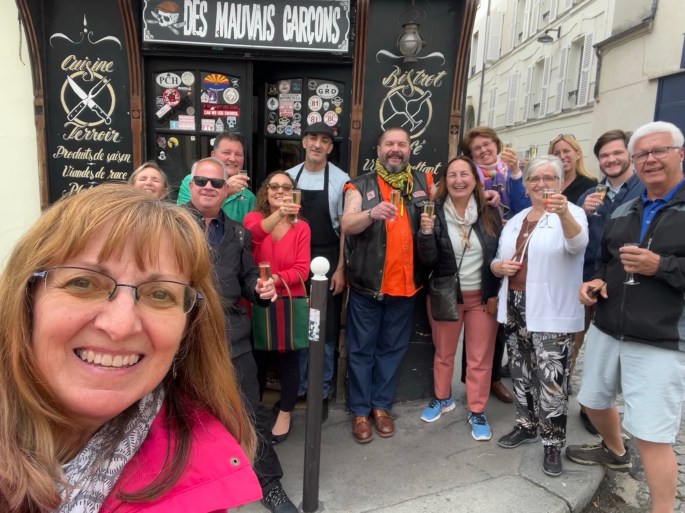
Always listen to your AirBNB host! We have never gone wrong when we ask our host to recommend a local restaurant nearby and this recommendation did not disappoint. After checking into our rental, first order of business was dinner at……………………..

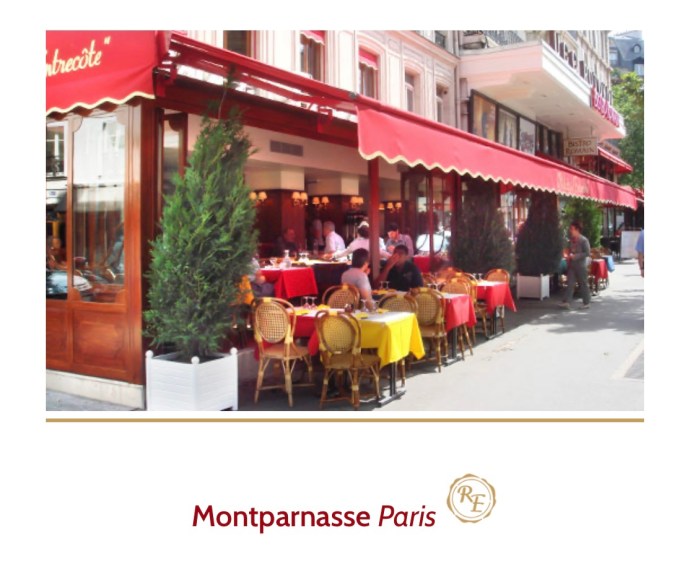
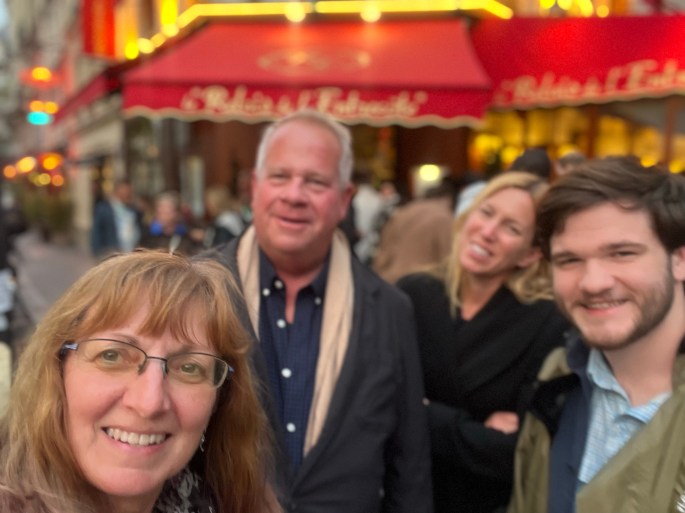
le Relais de l’Entrecote

The menu was created in 1959 in a brasserie and was a single course menu. What? Let’s just say it is so popular, there are three locations in Paris and two in Switzerland. Our host suggested we get there early, otherwise there could be a long wait. We were lucky the evening we visited.

Think about it. Do one thing and do it well. Ordering is easy. You’re asked for your beverage of choice and how you would like your meat cooked.

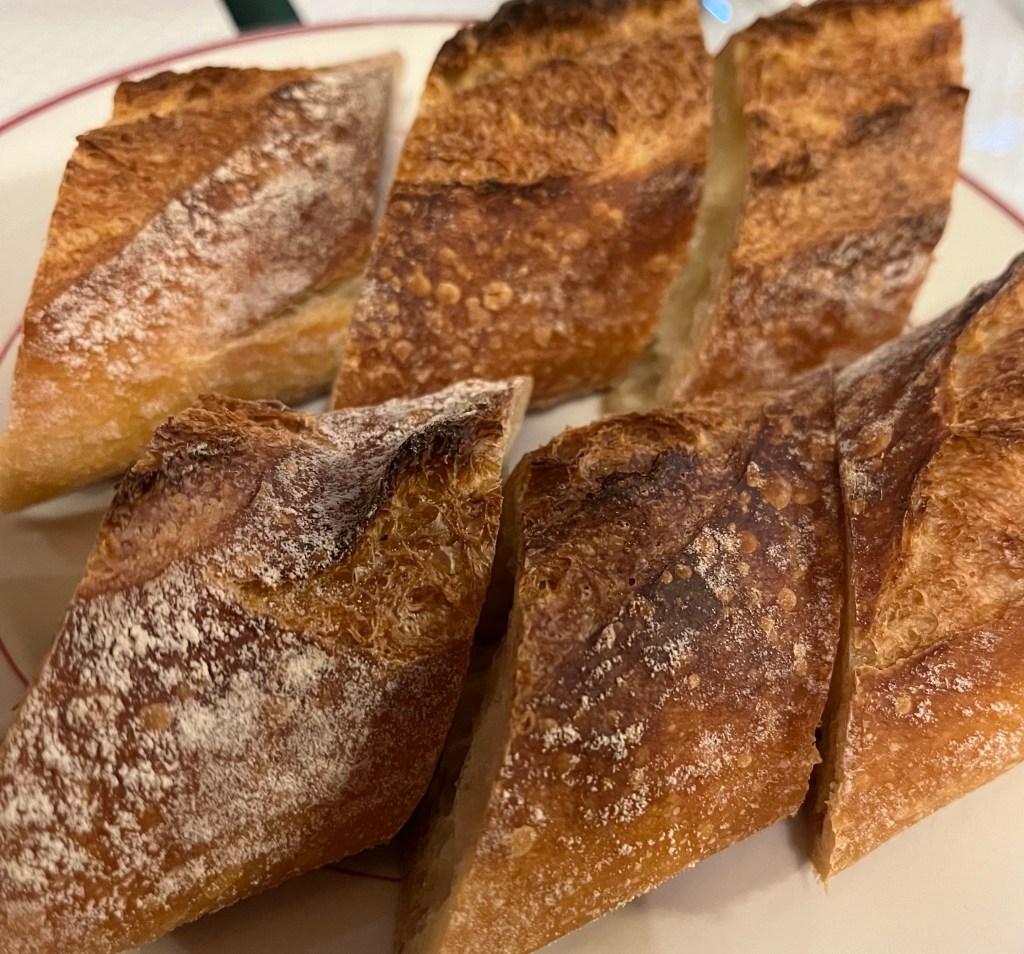
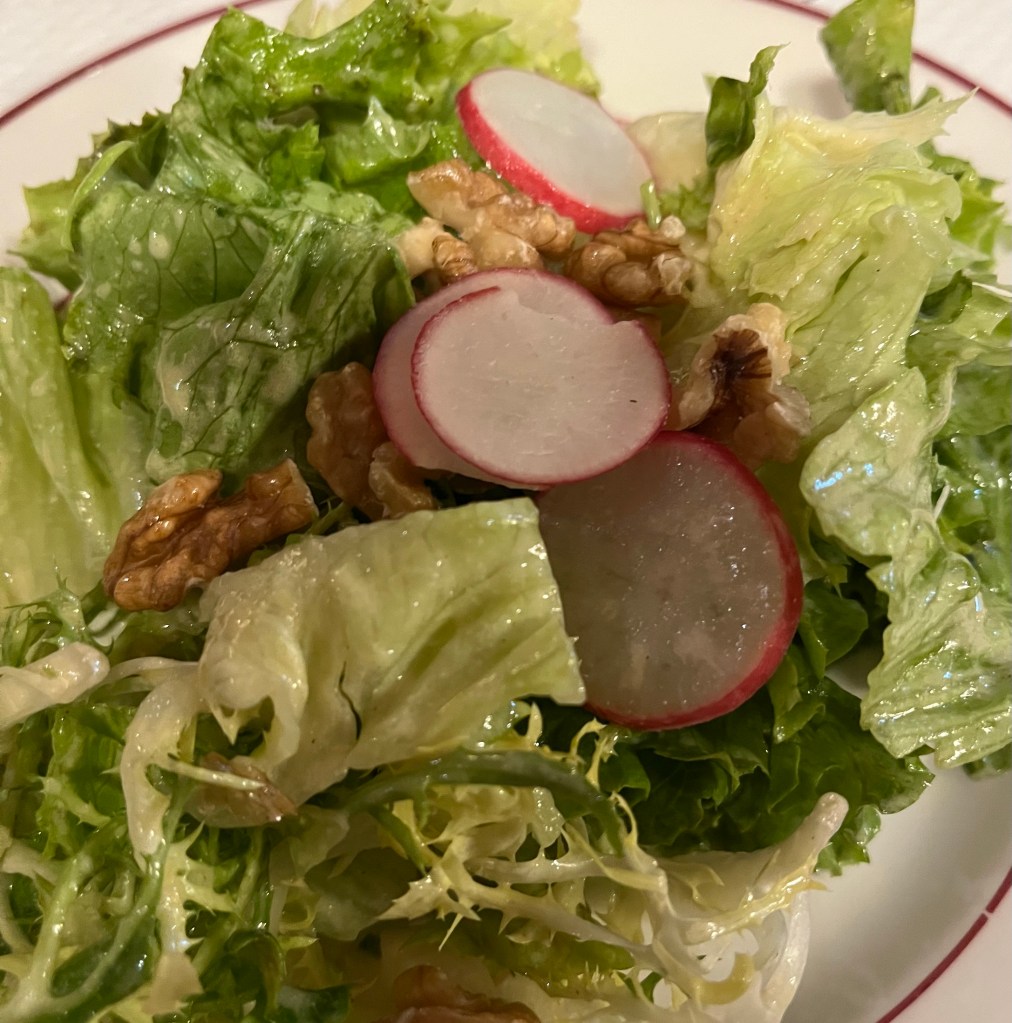
Bread and salad arrived promptly. Walnuts are part of their salad and add a nice crunch.

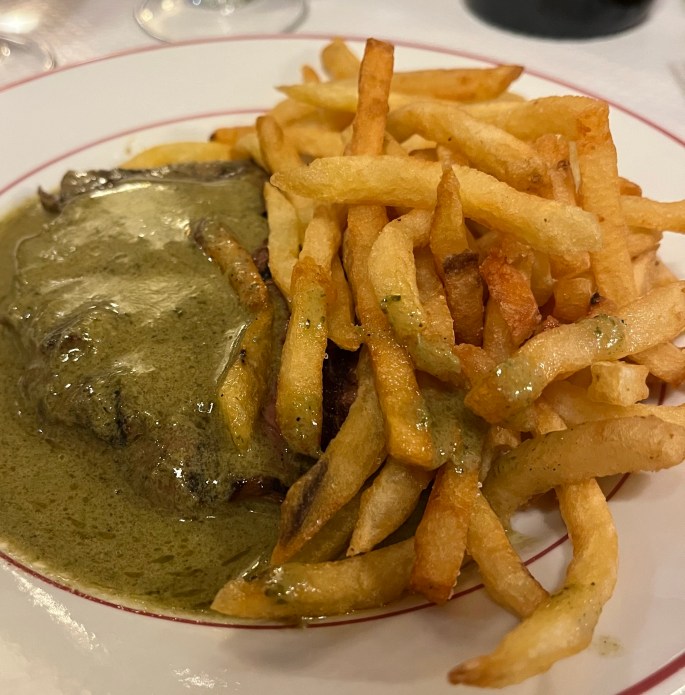
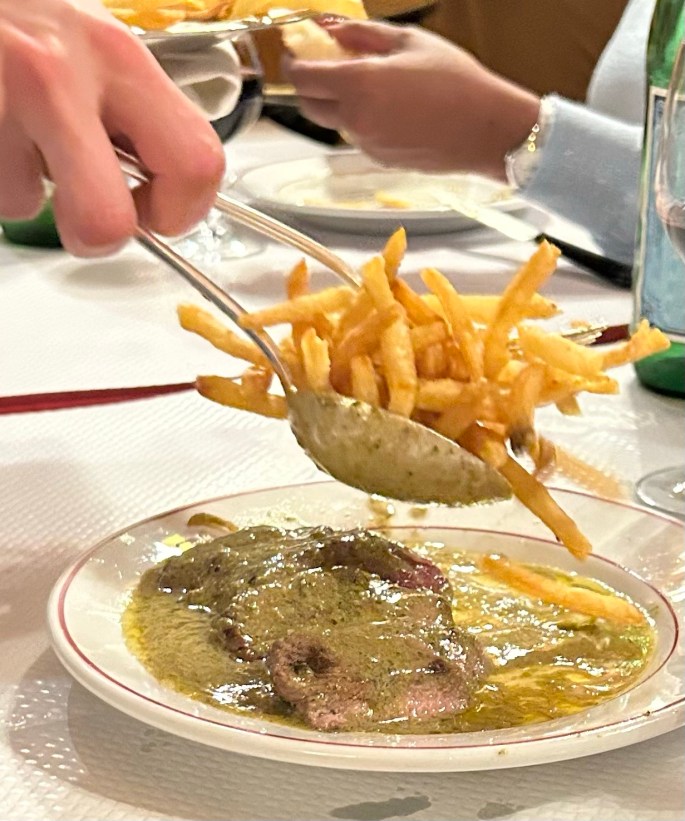
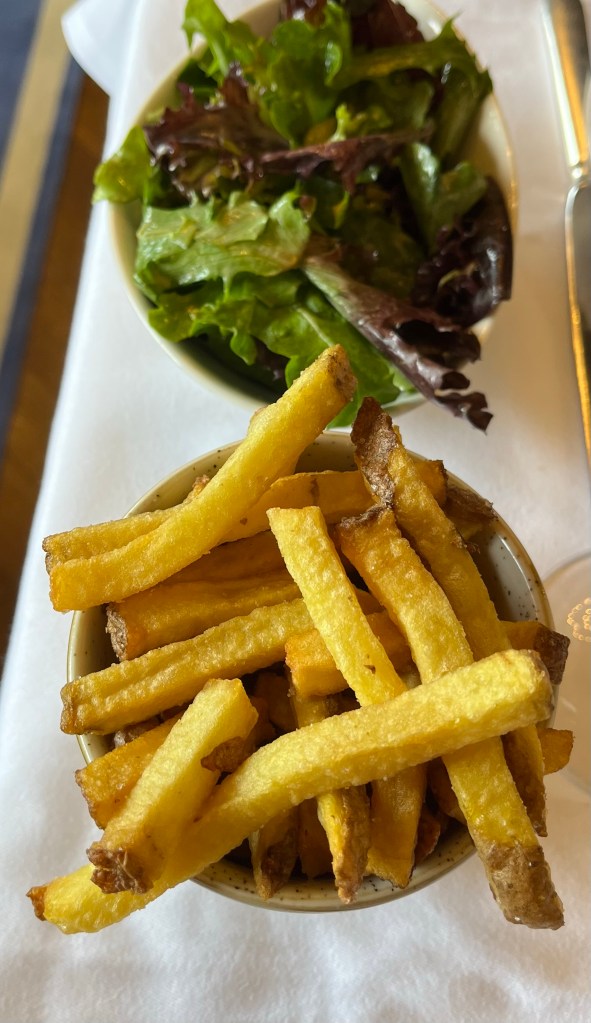
And then the main course arrives……………….tender sirloin steak with its ‘famous’ sauce and frites.

While theirs’s no recipe for their sauce, searching the internet, I came up with these ingredients: cream, tarragon, Dijon mustard and lots of butter. Yep, that nailed it.

What else is important? More is brought to the table when your plate is empty- without asking. The meat already arrived, and our waitress was dropping off more frites – delicious.

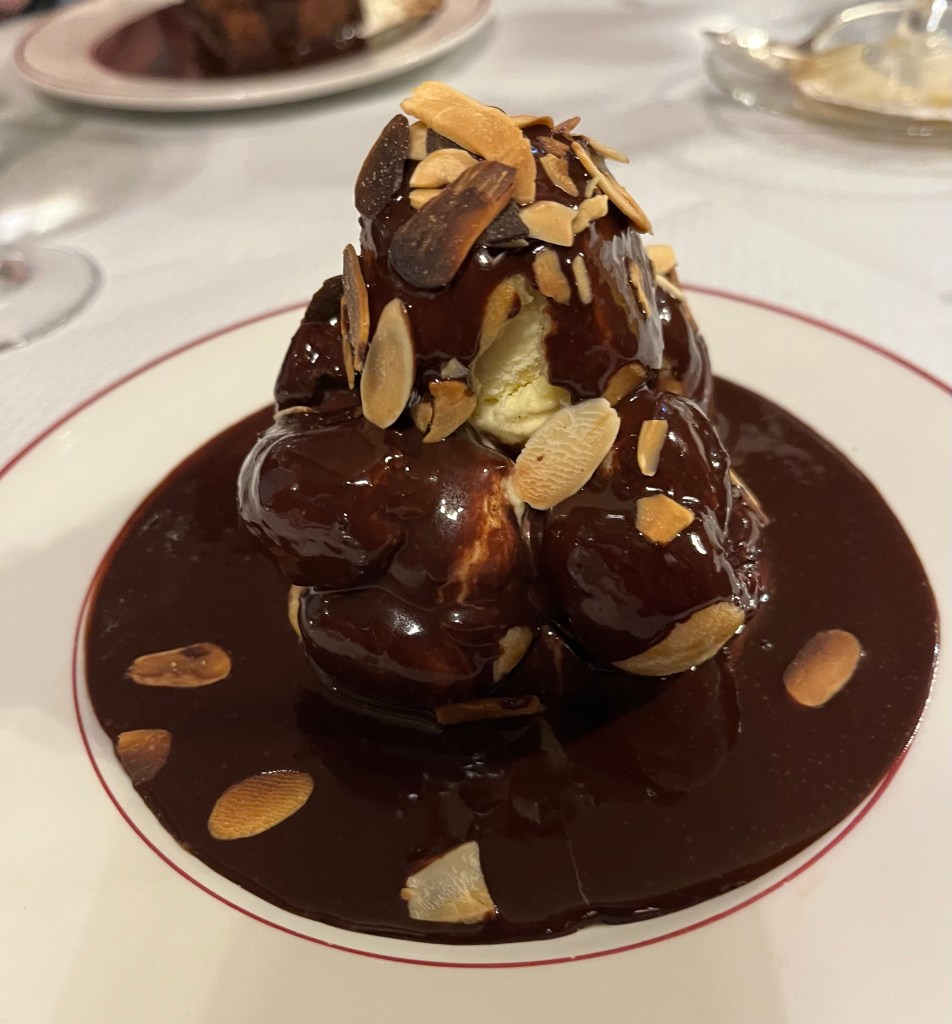
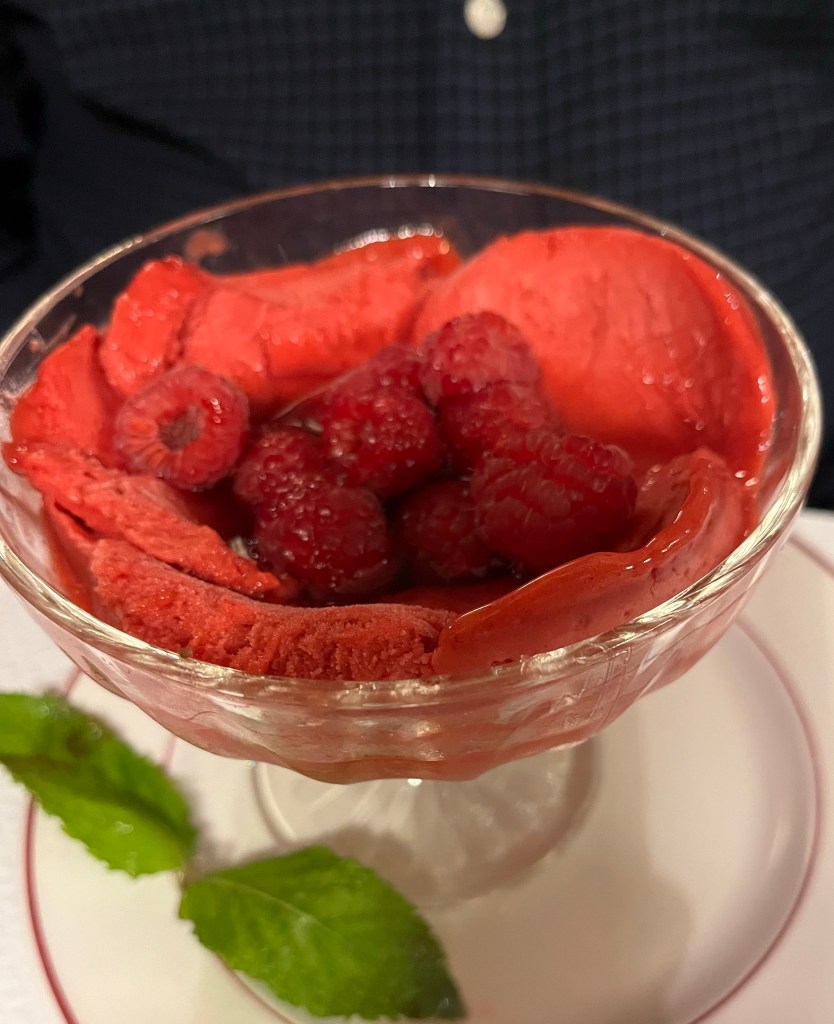
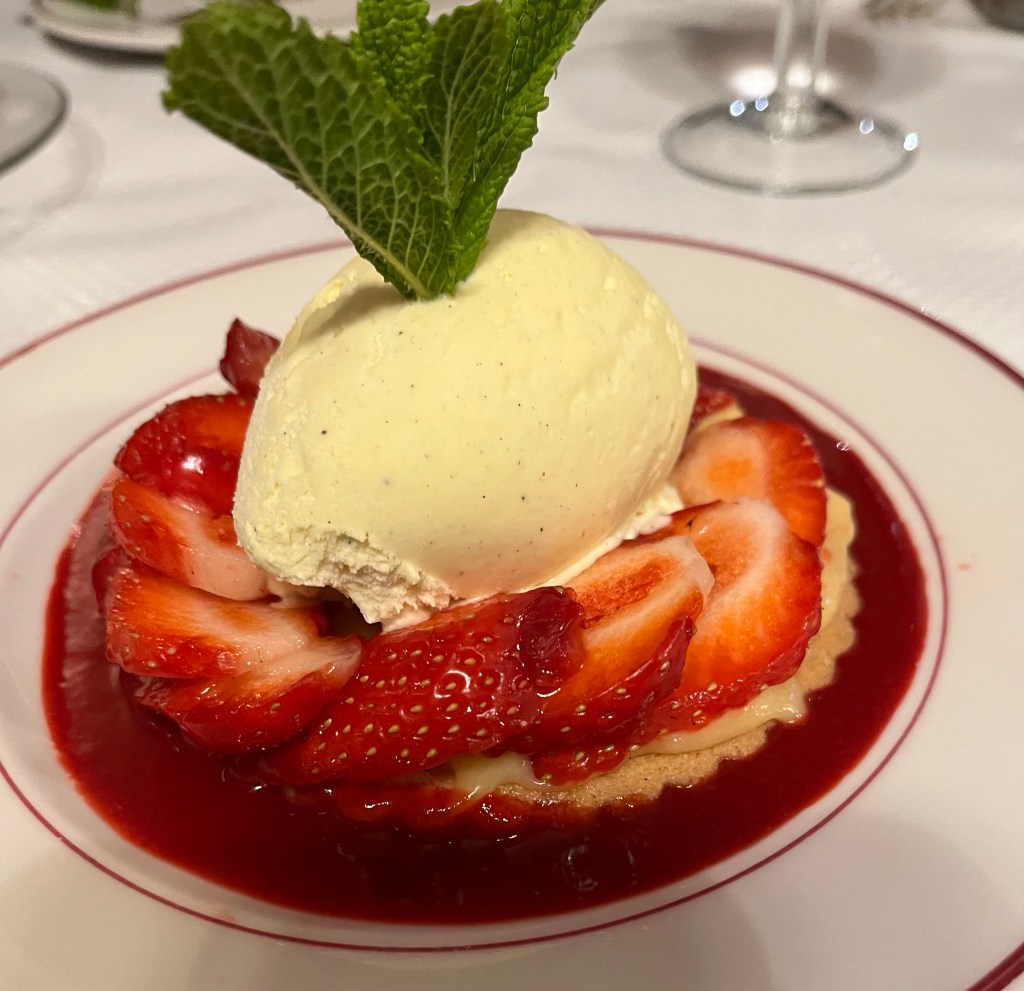
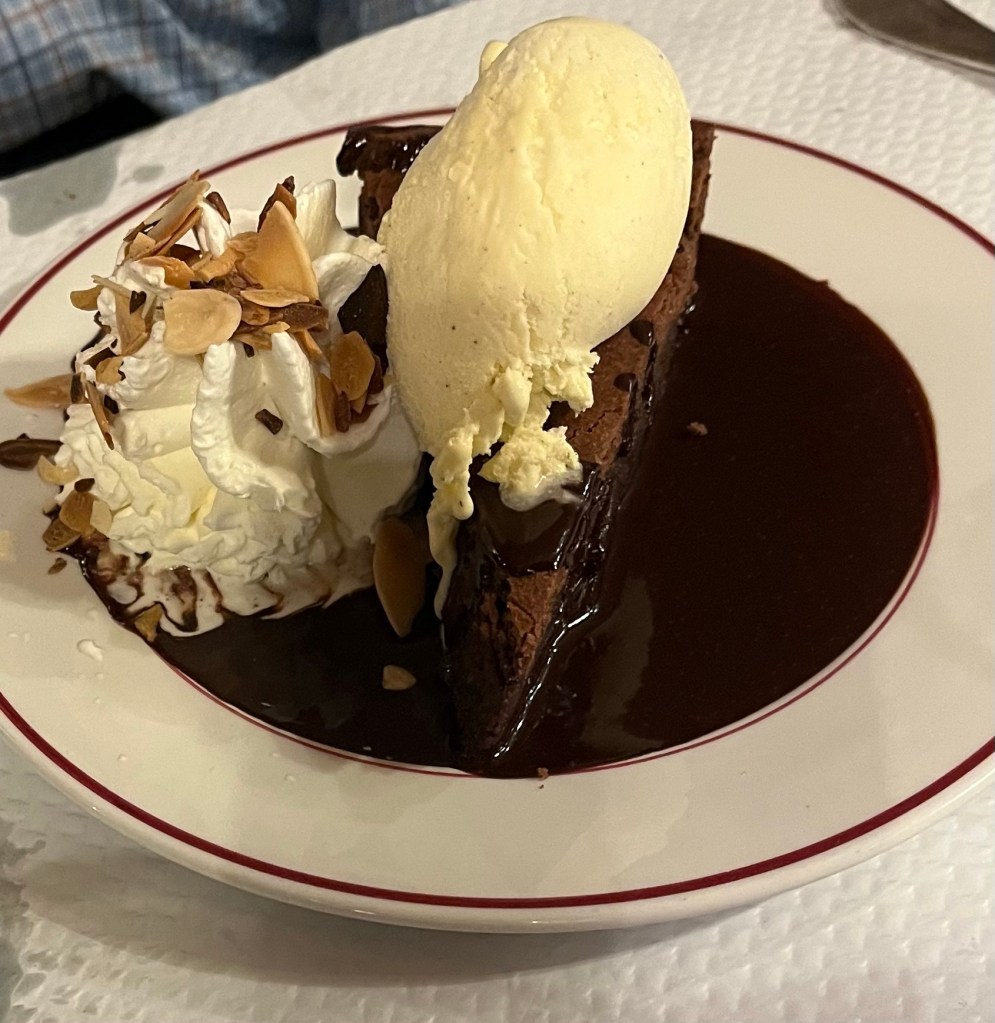
There was one major decision that evening – dessert! We each ordered something different and had the opportunity to try a variety of things – YUM.

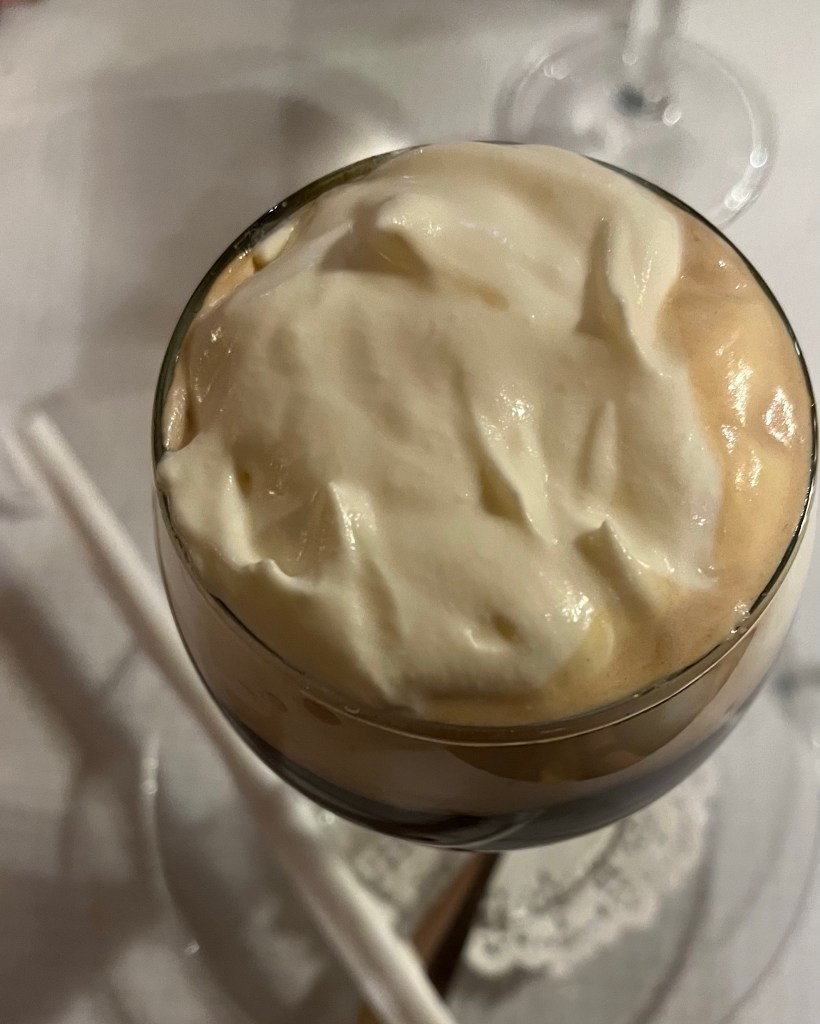
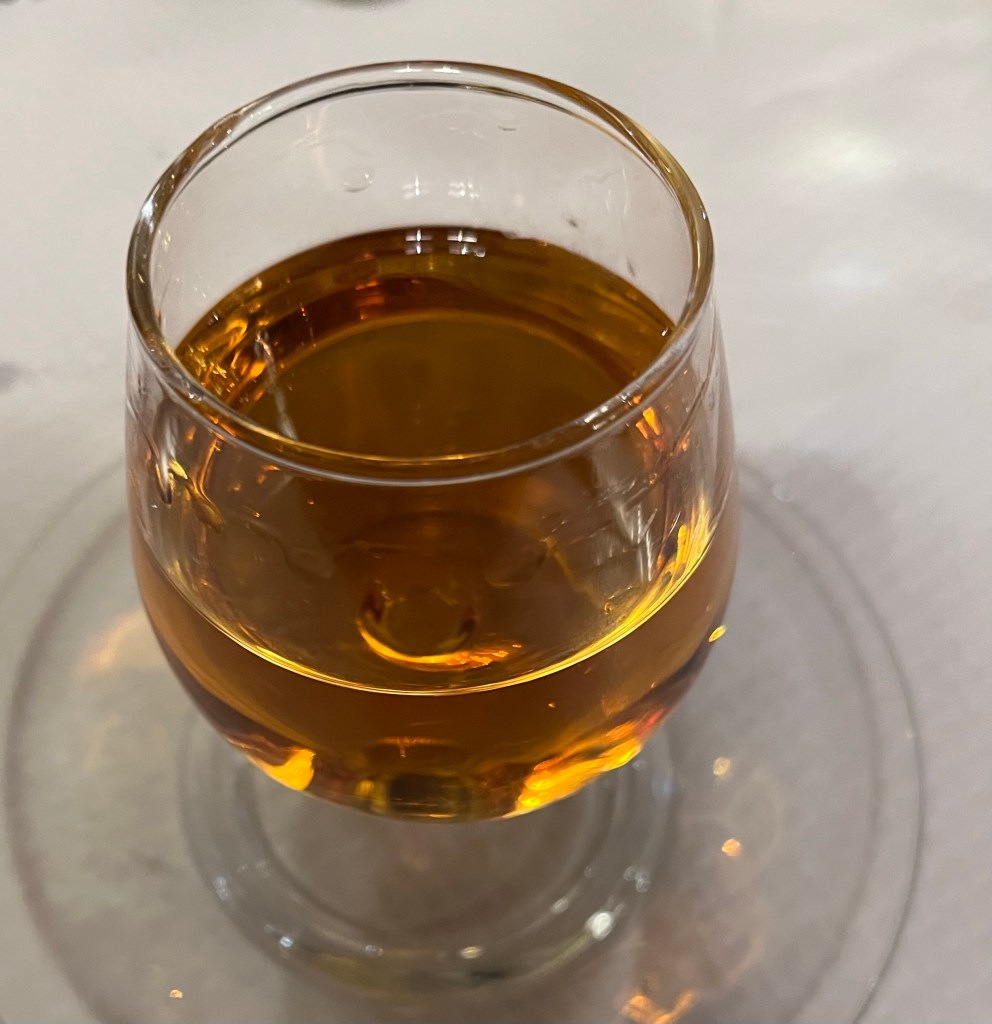
Add in an Irish coffee and cordial and dinner was complete.

This was definitely a nice way to start our time in Paris.

Our planned meal with reservations made before leaving the states was at……..

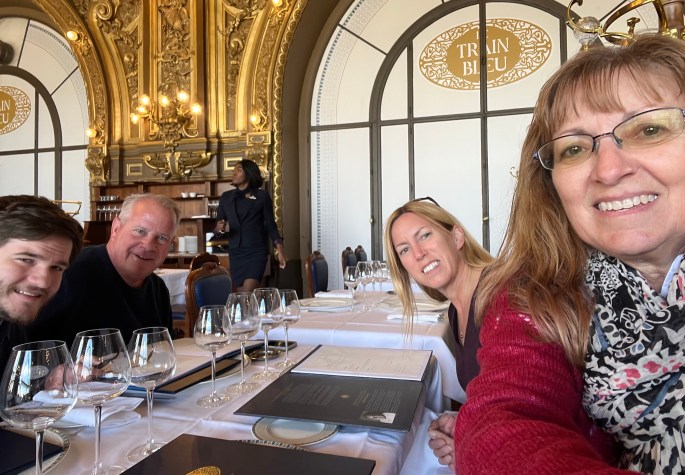
le Train Bleu

This was to be our anniversary (29 years!) meal since our date was during this trip, actually on May 14. We (Eric and I) had eaten here before and it’s not only about the food but the experience.

The location shouldn’t be a surprise. It’s in one of the train stations, steeped in history and has a distinctive and unique atmosphere. Gare = French for train and the blue line goes to Lyon. There you have it. 🙂

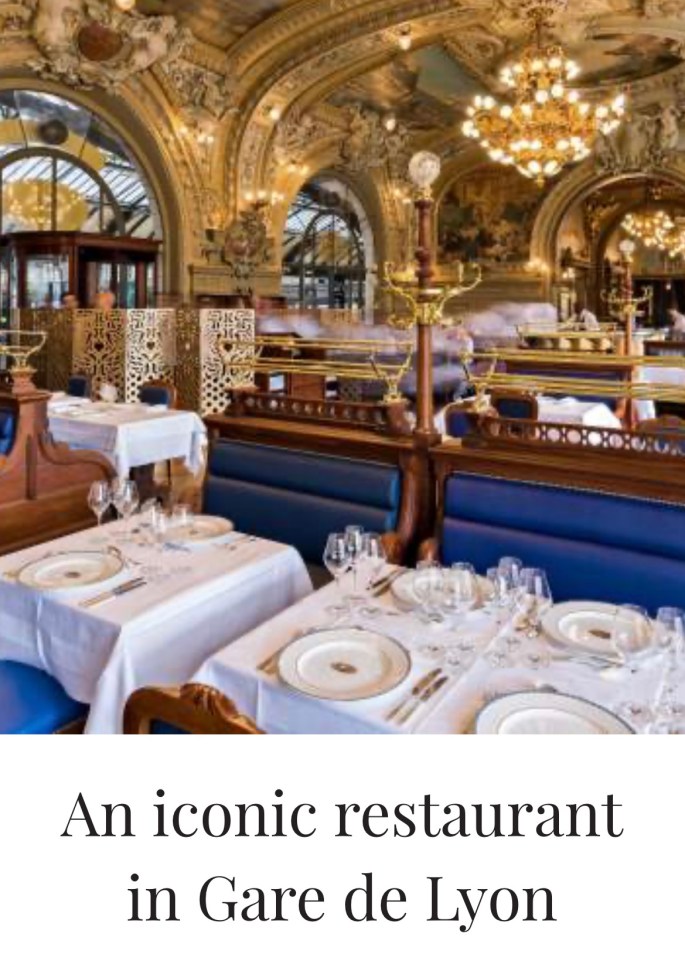
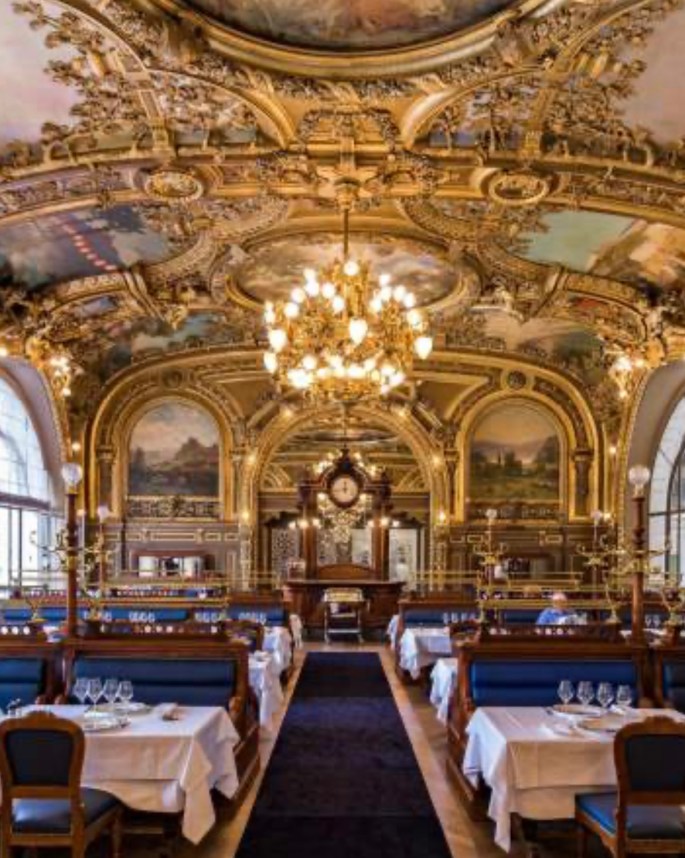
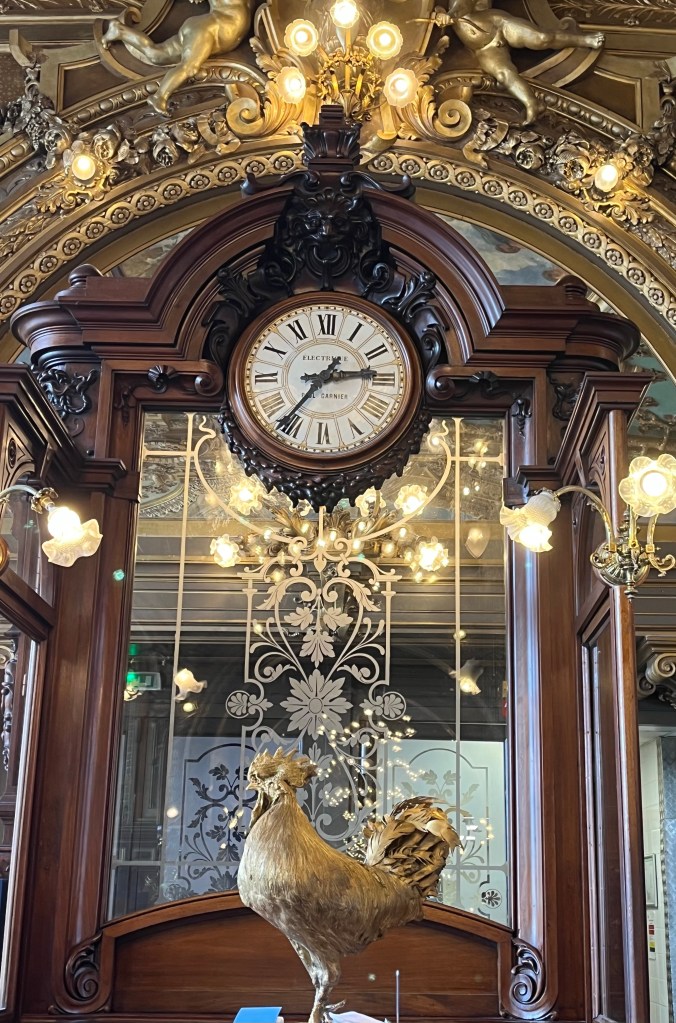
It has old world elegance. I found this photo on their website. Mine had a hundred people in it.

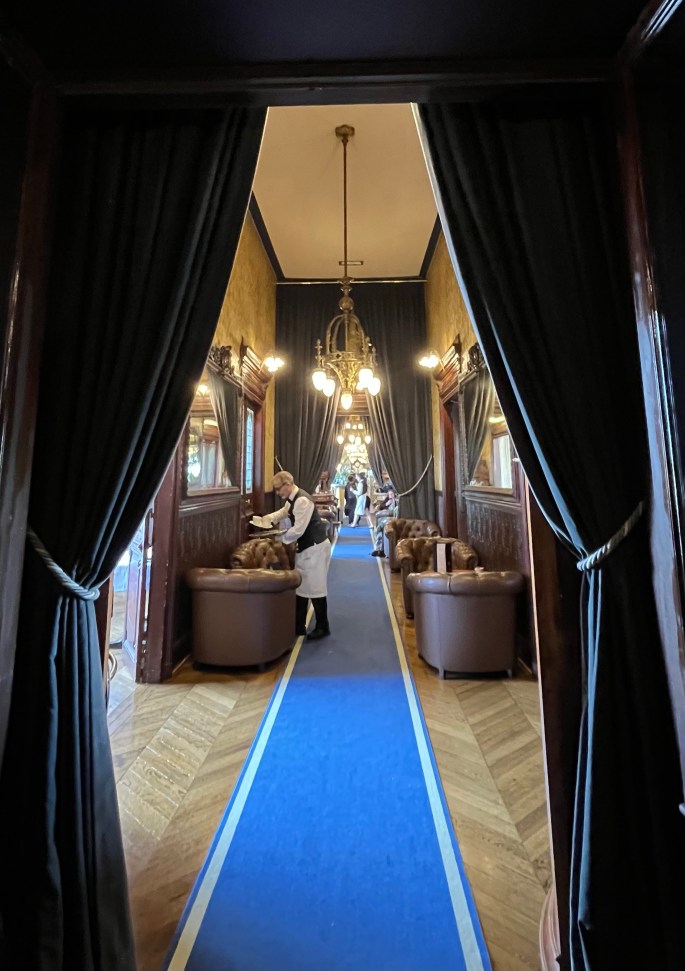
It offers travelers and Parisians a moment frozen in time, an experience that feels like the beginning of a fabulous journey of discovery. Each room is themed to represent cities and regions of France. At one end of the location is a bar for those needing a quicker meal.

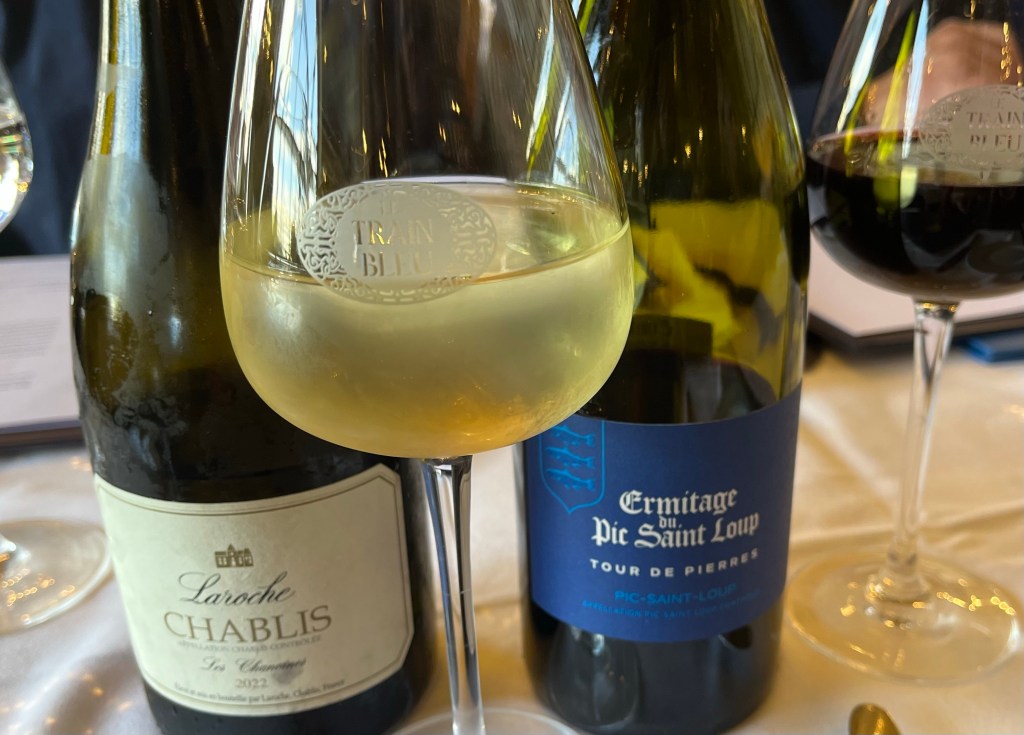
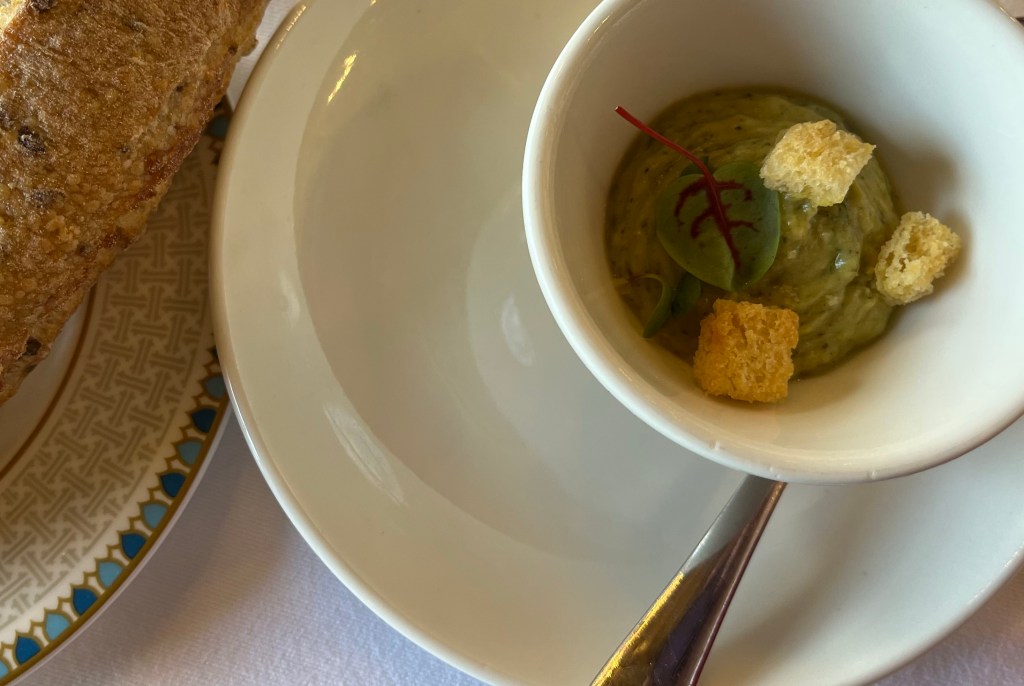
Enough about the restaurant, let’s talk about the food and wine. Before our selecitons arrived, an amuse bouche was set in front of us. Not exactly sure what it was, but it tasted ‘green’ – if green had a flavor.

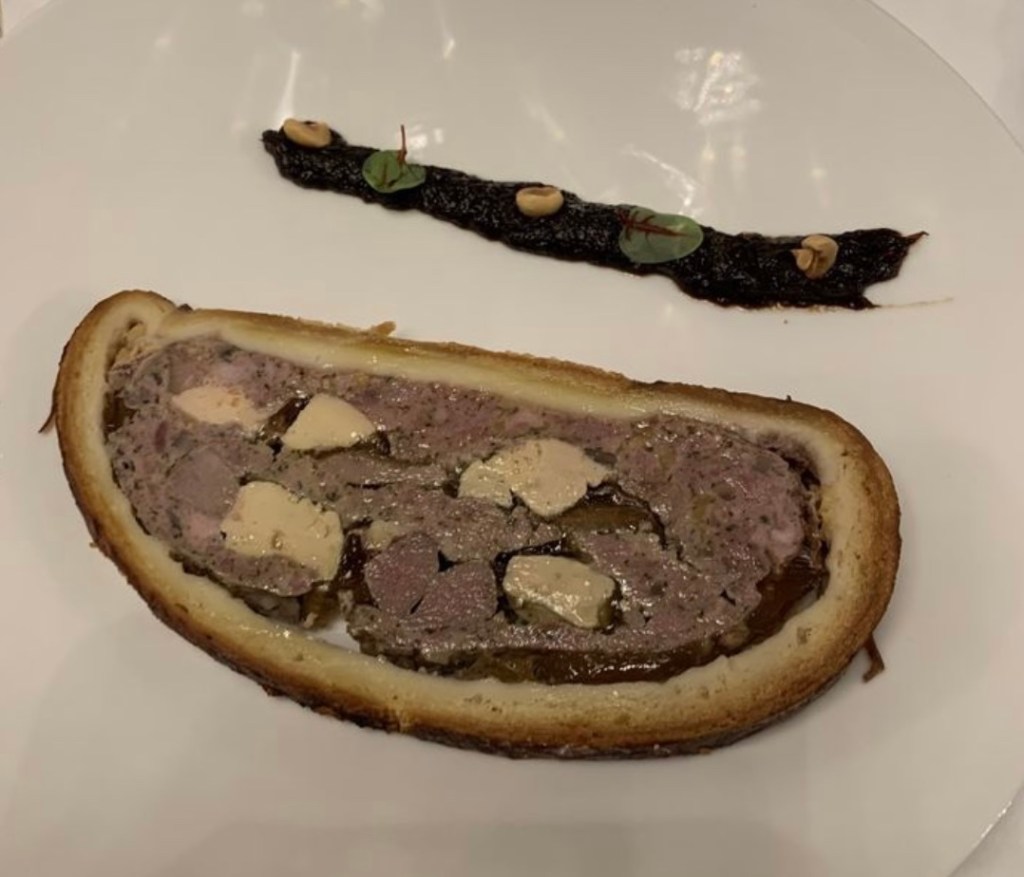
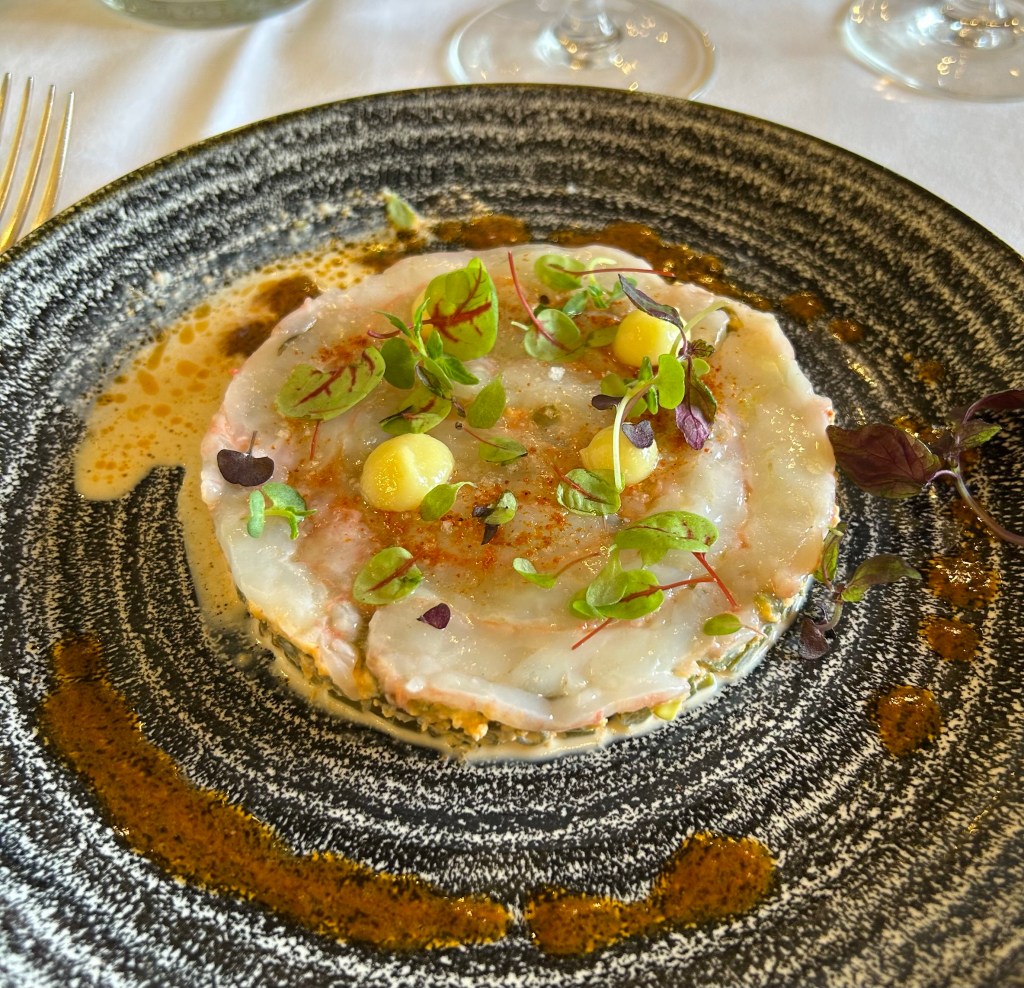
Appetizers were pate de campagna, foie gras and langoustine carpaccio.

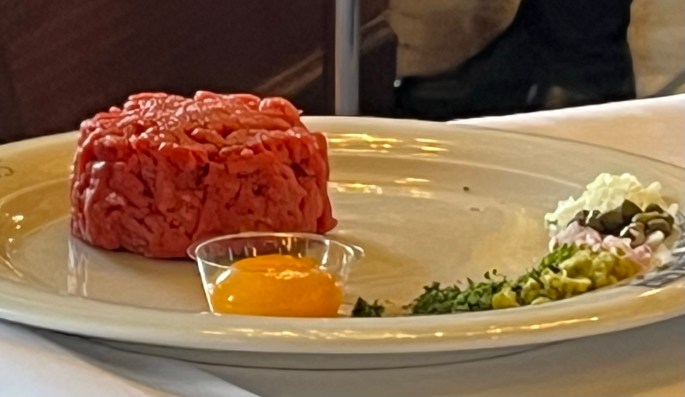
Connor ordered beef tartare.

It was one of two items ordered that was prepared table-side. I was able to get a video of most of the preparation.

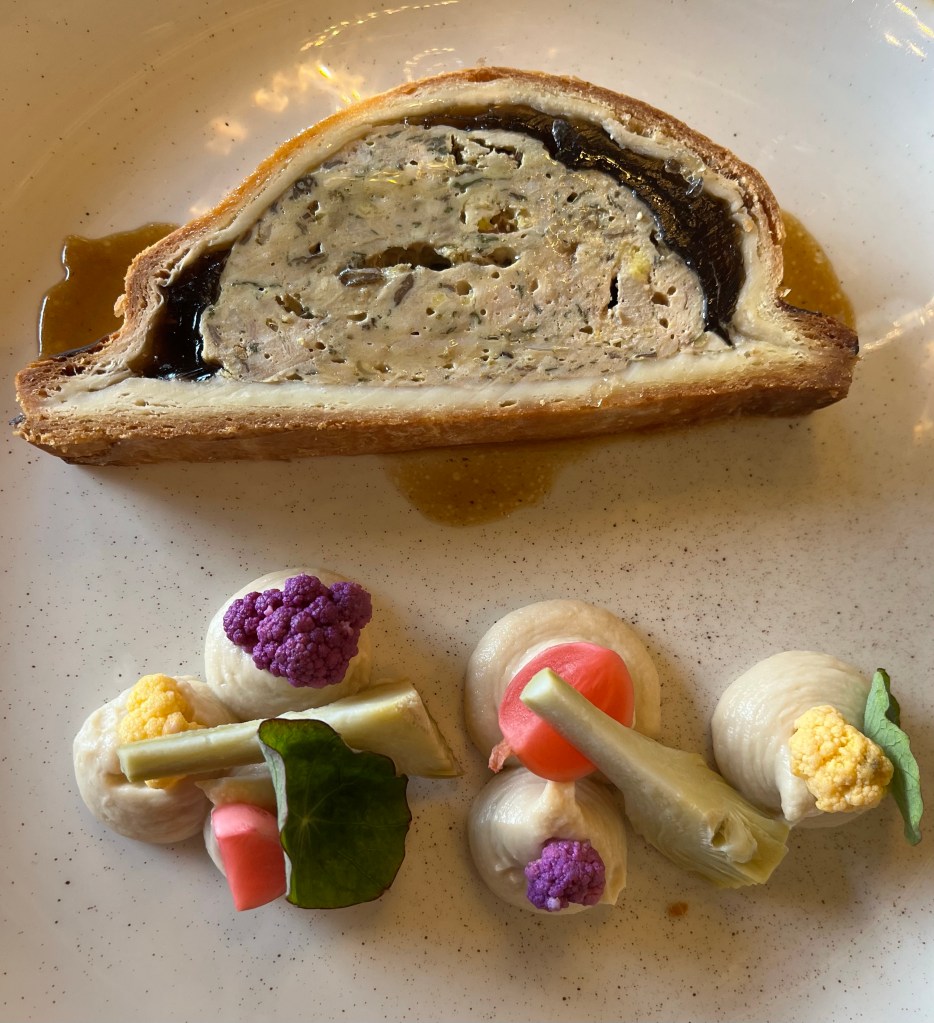
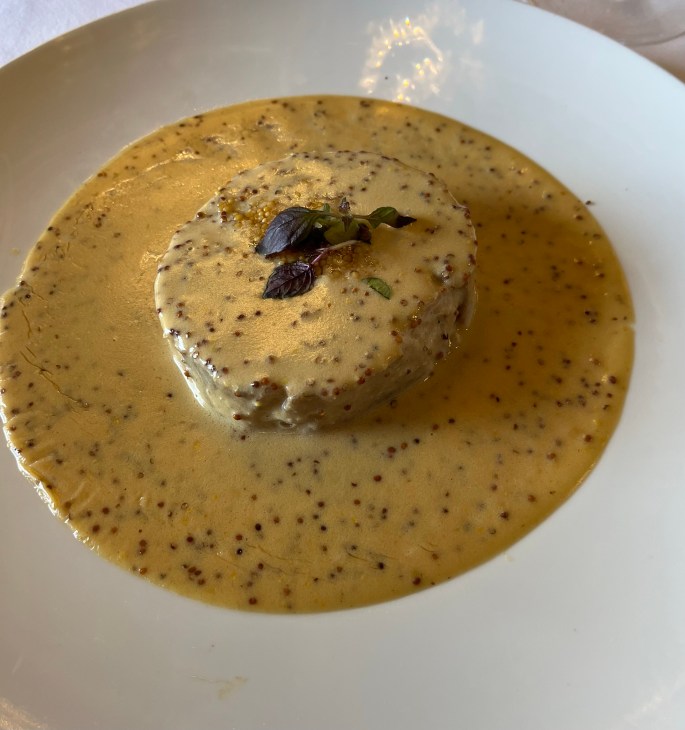
I had the a.b.s.o.l.u.t.e best rabbit ballentine with a mustard cream sauce:

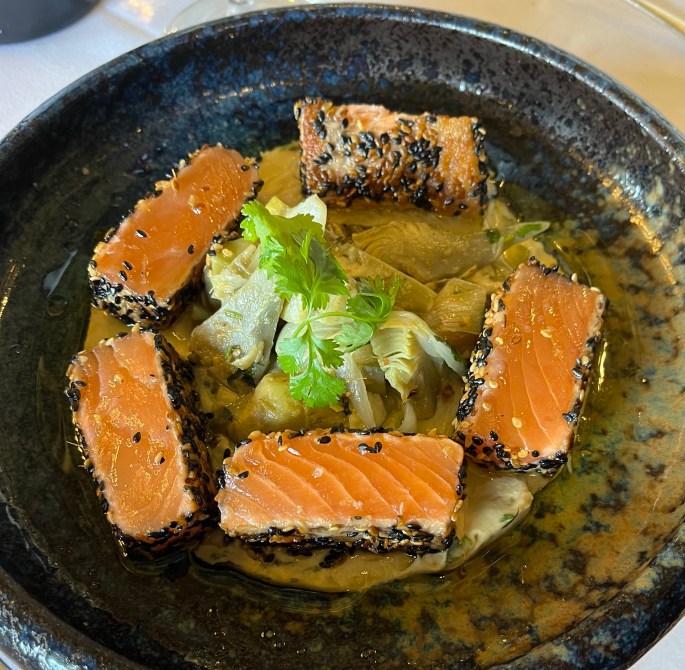
Adrienne totally enjoyed her sesame encrusted salmon sashimi:

Eric ordered roast leg of lamb, carved table-side.

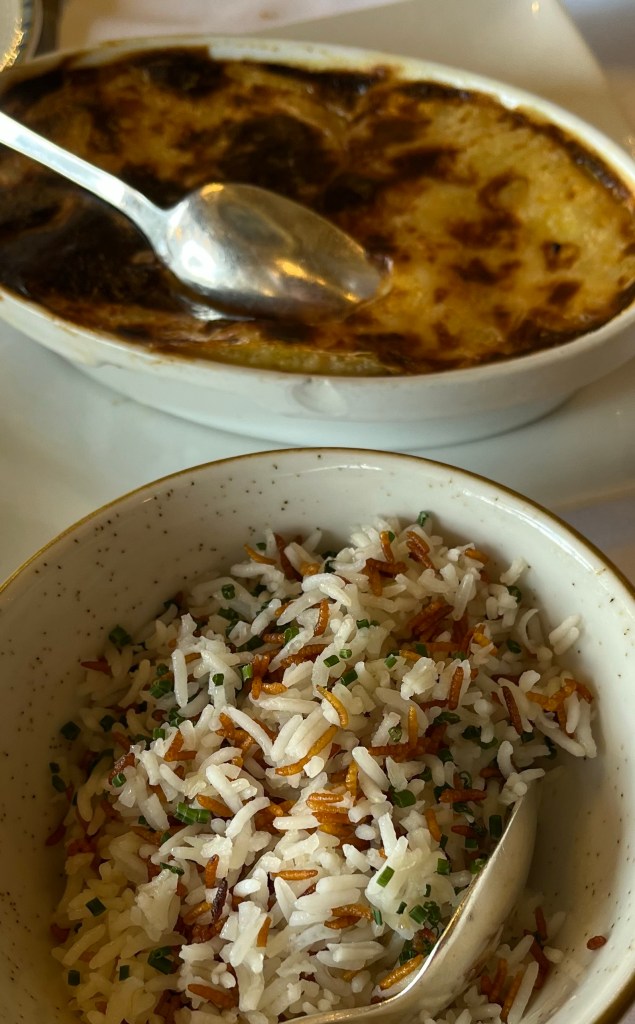
There were several accompaniments to our meals.

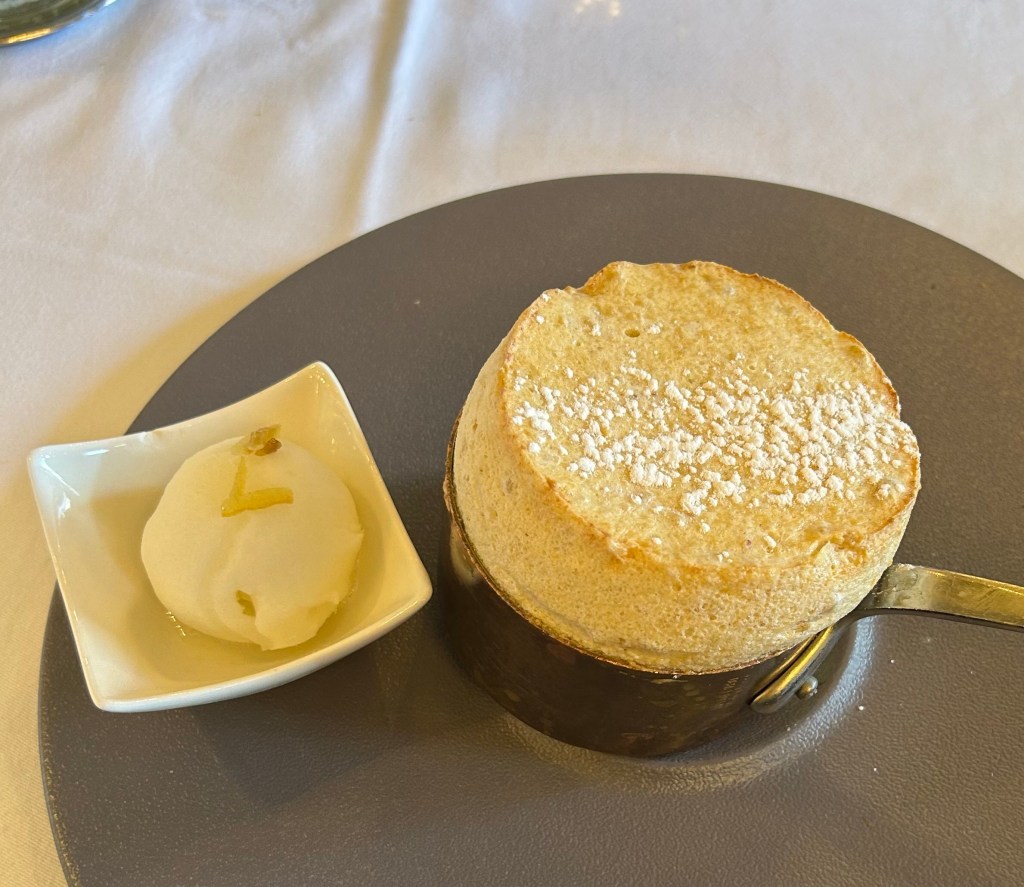
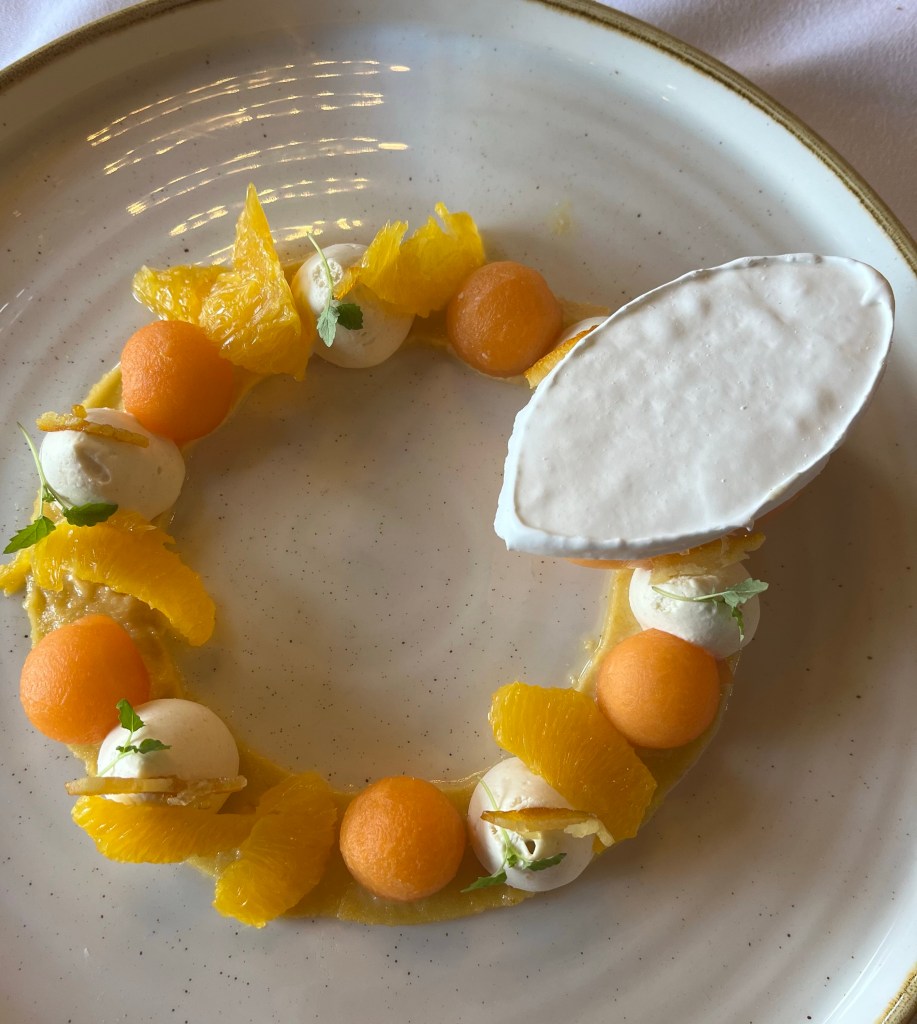
But then came desserts……………………Eric choose a hazelnut souffle with lemon ice cream and I had a citrus & melon delight.

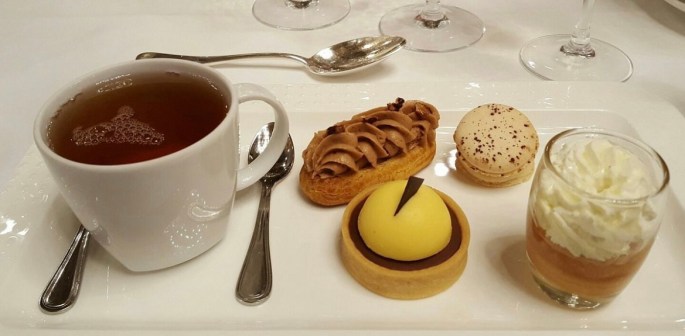
Connor had been enjoying coffee gourmand which had a number of mini-desserts accompanying a cup of coffee.

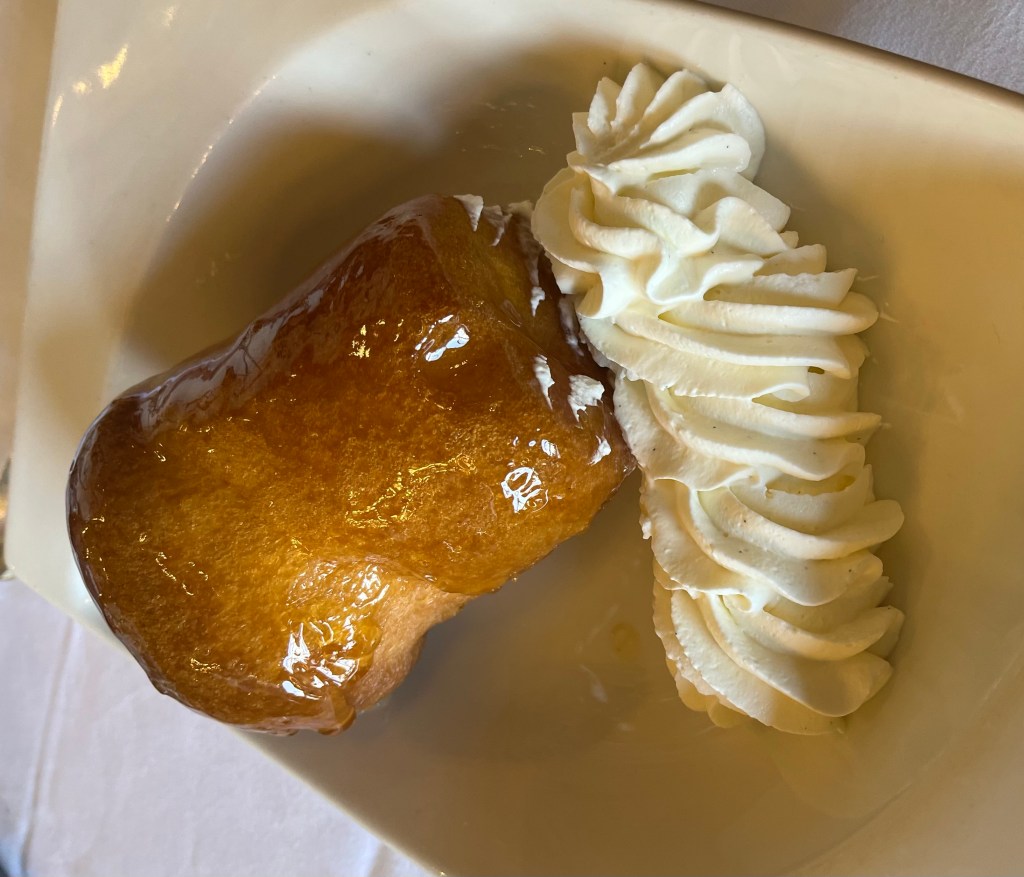
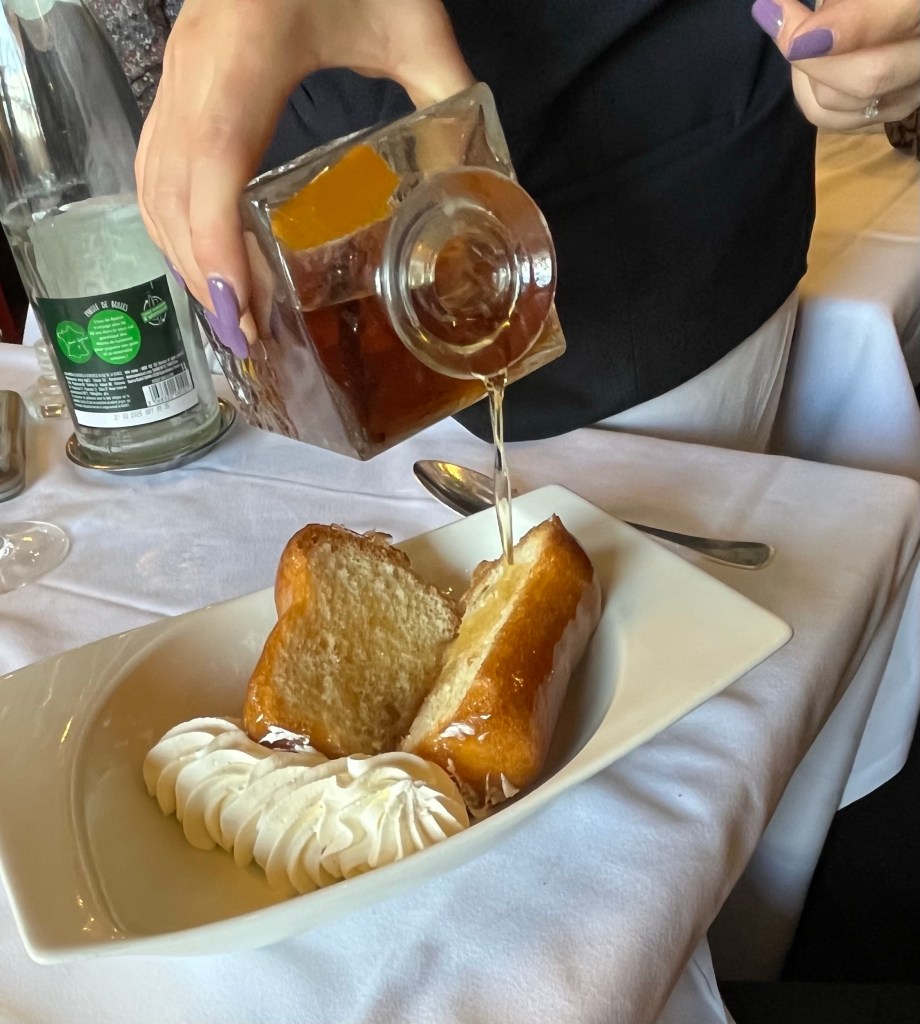
Adrienne ordered the rhum baba. It looks innocent enough until the rhum is poured and poured.

We all enjoyed our selections, the meal, the ambience and the company.

While this may not be a stop for every trip, it is definitely a special place for a special French meal.

Ginny

Sainte-Chapelle, Paris

The Sainte Chapelle is a royal chapel in the Gothic style within the medieval Palace de le Cite, the residence of the Kings until the 14th century, on the River Seine. It is one of the very visible remains of the oldest palace of the Kings of France. No, that is not my photo above. I took a shot of an informational sign, describing ongoing refurbishment. The remaining shots are my photos.

The chapel was built between 1242 – 1248 to house the relics of the Passion of Christ purchased by Louis IX. The most notable being Christ’s Crown Of Thorns – one of the most important relics in medieval Christendom. It was later moved to Notre Dame until the 2019 fire, which it survived.

The 30 odd relics purchased by Louis IX increased the prestige of France and Paris in the eyes of medieval Europe. It also has one of the most extensive 13th century-stained glass collections than anywhere in the world. More on that later.

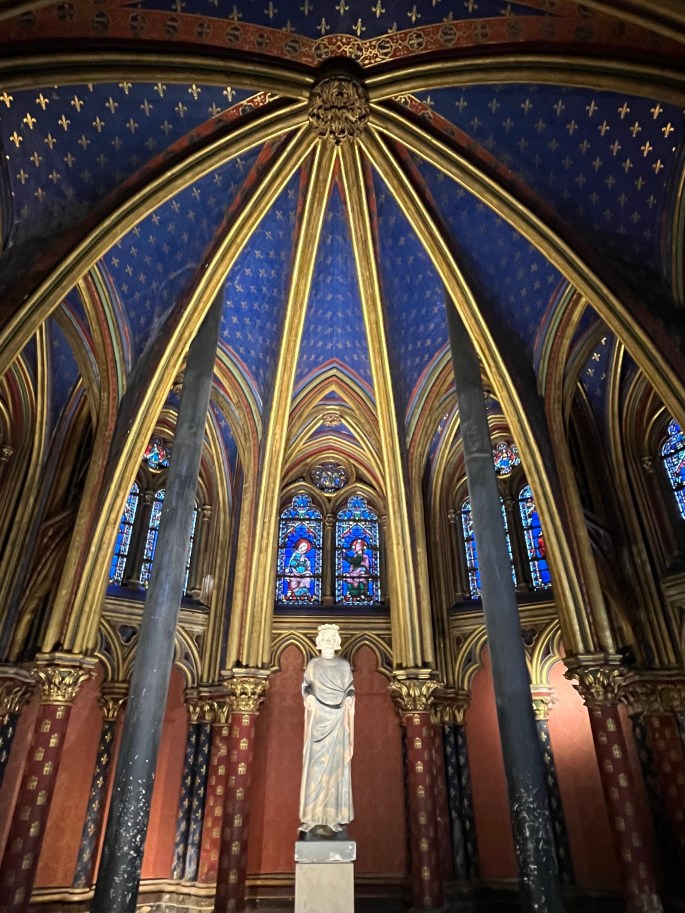
There are two sanctuaries, one on top of another. The upper level, where the relics were kept, was reserved exclusively for the royal family and their guests. The lower level was for courtiers, servants and soldiers of the palace. The lower chapel was dedicated to the Virgin Mary and her sculpture is at the portal.

The original stained glass in the lower chapel was destroyed by a flood in 1690 and replaced by colorless glass. The present glass was part of the 19th century restoration and has scenes from the life of the Virgin Mary. The statue in the lower chapel…..Louie IX.

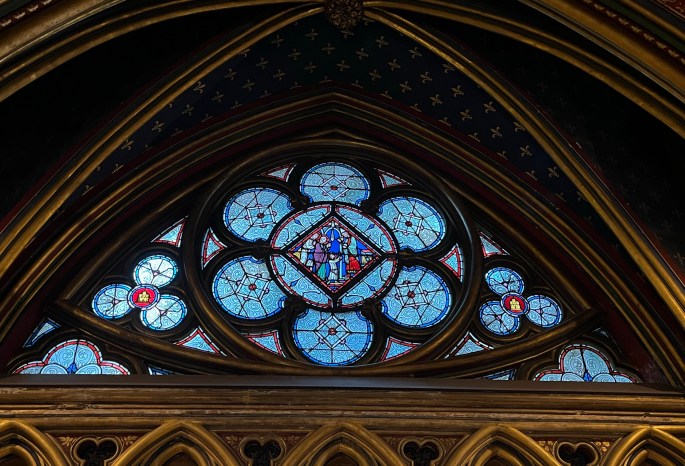
There was a small rosette in the back of the lower chapel.

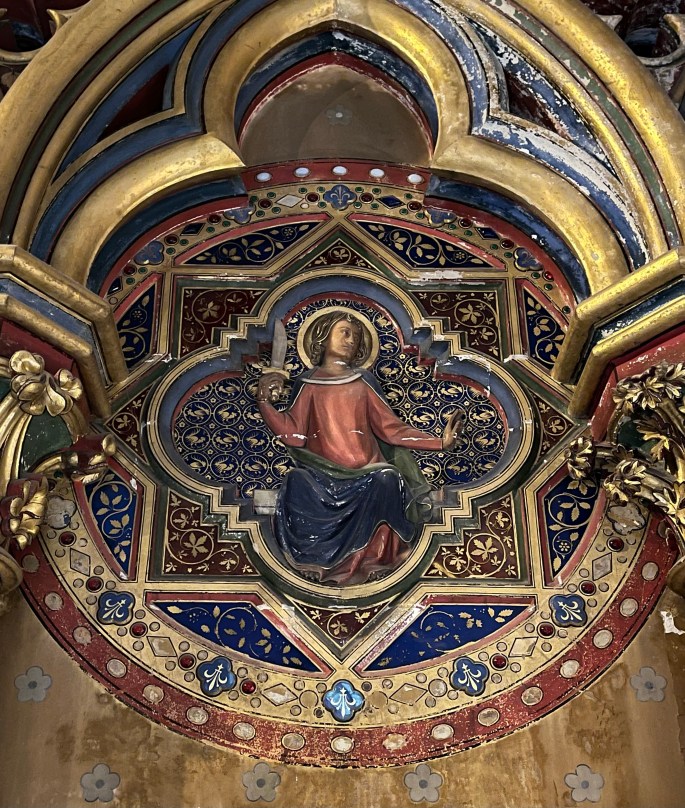
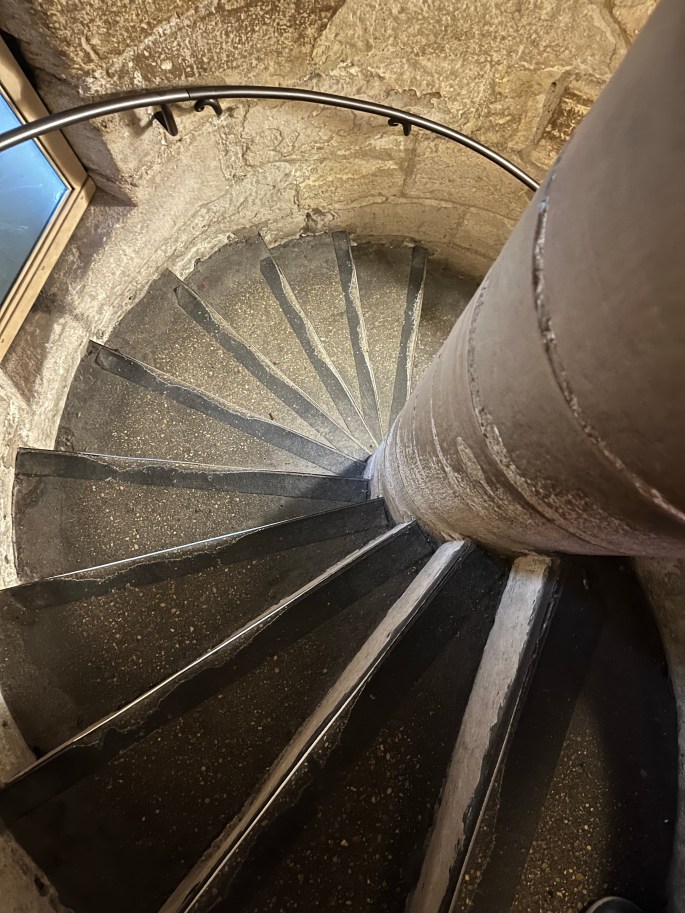
The upper chapel is reached by narrow stairwells in the corner towers. Below gives you an example of the details along the walls – still in the lower chapel – as you go up the staircase.

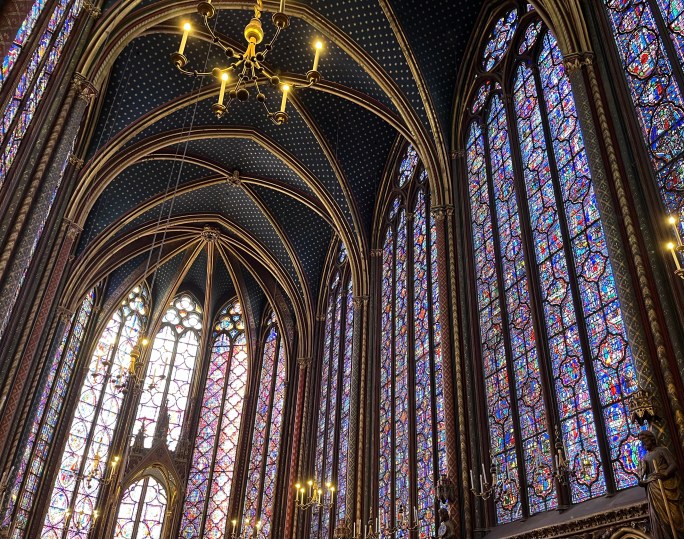
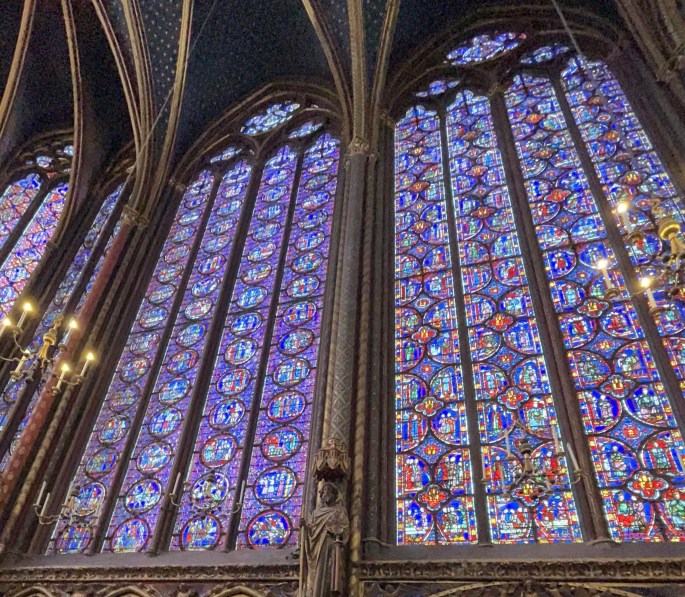
There is no other word but W.O.W. This was literally my first step inside the upper chapel from the stairwell. It takes your breath away.

1113 scenes are depicted in 15 stained glass windows, telling the story of mankind, Genesis through Christ’s resurrection.

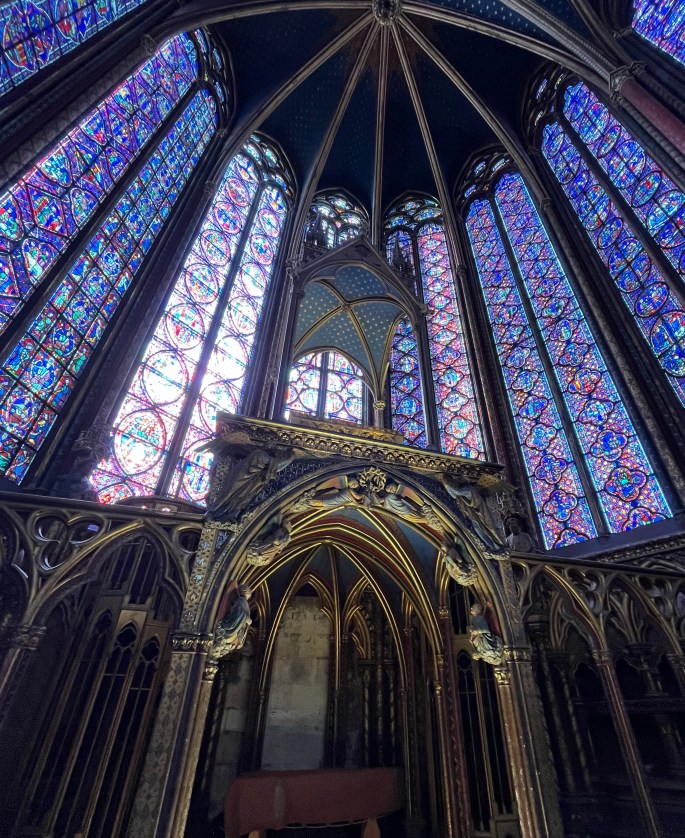
The alcove below would have housed the reliquary. Sainte-Chapelle, both as a symbol of religion and royalty was a prime target for vandalism during the French Revolution. The vessels holding the relics were taken apart and melted down for their jewels and precious metals. Sculptures and royal emblems on the outside were smashed. The spire was pulled down. Some of the stained-glass windows were broken or dispersed, but nearly 2/3 of the glass today is original.

There are 16 statues of the apostles which date about to 1240.

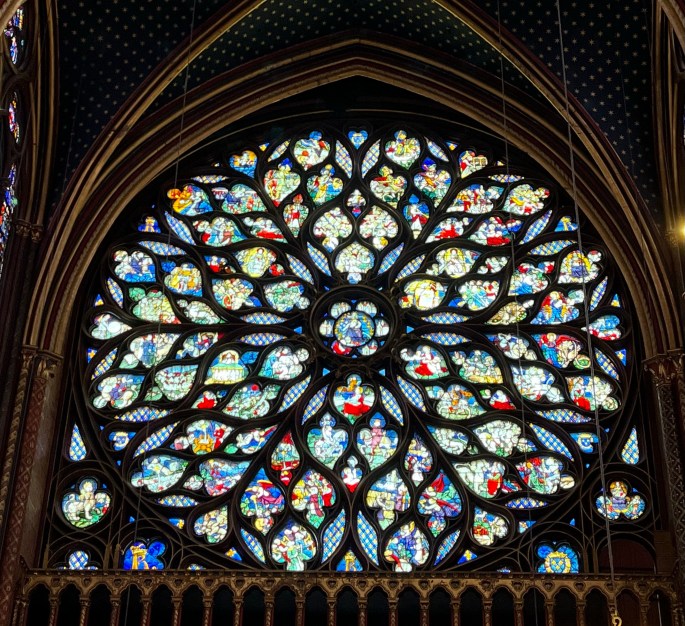
The rose window at the back of the chapel was made in the late 15th century in the ‘flamboyant’ gothic style. It is composed of 89 separate panels representing the scenes of the Apocalypse.

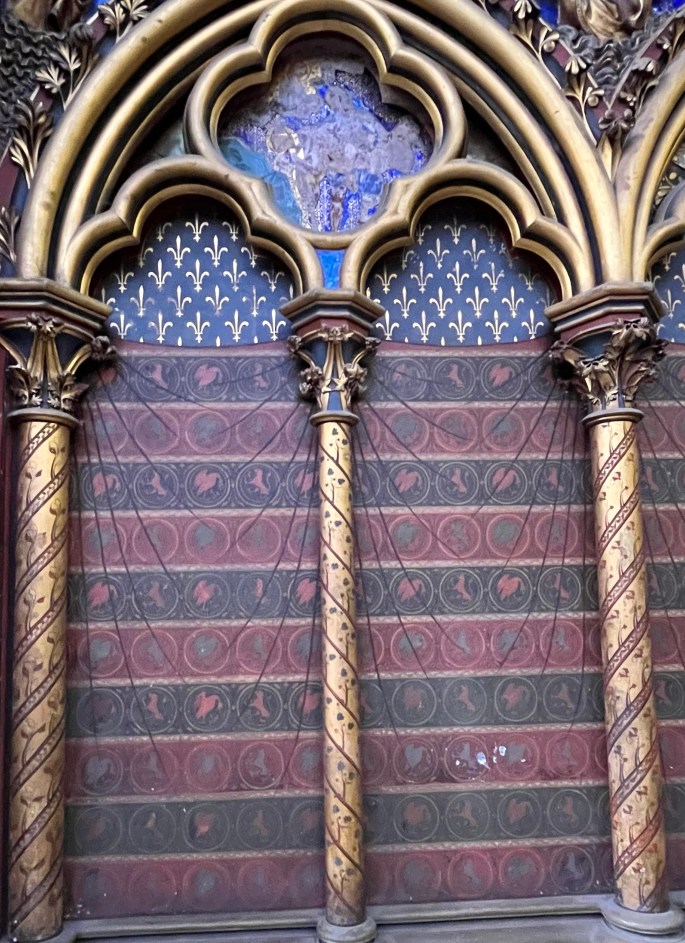
Even the paintings along the wall had been restored for the most part, going back to royal books in the library to check for style, remaining faithful to the colors and techniques of the 13th century.

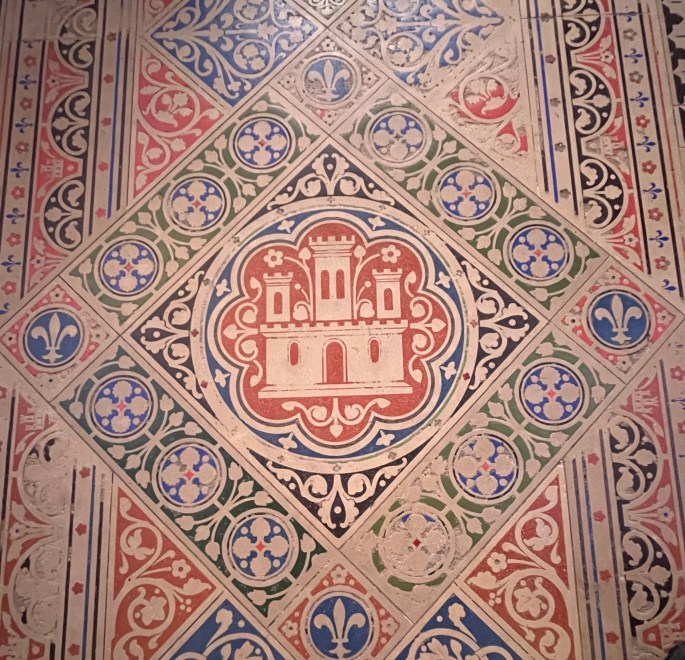
So many people are looking up, most don’t even notice the stone floor and its design.

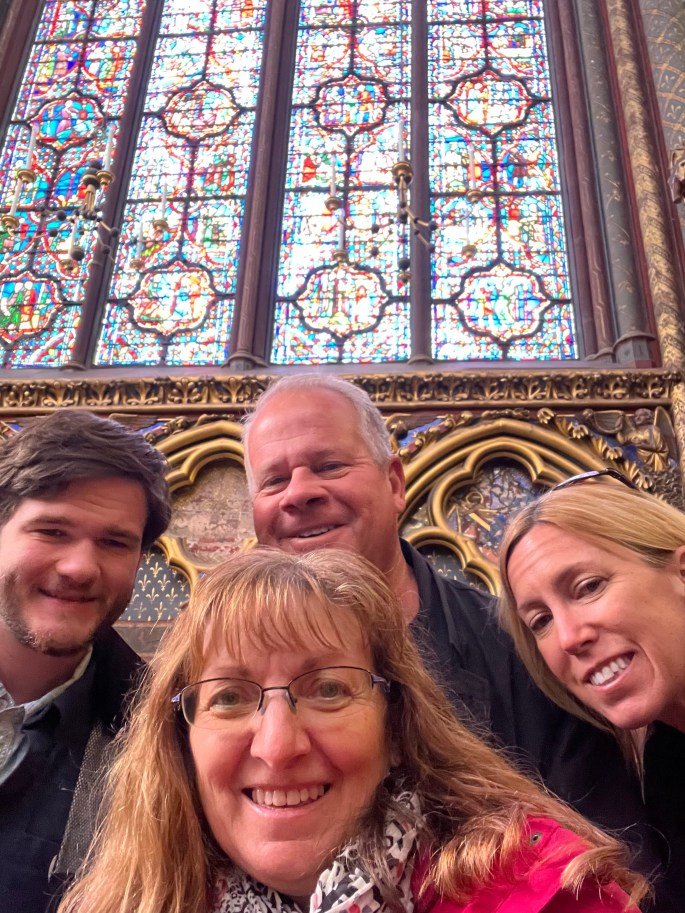
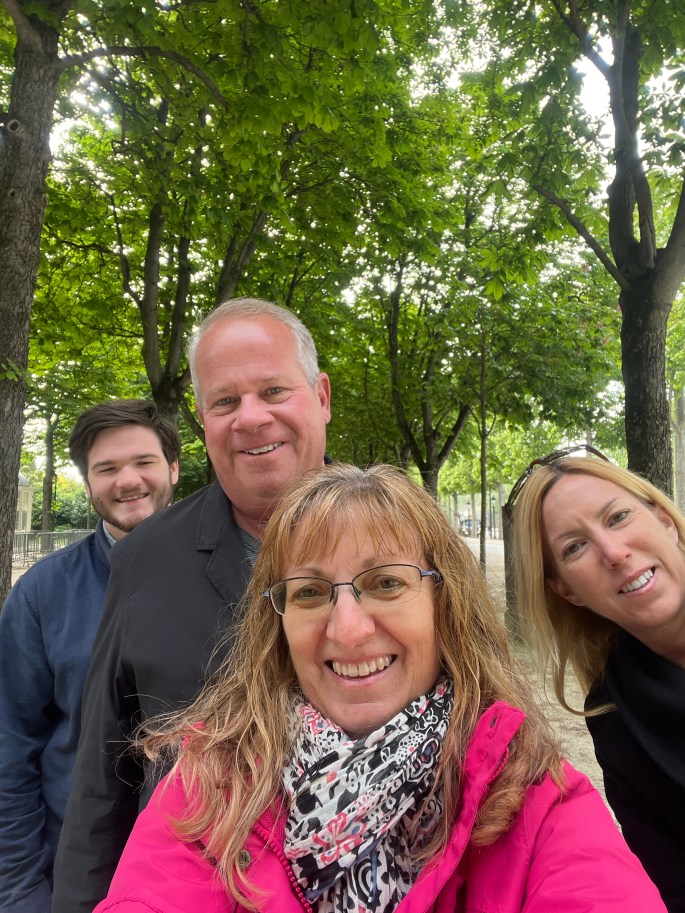
Before leaving, was able to catch a shot of the four of us in the upper chapel – without all the others in the room, not an easy feat. 🙂

Now, I’ve got to be honest……………we headed down these stairs and I was expecting to see more.

What? Yep, I was expecting more and for a while was disappointed in our visit. We had been to soooooooo many French cathedrals (Reims, Amiens, Bayeux and Notre Dame to name a few) that after going down, I thought we would be seeing the ‘rest’ of the cathedral. Obviously, I had not done my homework prior to our visit, it was after all a ‘chapel’.

Searching the internet before writing this post definitely gave me a different perspective. Next time…….note to self…….need to do my research beforehand.

This was a most amazing spot to visit within the city of Paris.

Ginny

Had to throw in at least one gargoyle.

Lafayette’s Grave

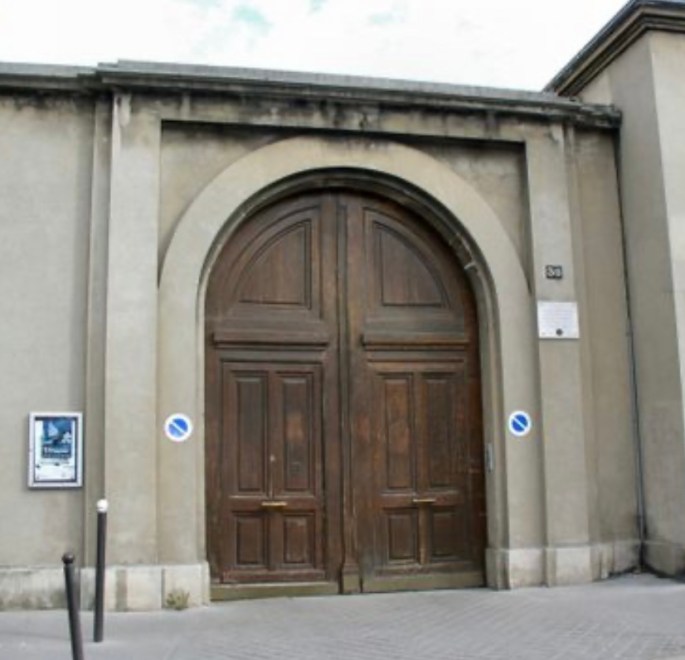
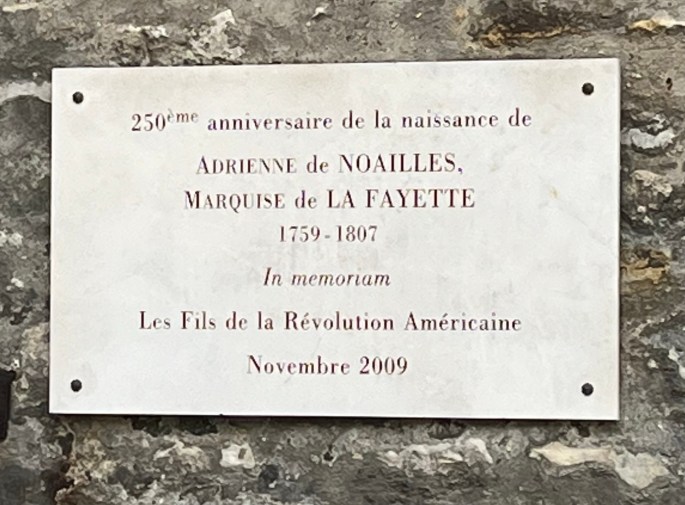
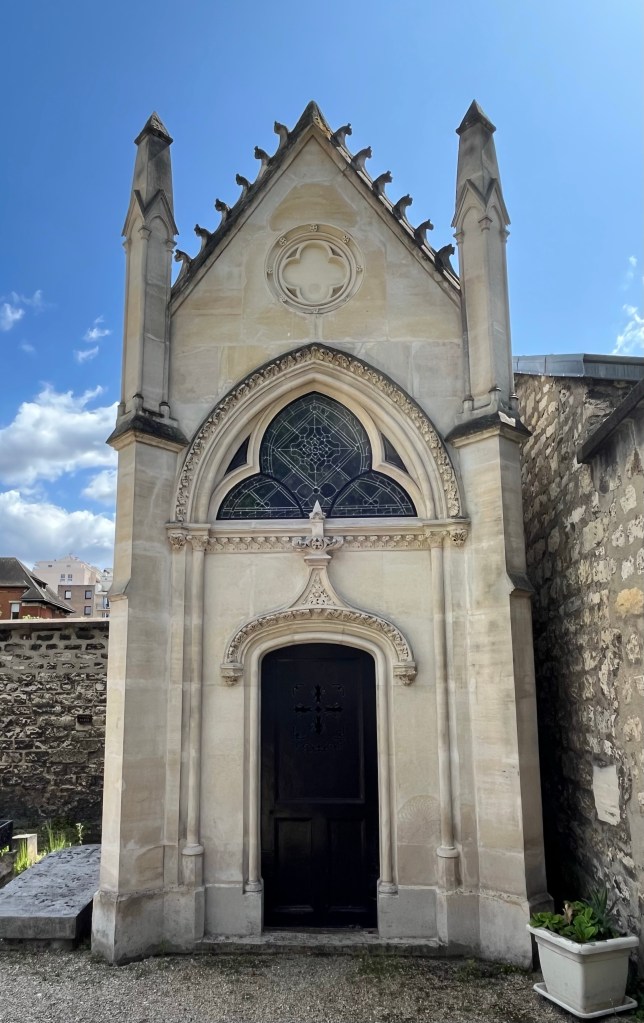
Along a quiet unassuming street this doorway marks the entrance of one of Paris’ largest private cemeteries. There are not a lot of visitors and truthfully it was only Eric’s interest that sparked this quest. But because so few visitors know about it, we had the place all to ourselves.

It is a family cemetery for members of the highest French aristocracy of which everyone is interrelated.

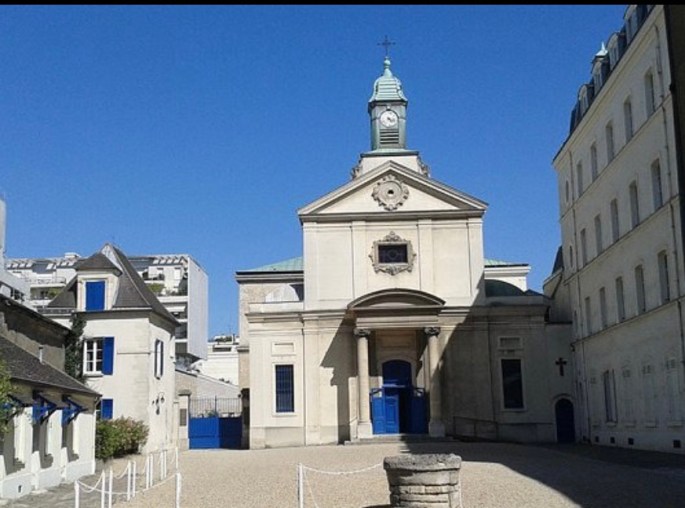
For a modest fee, entrance is gained and the first thing seen is The Chapel of Our Lady of Peace.

The walls inside are inscribed with those that are buried on this land.

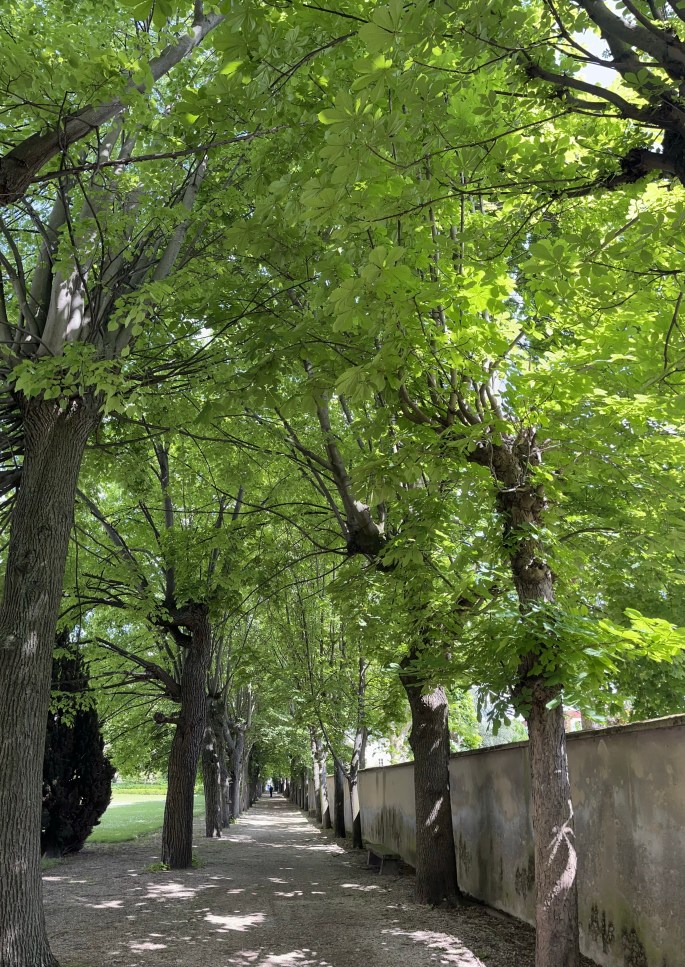
Past the chapel is an alley of trees, leading to the cemetery.

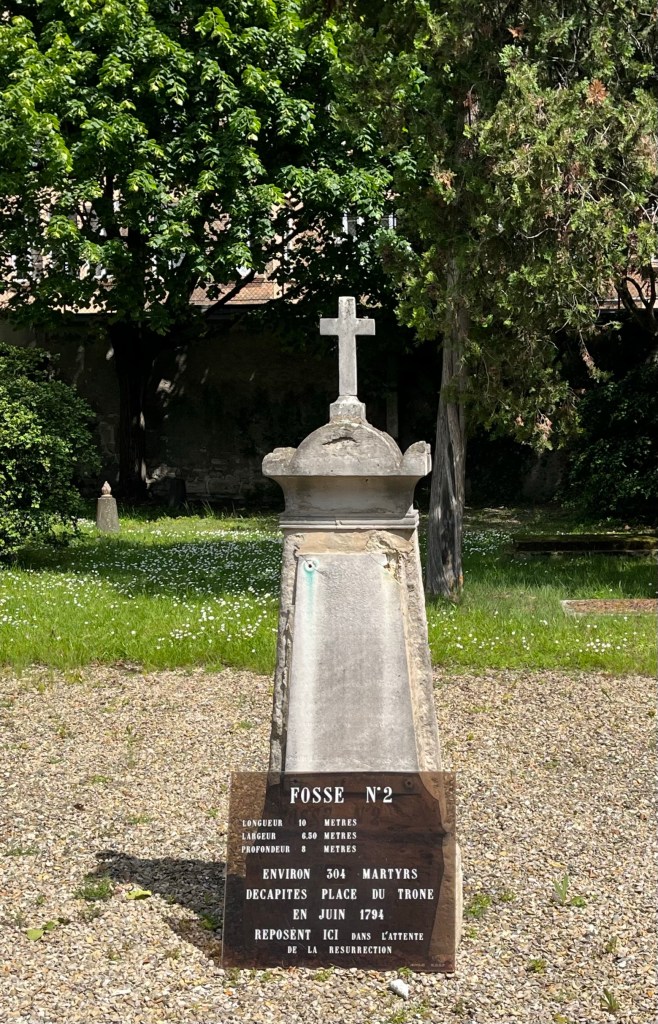
During the Revolutionary Tribunal a quick but relatively anonymous way to dispose of the bodies was needed. This spot was a five-minute walk from the guillotine set-up. The individuals beheaded were brought to this area under cover of night. Bodies and heads were thrown in after their clothes removed – the clothes being the compensation of the workmen. Two of the three fosse (pit or trench) were filled before the reign of terror was finally stopped. Fosse No1 is further back.

A young commoner followed the cart filled with bodies to know the location where her father and brother were buried and was thus able to help others. The aristocrats formed a group to secretly buy the land, create a memorial and the final resting place for their loved ones – which is managed by a nunnery. The cemetery is walled off and near where the pits were dug.

Descendents of the 1306 victims are eligible to be buried here. We found a headstone dated 2022.

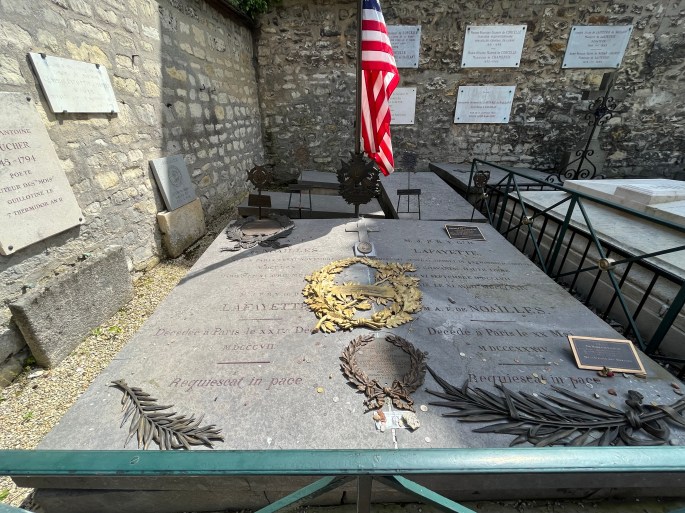
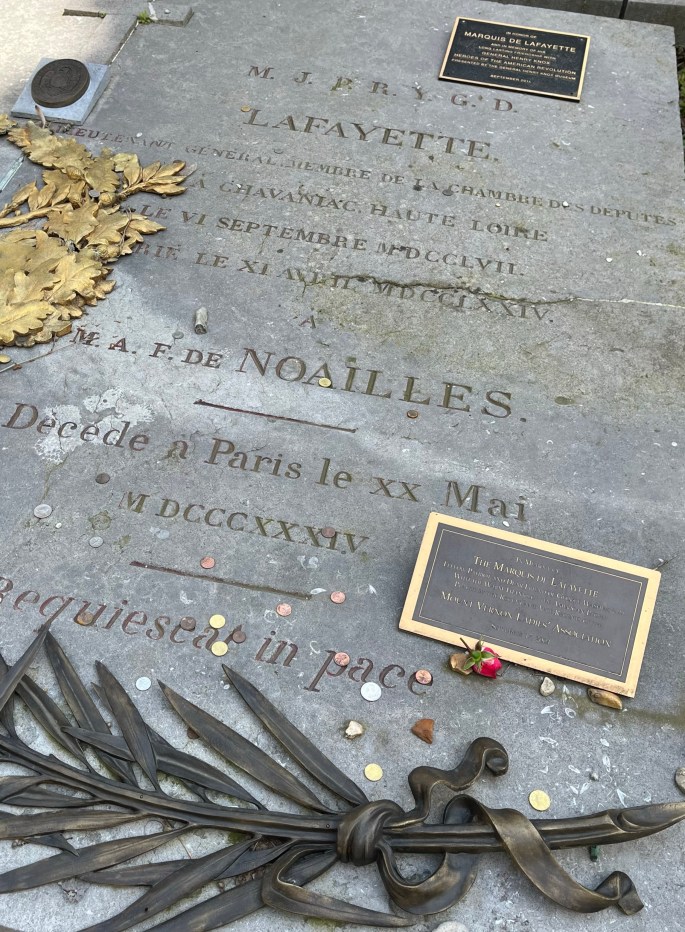
Lafayette is considered a national hero in both the U.S. and France. Lafayette died in 1834 from pneumonia. His wife’ sister, mother and grandmother were beheaded and therefore they were eligible to be included. In the corner of the cemetery is Lafayette’s tomb. It is visited regularly by Americans. When the Germans occupied Paris in WWII, they never entered and an American flag continued to be flown over his grave. The flag is renewed yearly on July 4th.

The soil surrounding his grave is from the Battle of Bunker Hill, therefore he is buried in American soil. Lafayette was a key figure in US history and Geroge Washington treated him like a son. There is so much more to that story that everyone should google and read.

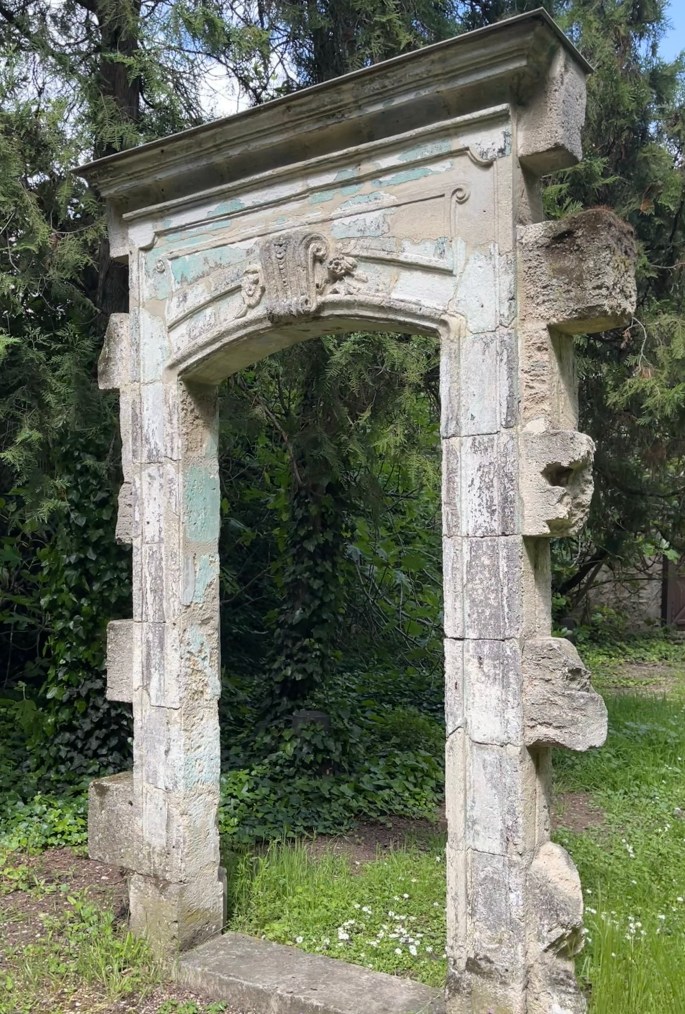
At the back of the lot was how the cart came to drop off the bodies, here is one of the portals that was kept.

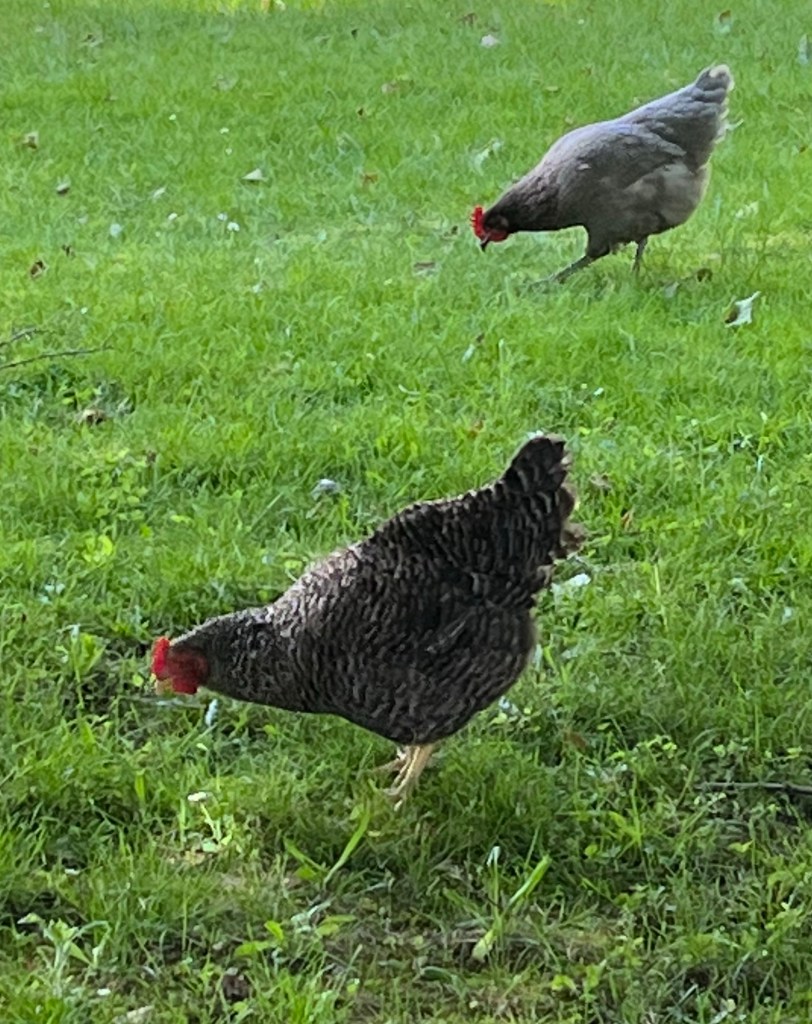
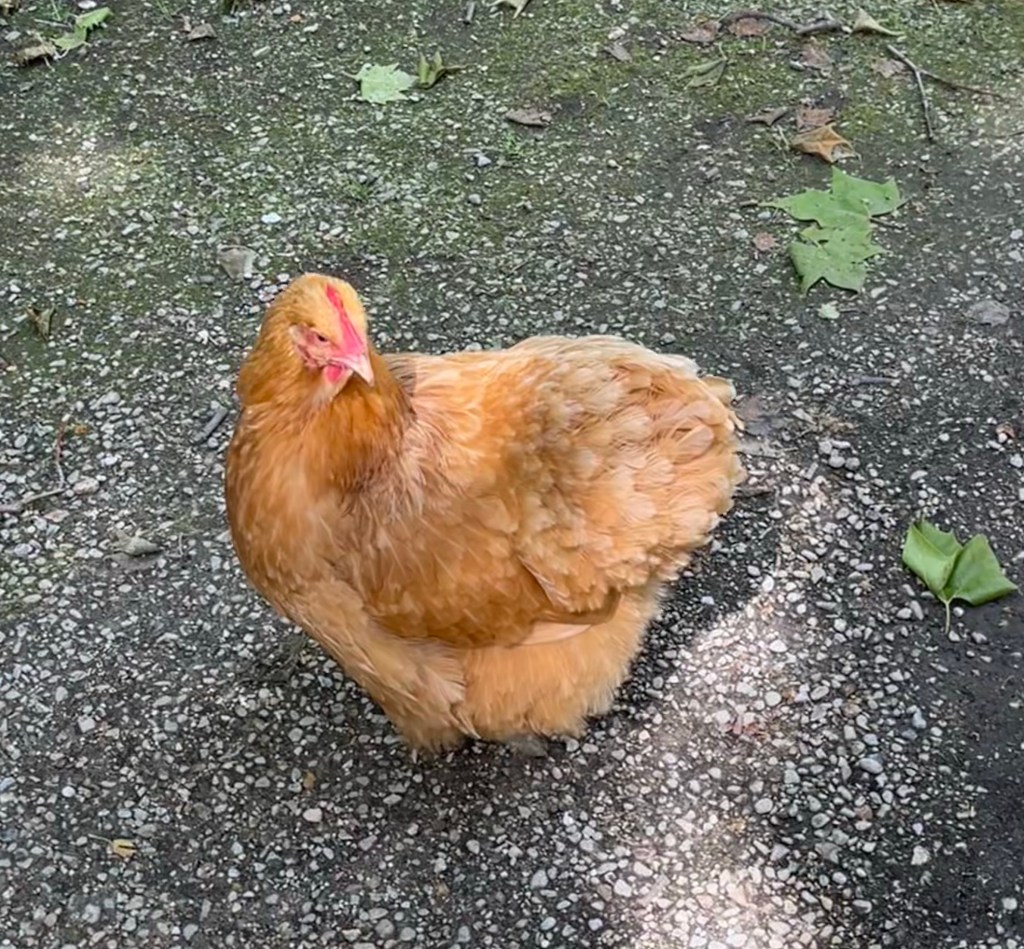
I mentioned this is a working nunnery. There are some chickens running around, roses have been planted throughout the property and in one corner I found some beehives. The brown chicken was expecting me to feed her and kept following me around.

Inside the walls the chirping birds blocked out all of the daily work noise surrounding this area. There was a peaceful calm about the place that was needed after the atrocities that occured in the past.

Ginny

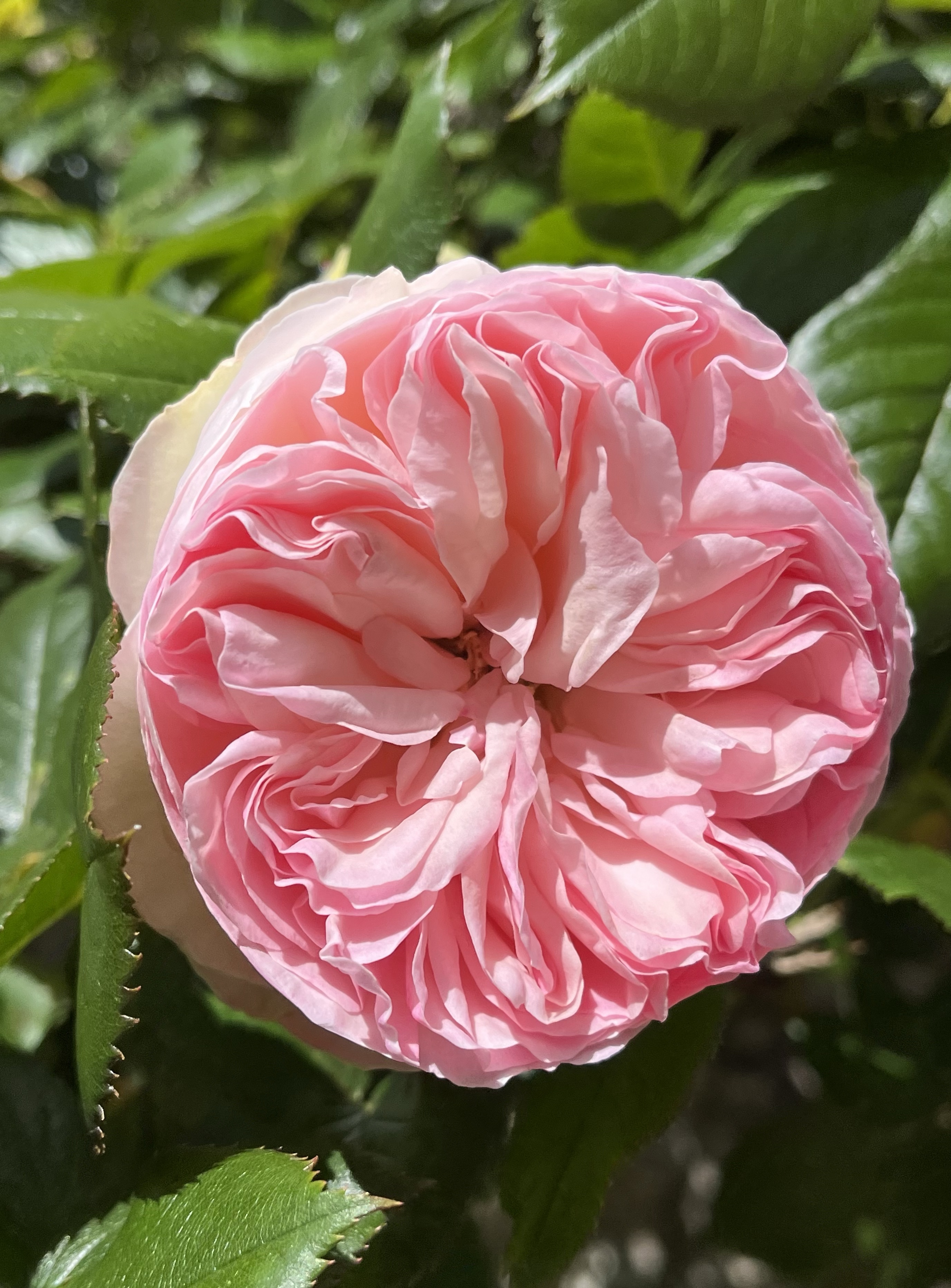
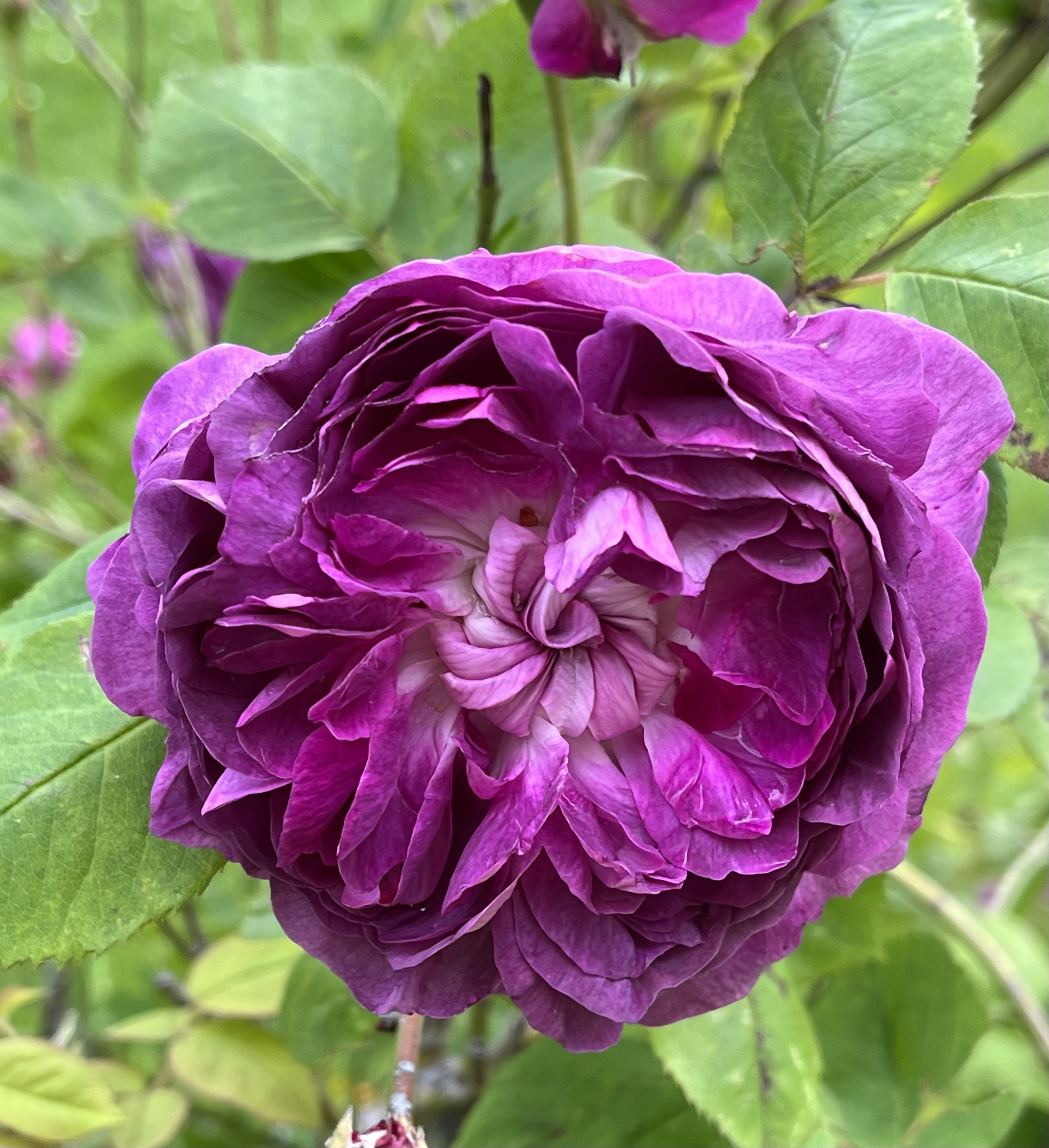
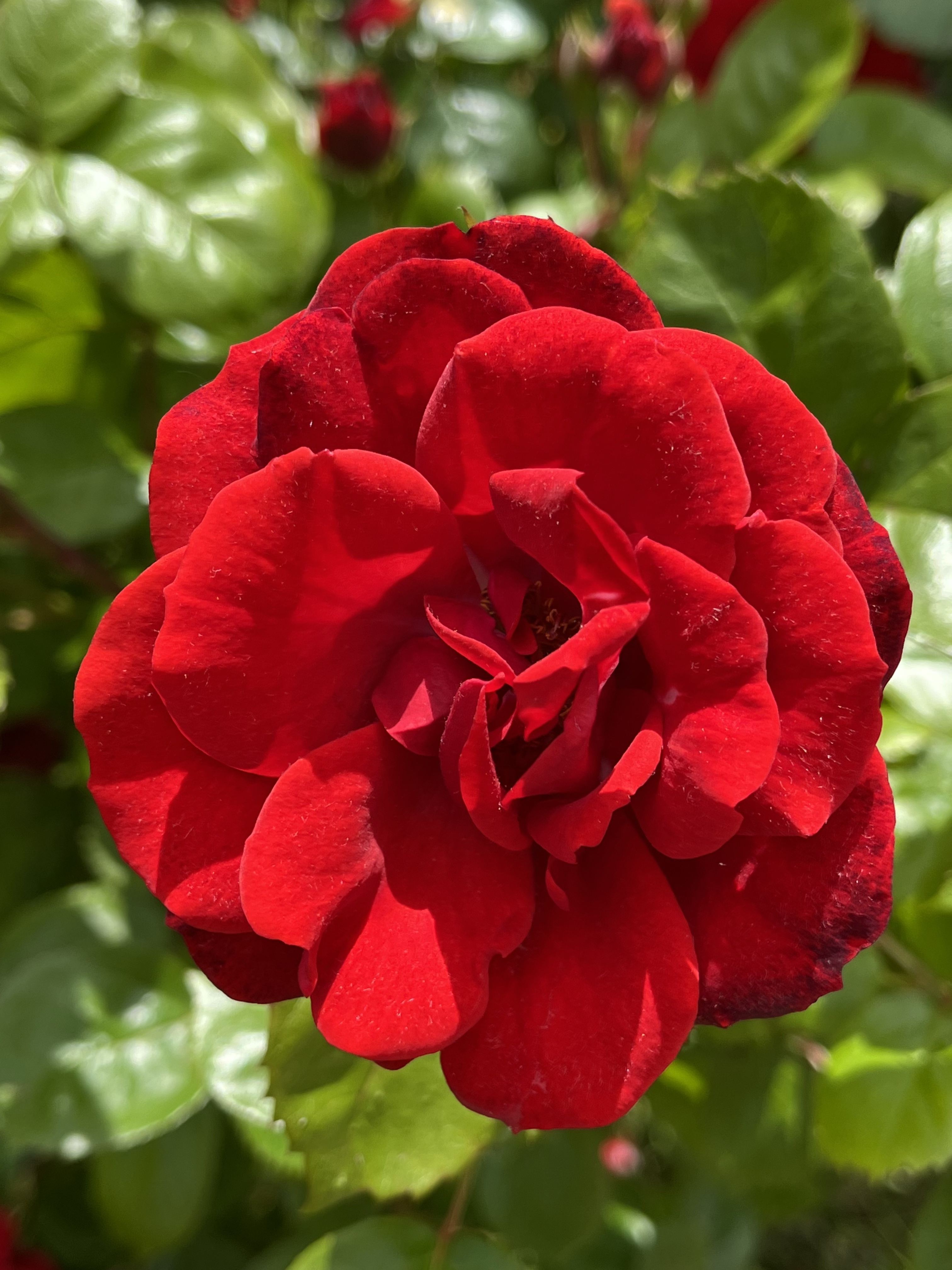
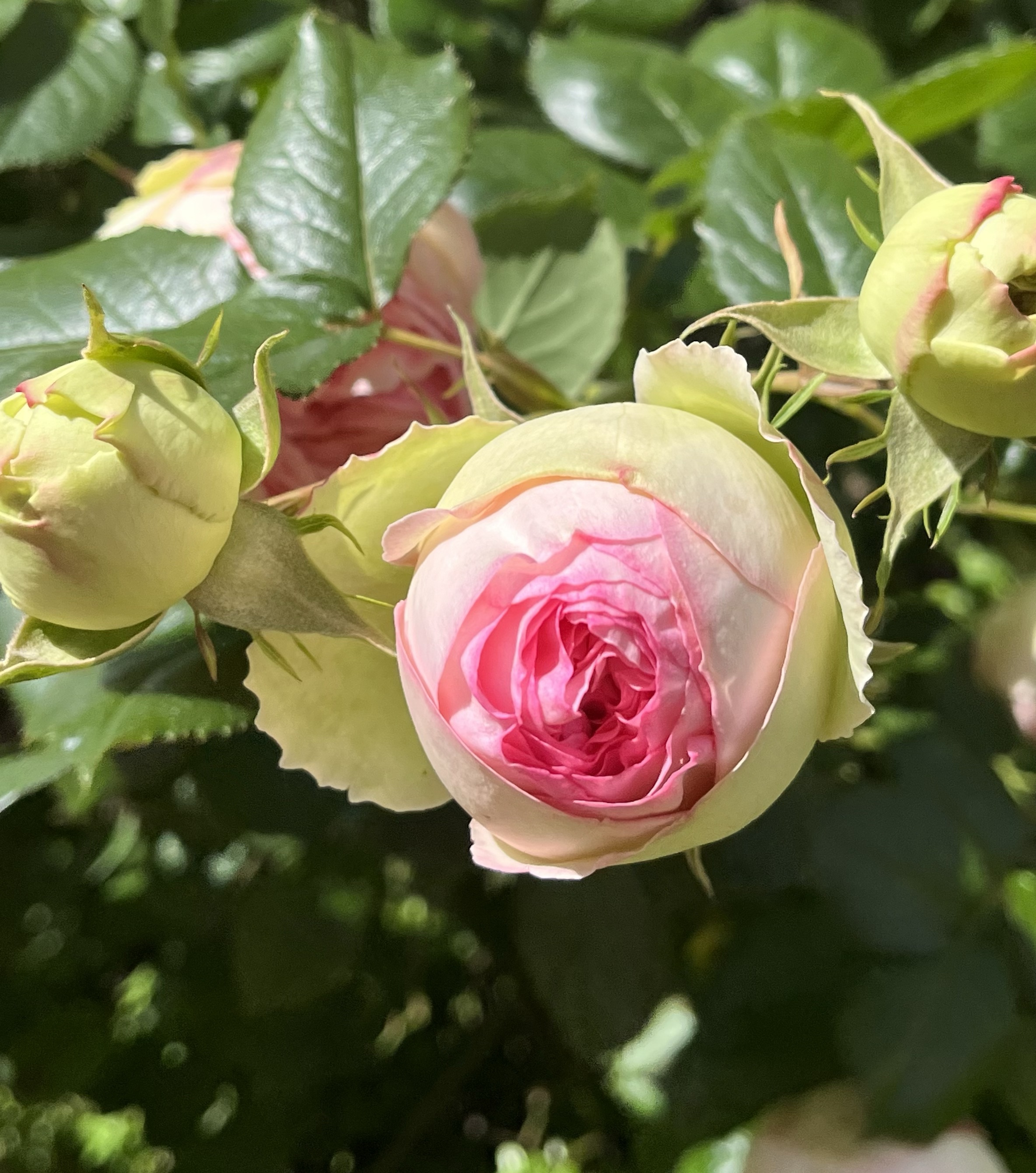
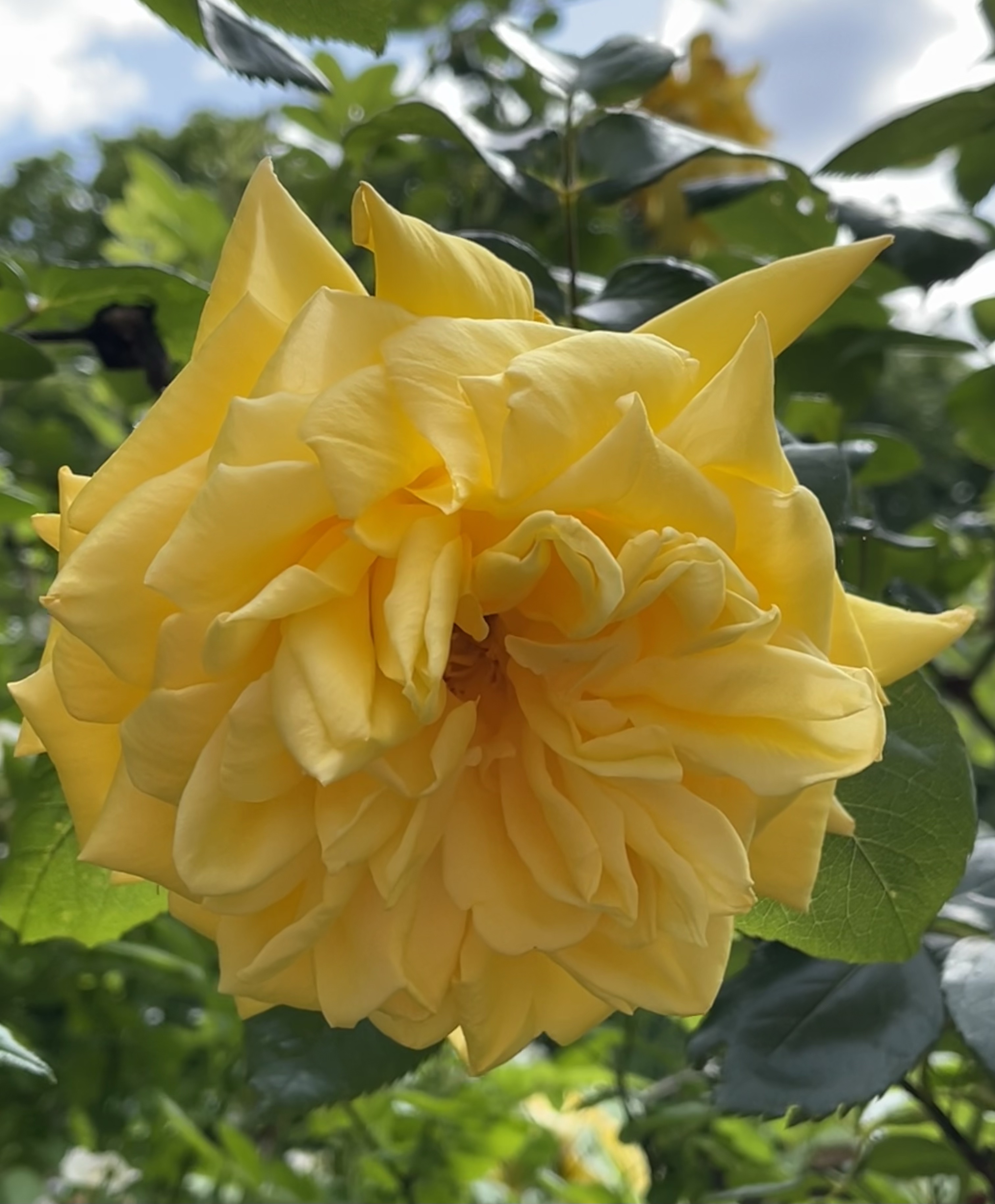
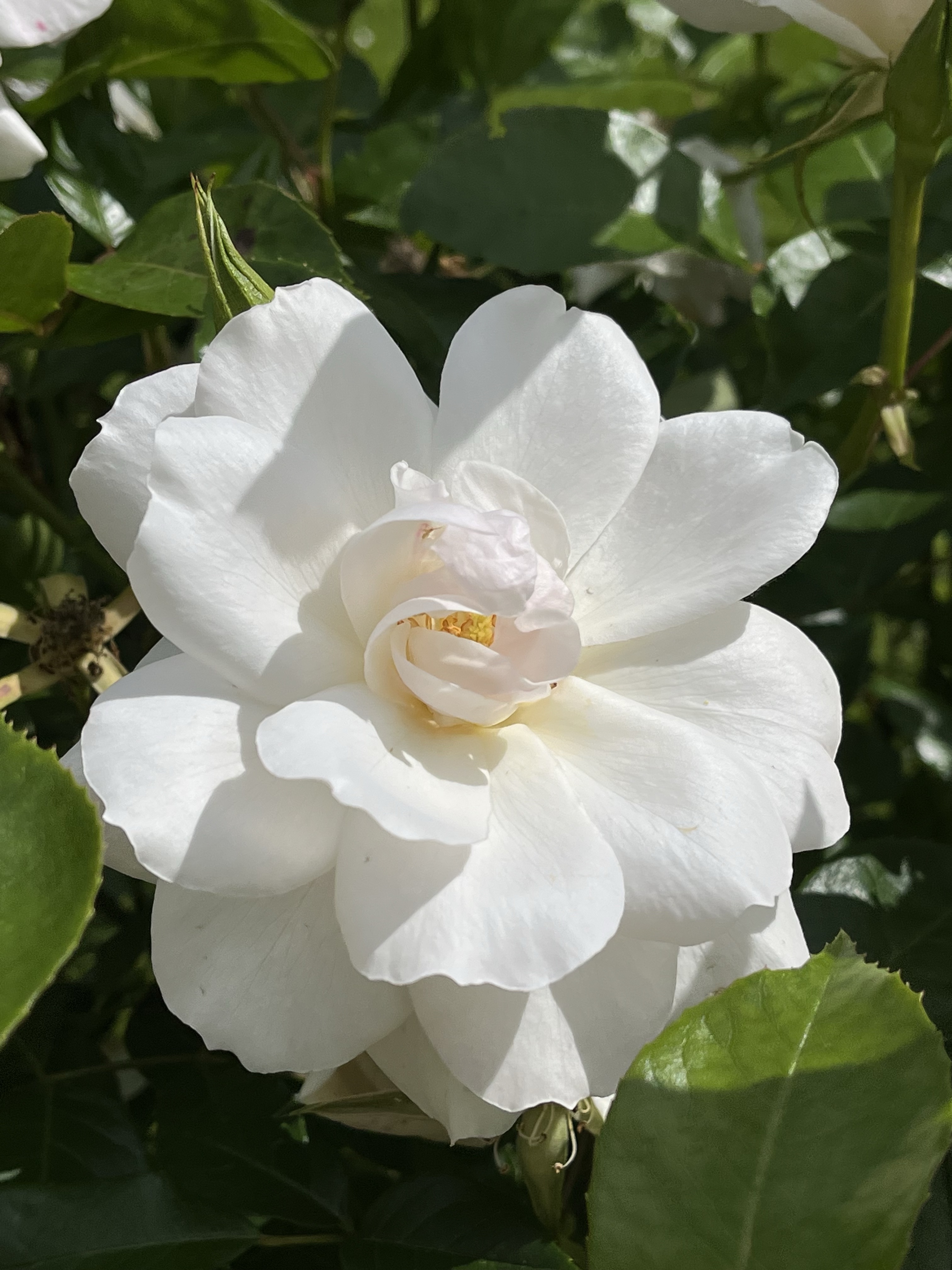
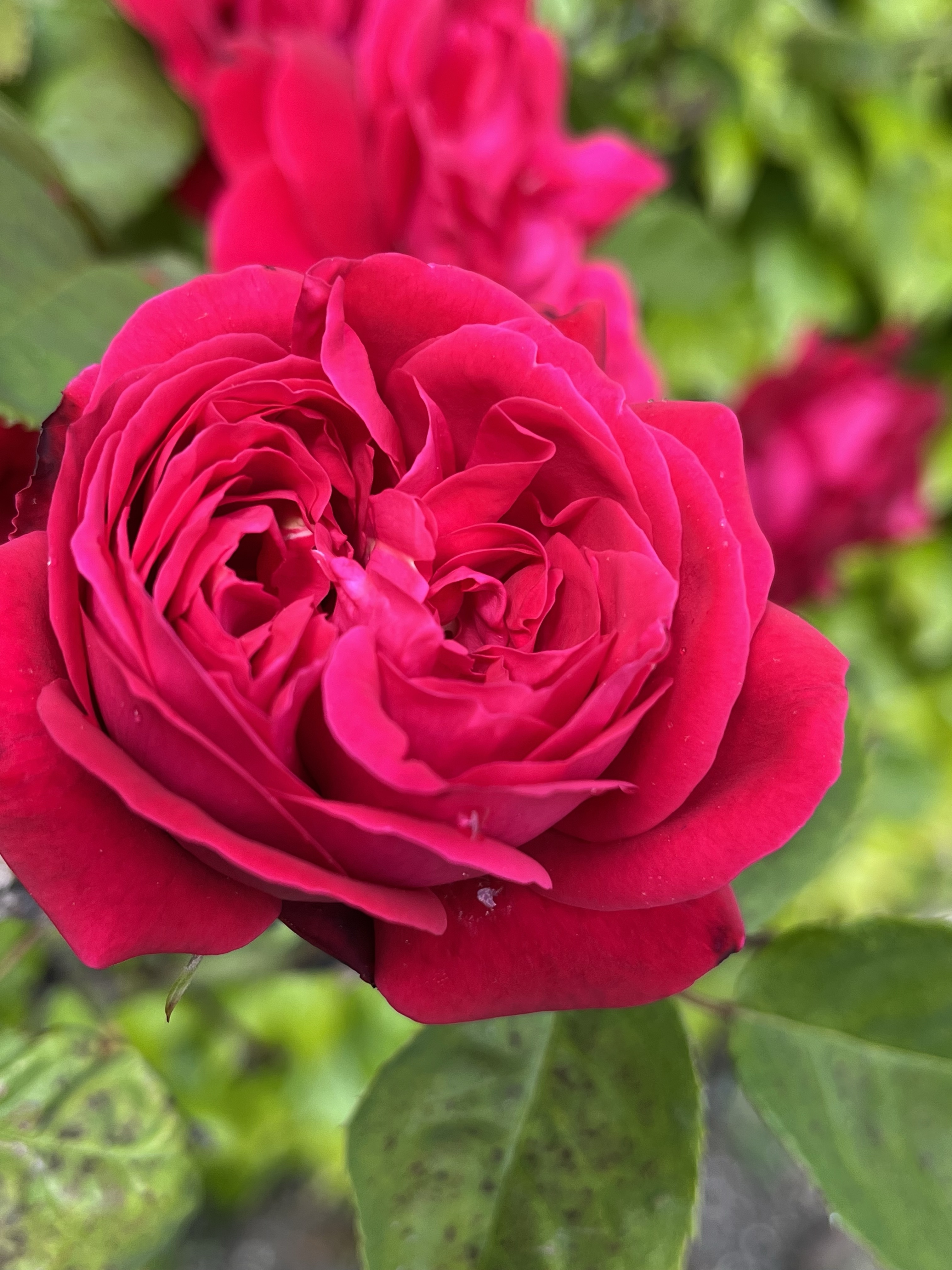
I took waaaaaay to many photos of the roses, but they were blooming spectacularly.

Paris, France 2023!

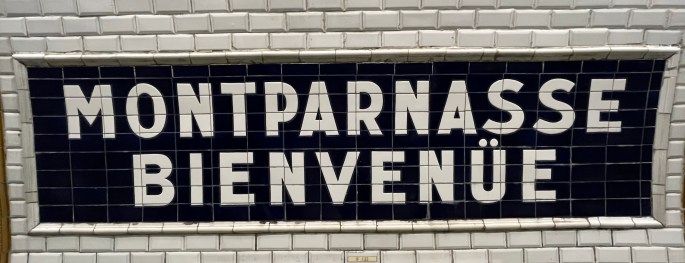
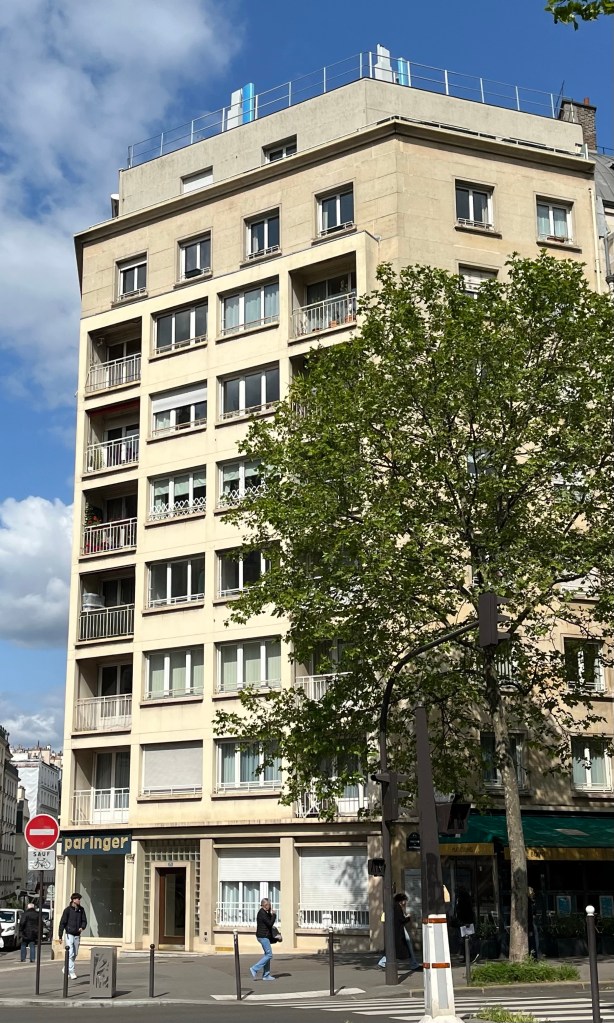
After spending time along the northern French coast, we headed south to Paris – turned in the rental car and got a taxi to our AirBNB. It is in the Montparnasse district, which has been part of Paris since 1669 and is split between the 6th, 14th and 15th arrondissements of the city.

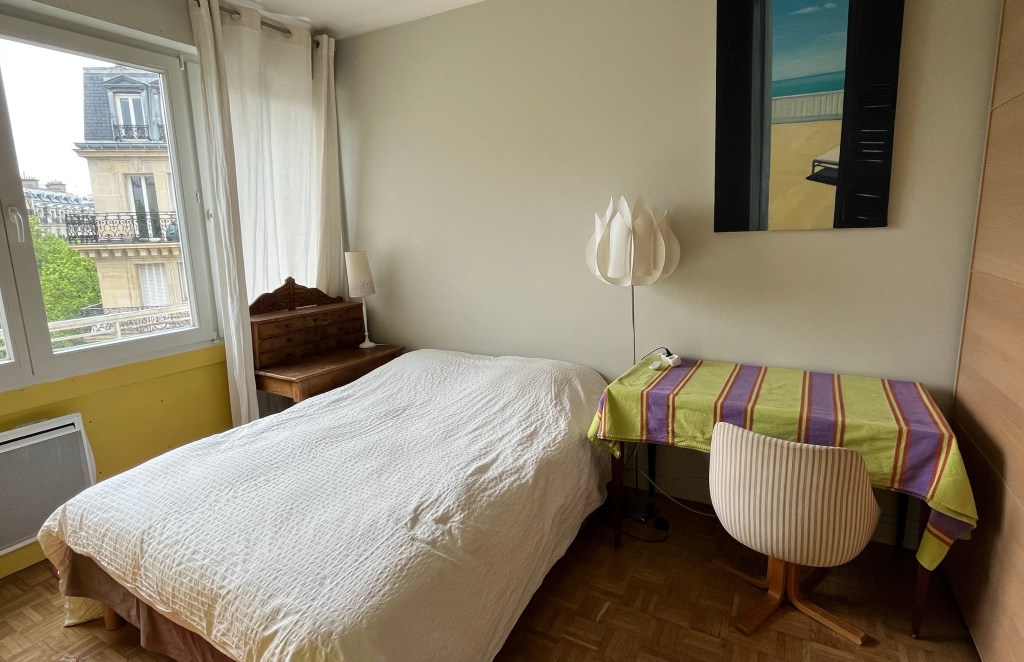
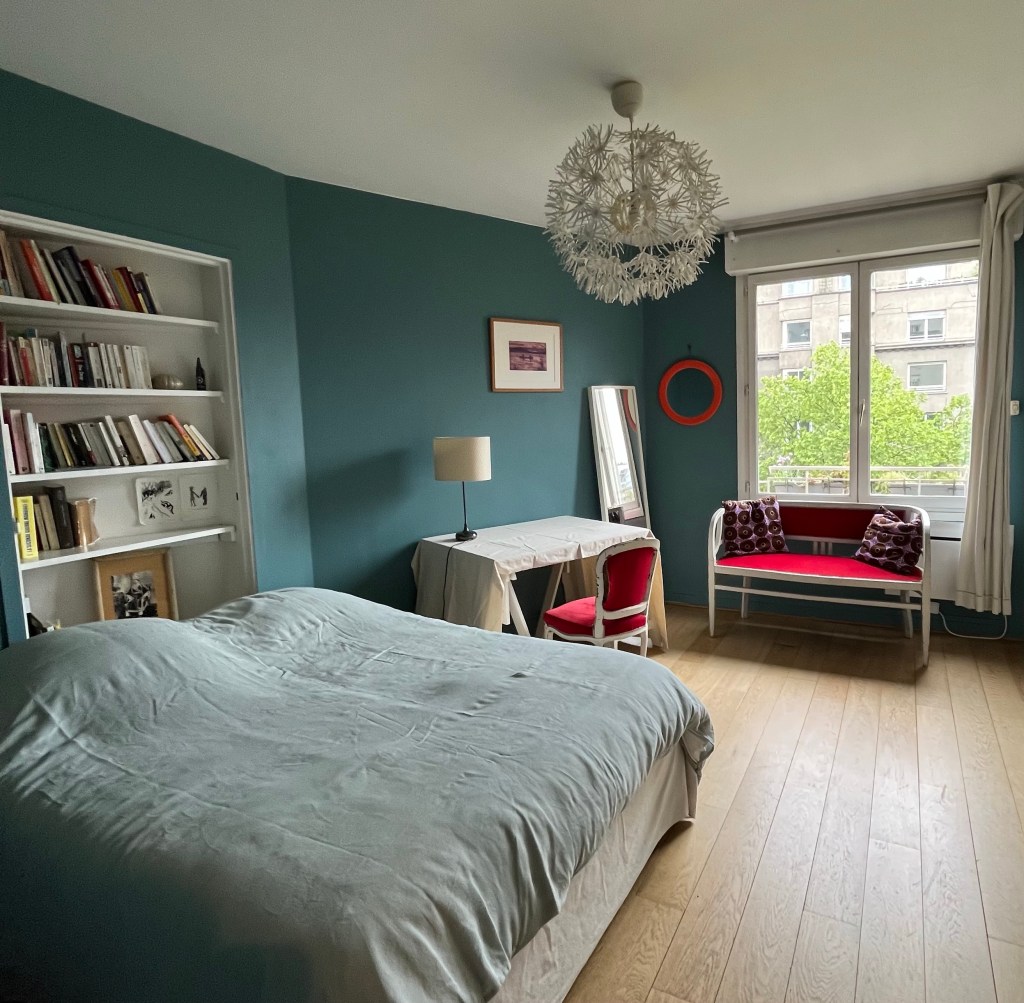
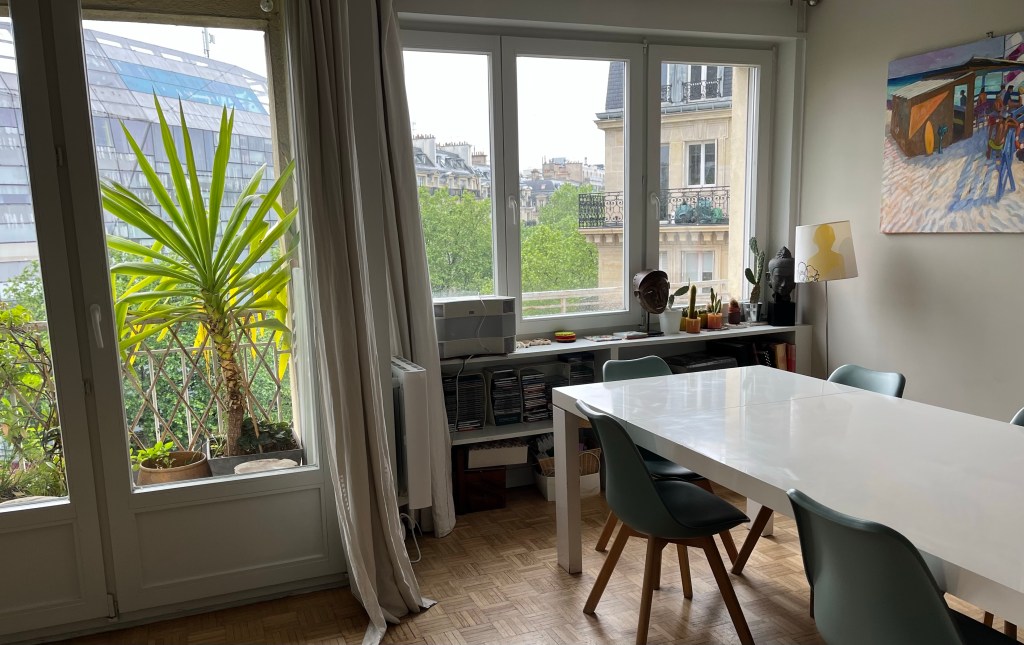
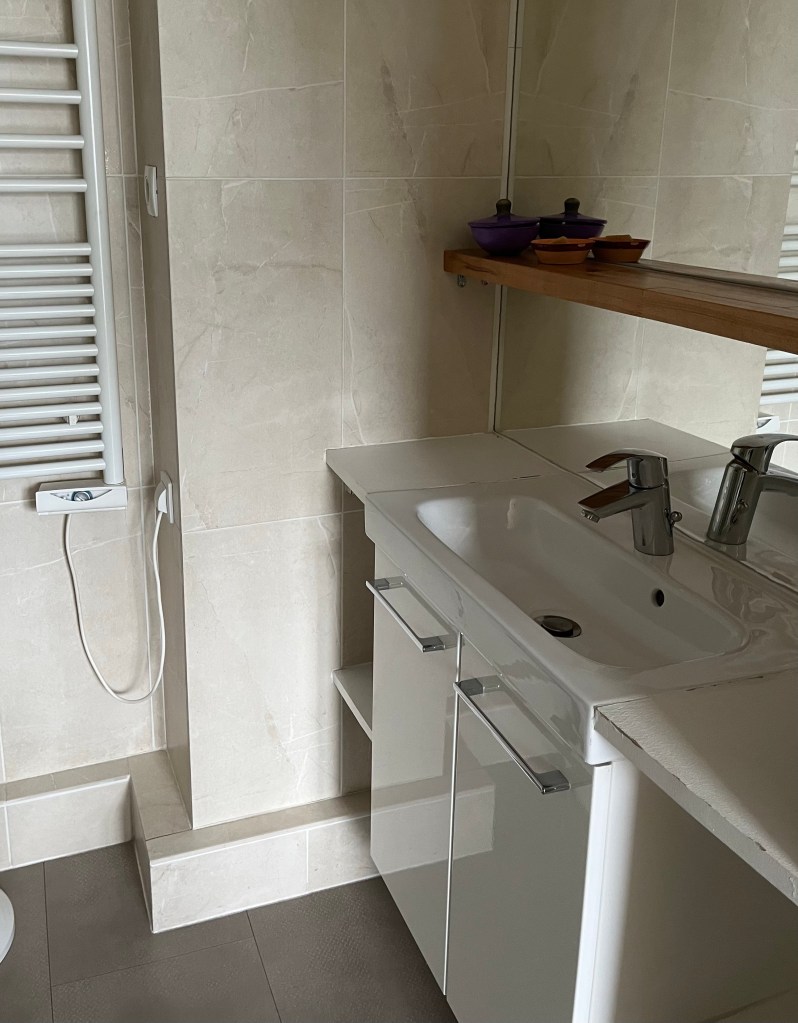
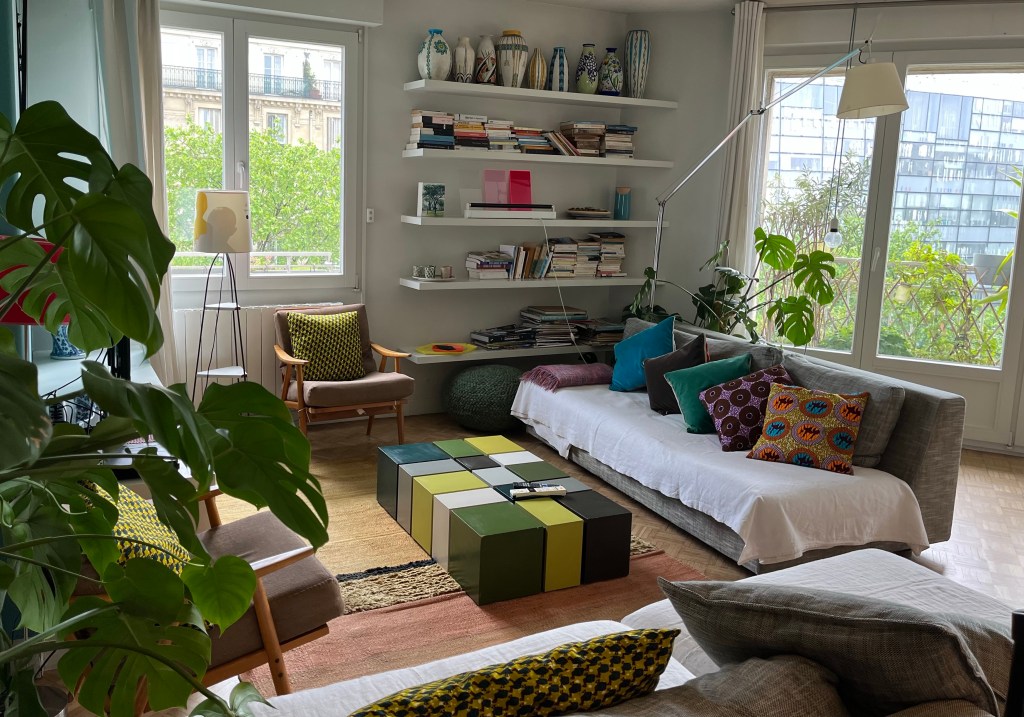
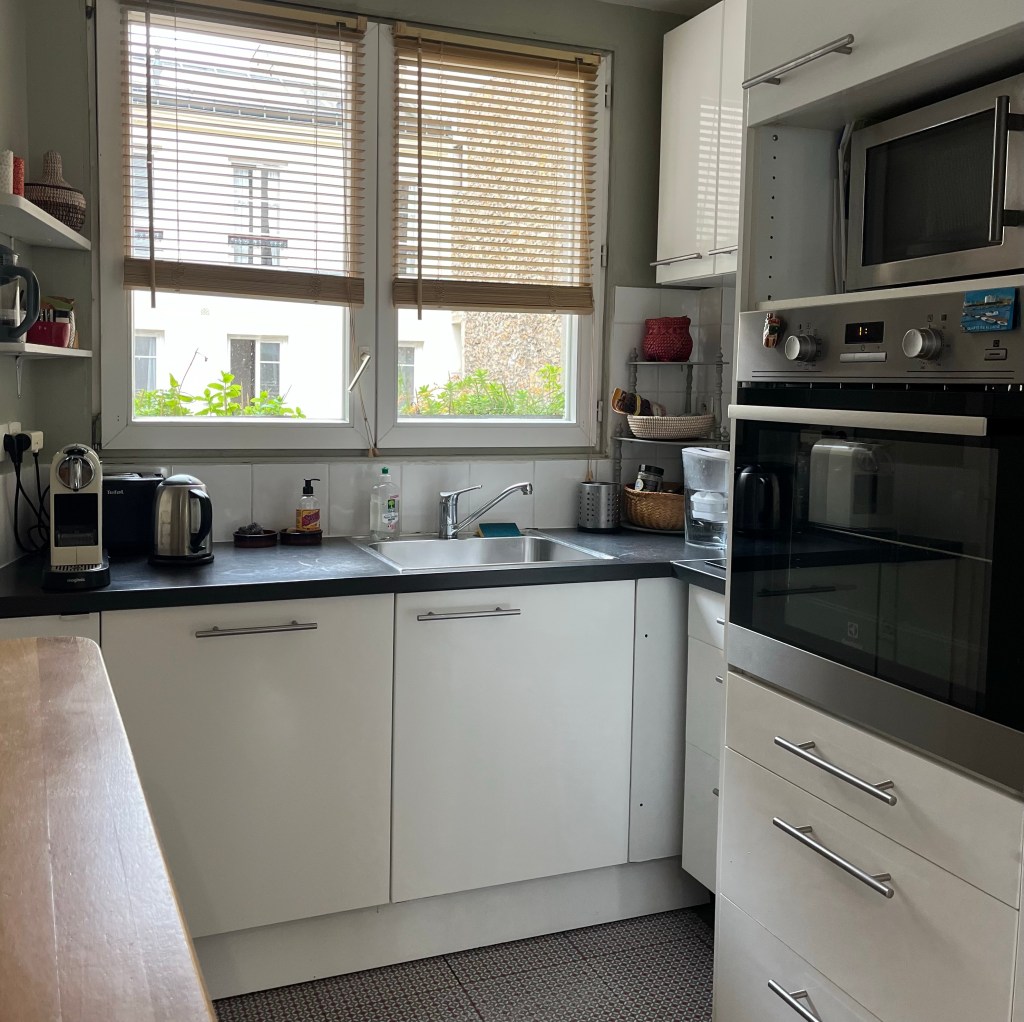
Our AirBNB was located on the fifth floor………and had an elevator, thank goodness. It had a teeny tiny balcony, just deep enough for a chair and a few plants.

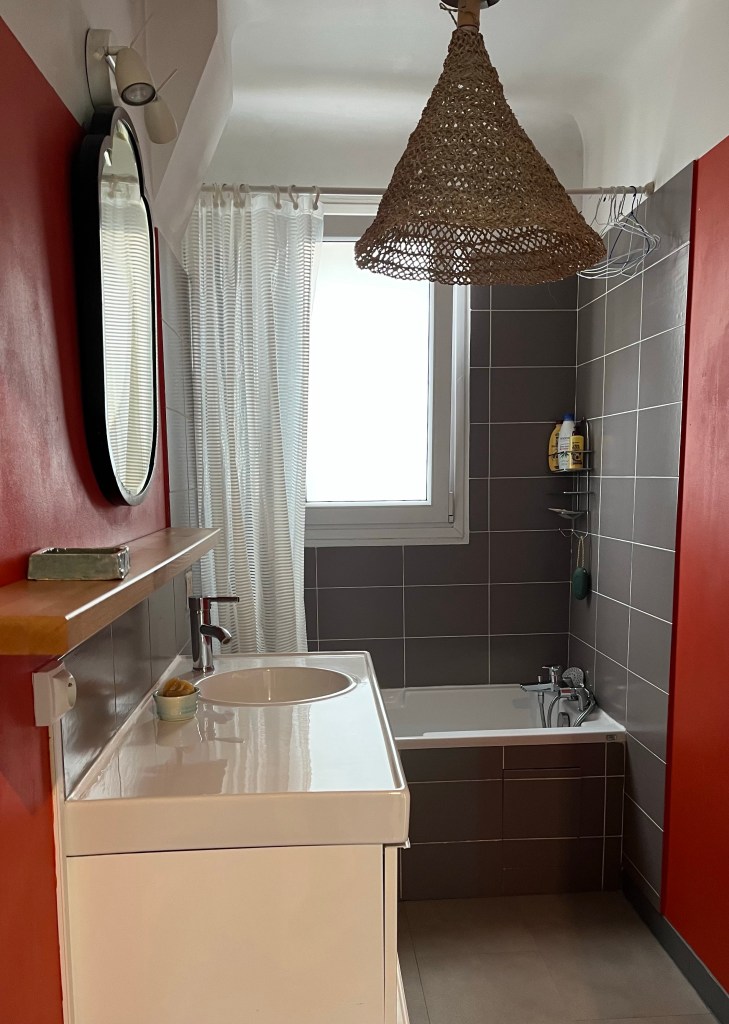
A bedroom for each of us, two bathrooms, a sitting area, dining area and kitchen. Check, check and check.

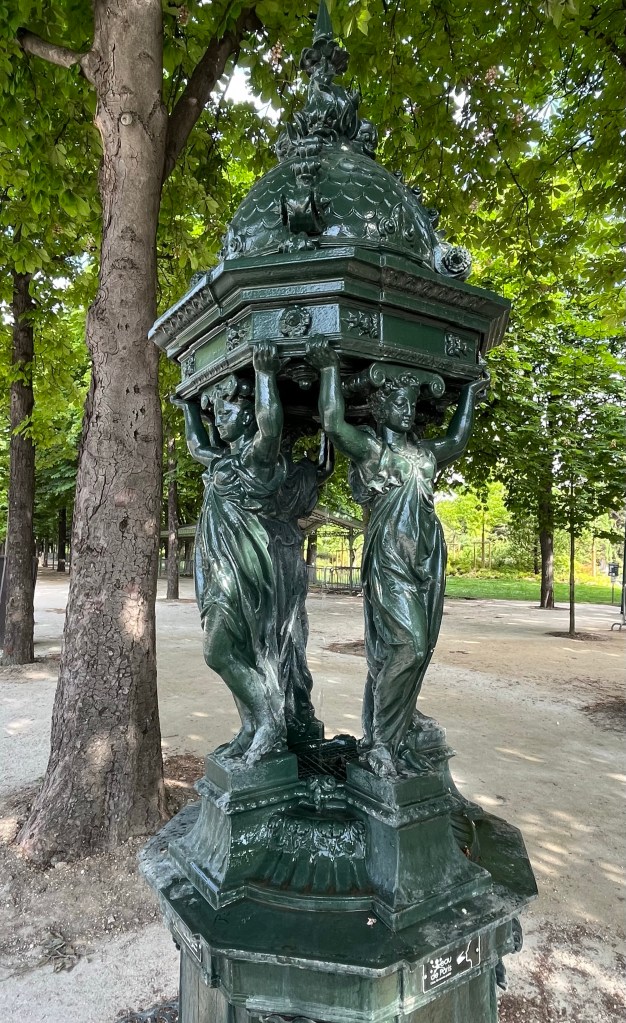
Walking through neighborhoods we discovered more of the green cast-iron water fountains donated by Englishman Sir Richard Wallace. He loved Paris and in 1872 used his own money to provide the people of Paris with drinking water. Hard to capture the water dripping from my photo – but it is there.

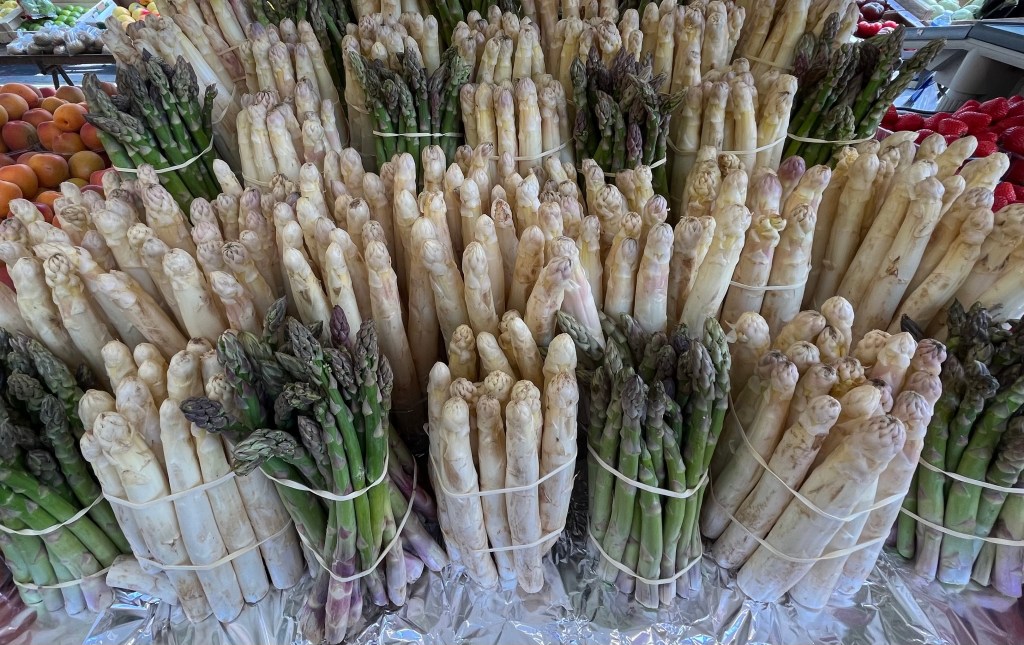
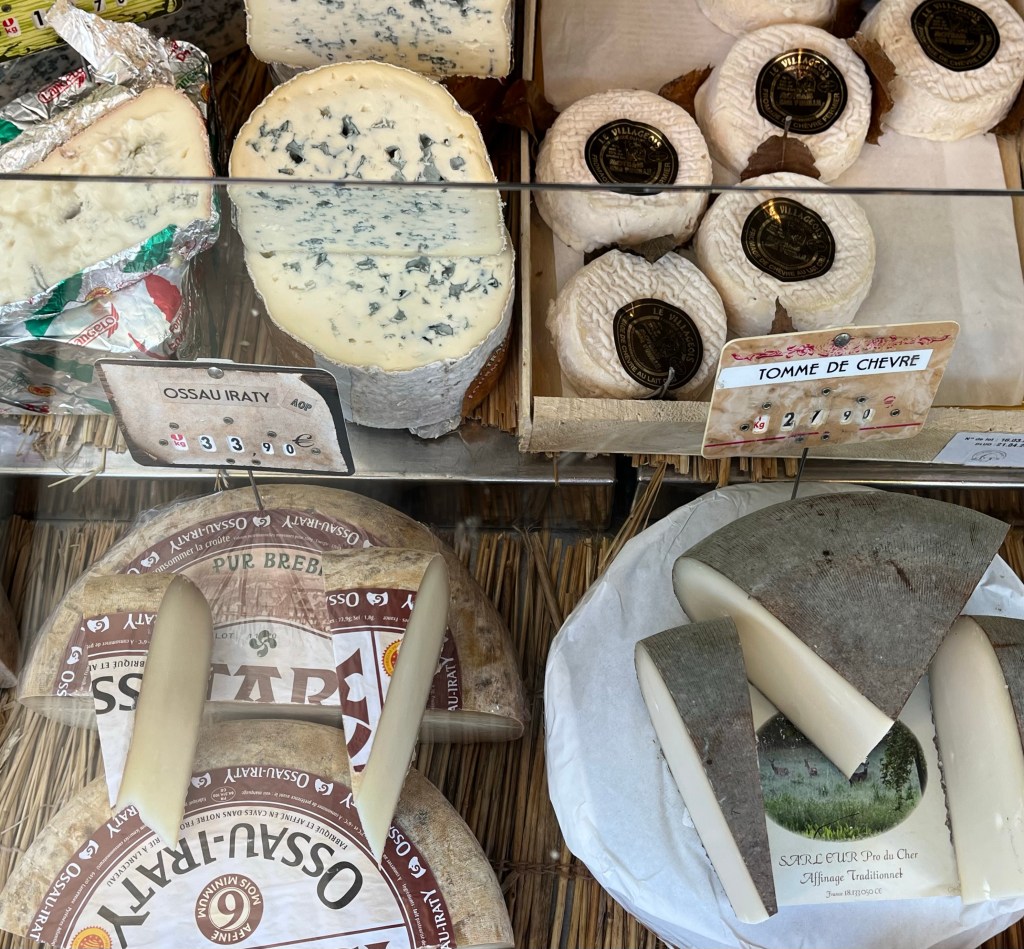
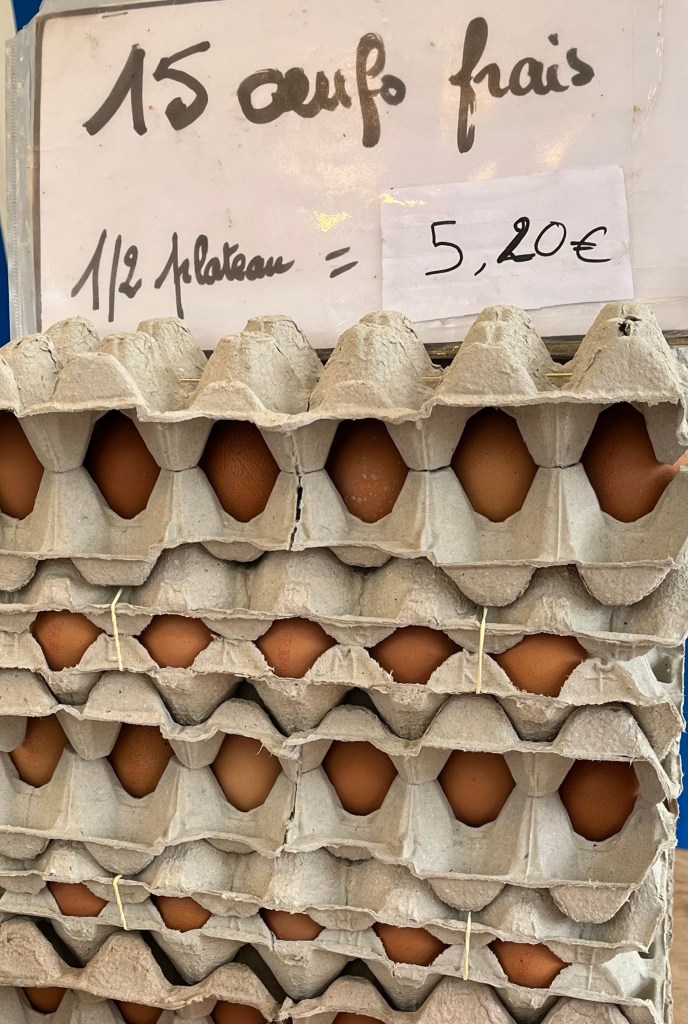
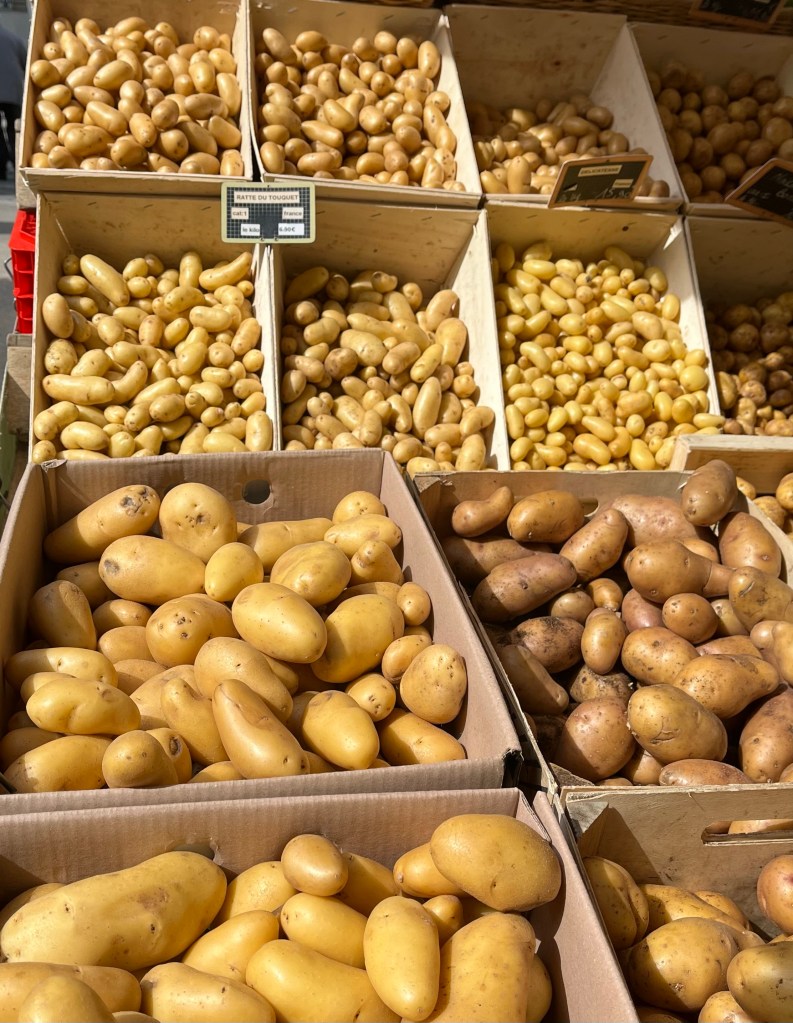
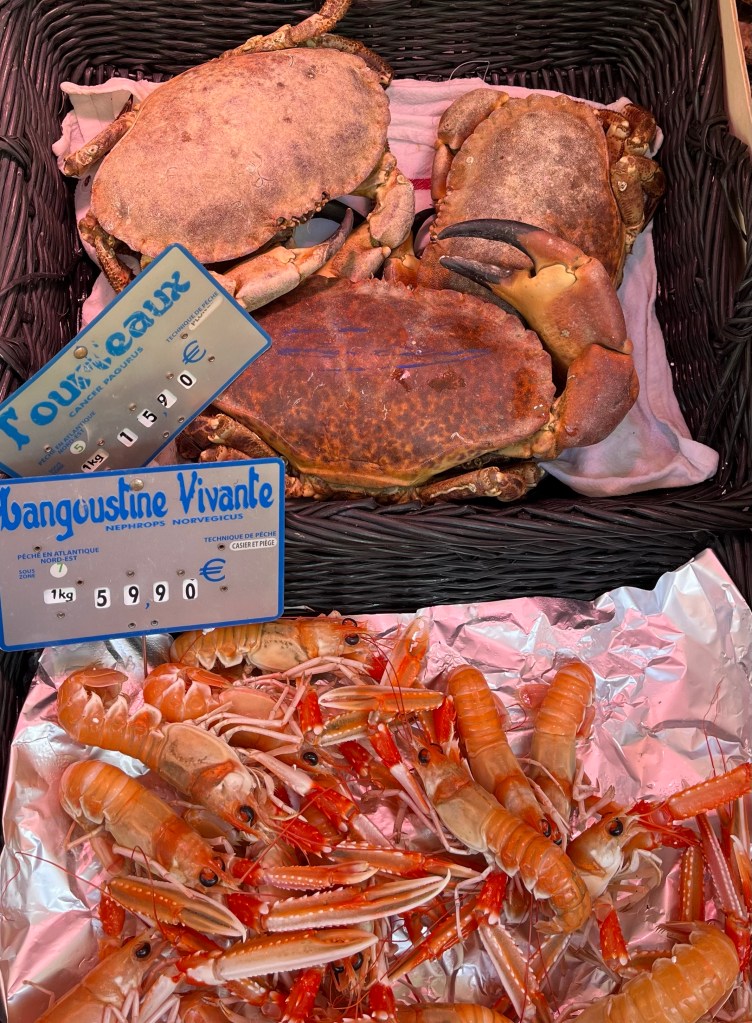
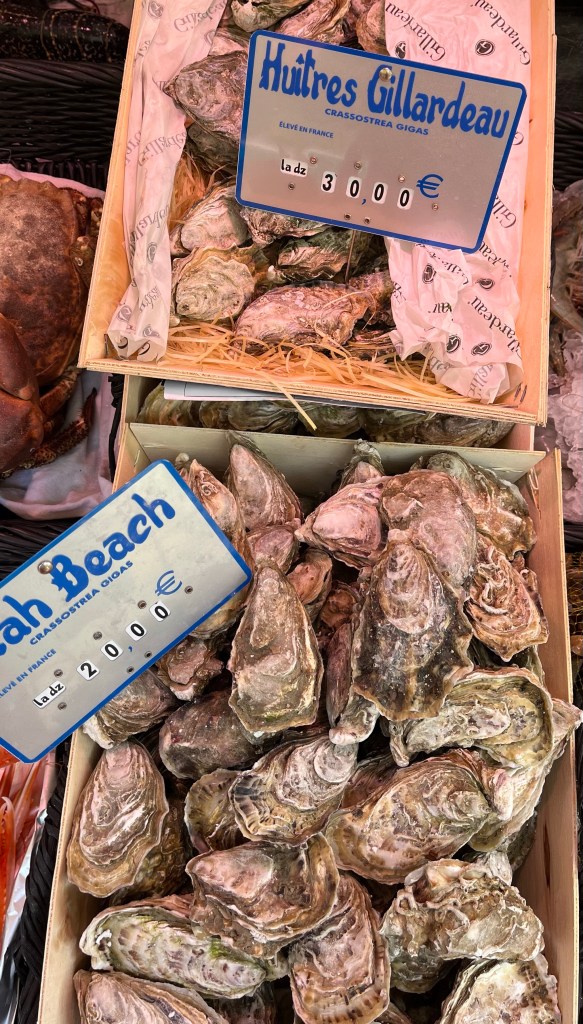
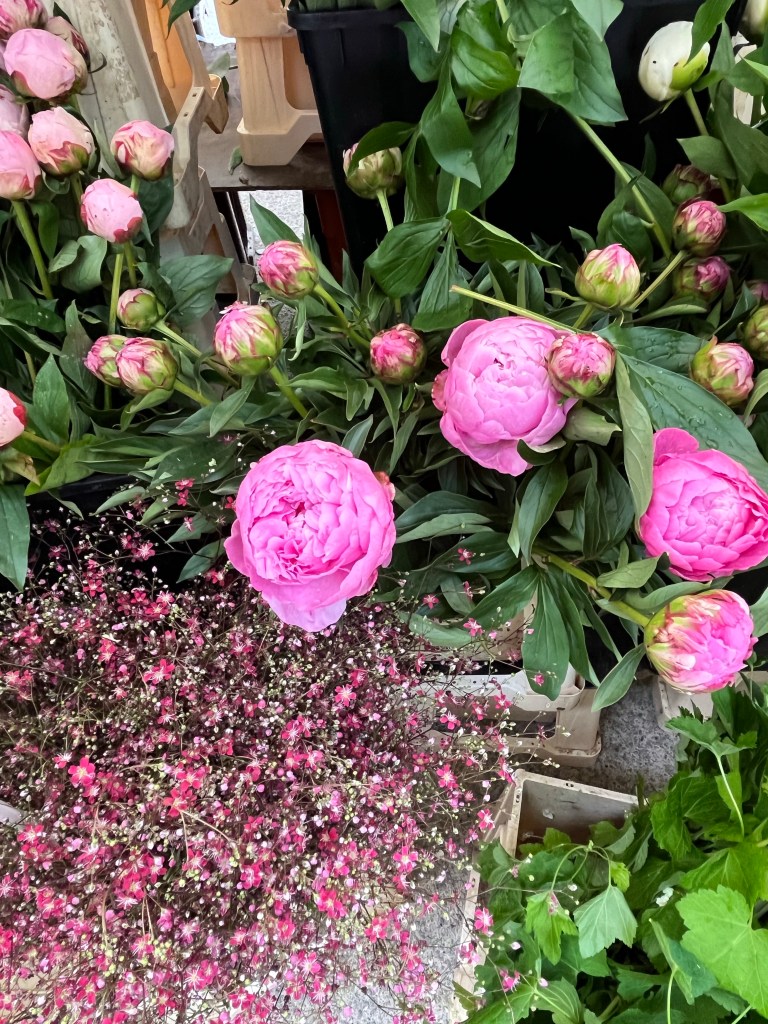
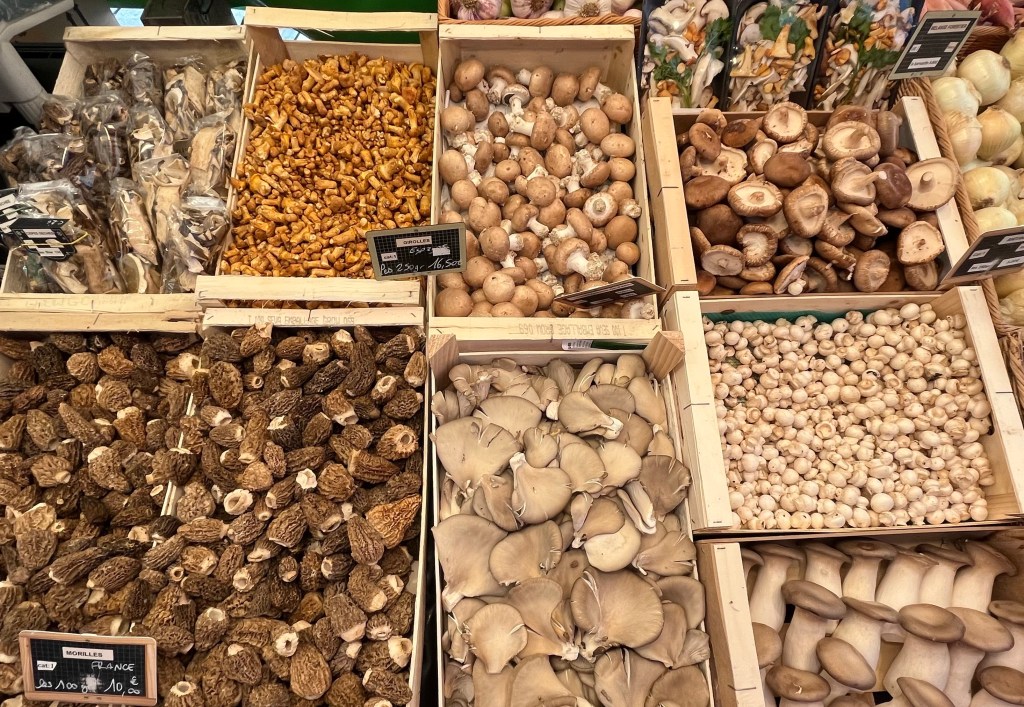
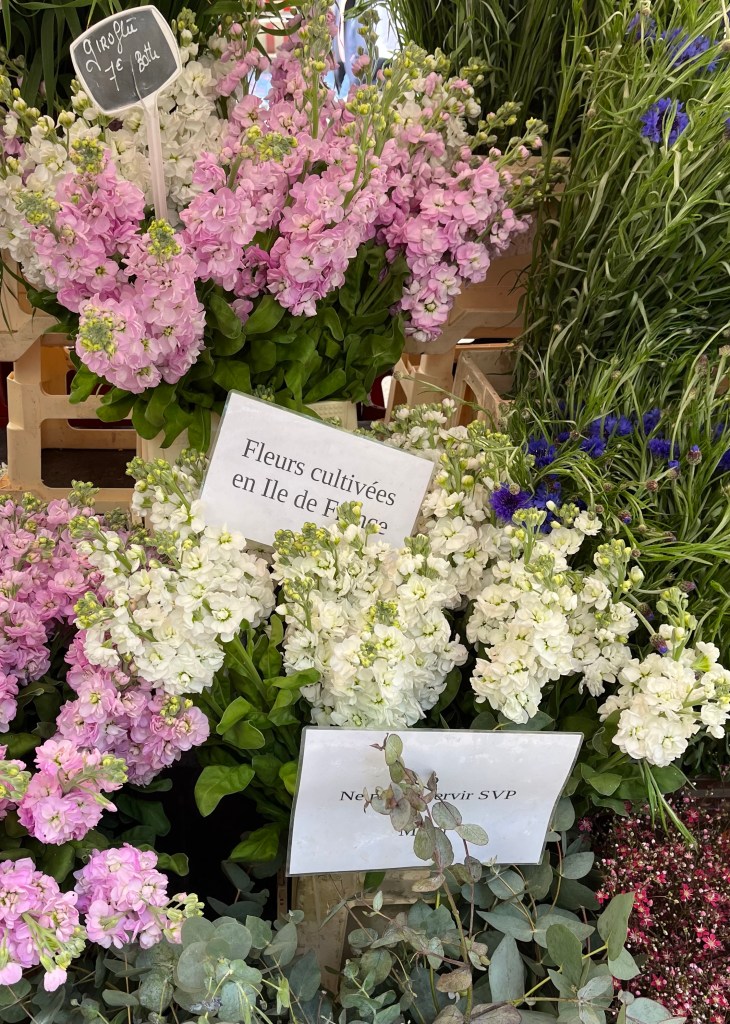
Walking the streets, you never know when youre going to come across a street market like this one. LOVE the fresh produce, fresh seafood and fresh flowers.

Imagine………one stall dedicated to cheese (1st row, middle photo), a stall dedicated to potatoes (second row 1st photo), a stall dedicated to mushrooms (second row, middle photo), stalls dedicated to seafood (bottom row, BTW super fresh!) and of course my favorite, stalls dedicated to flowers.

During our visit, my favorite flower was in bloom – peonies – and available for purchase in the markets.

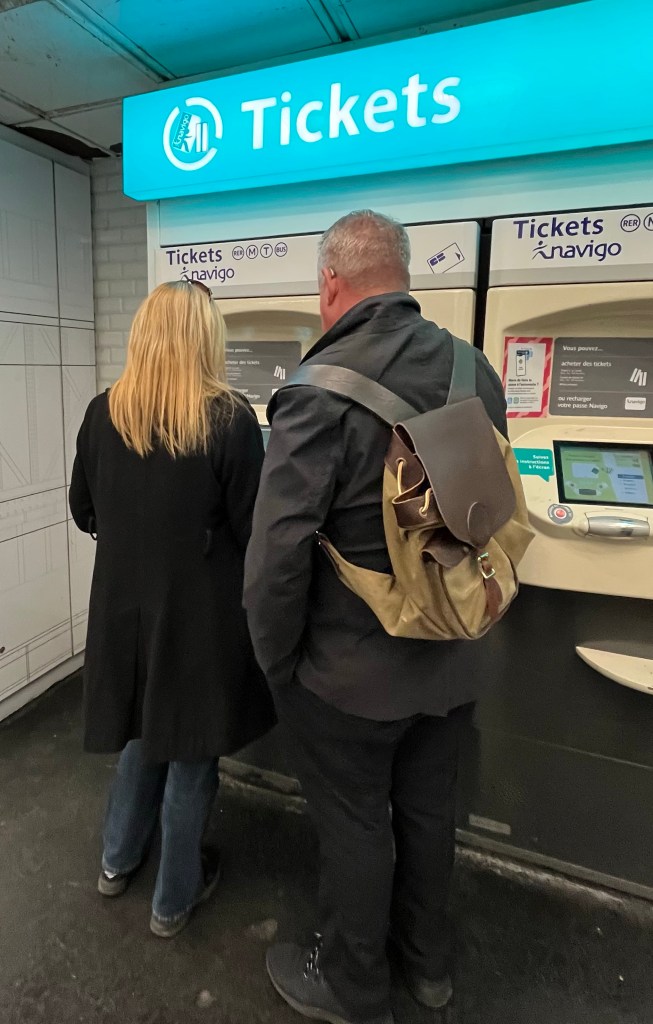
Getting our metro pass gave us a wider range of neighborhoods. Sometimes it takes more than one set of eyes to figure out the purchase………………….

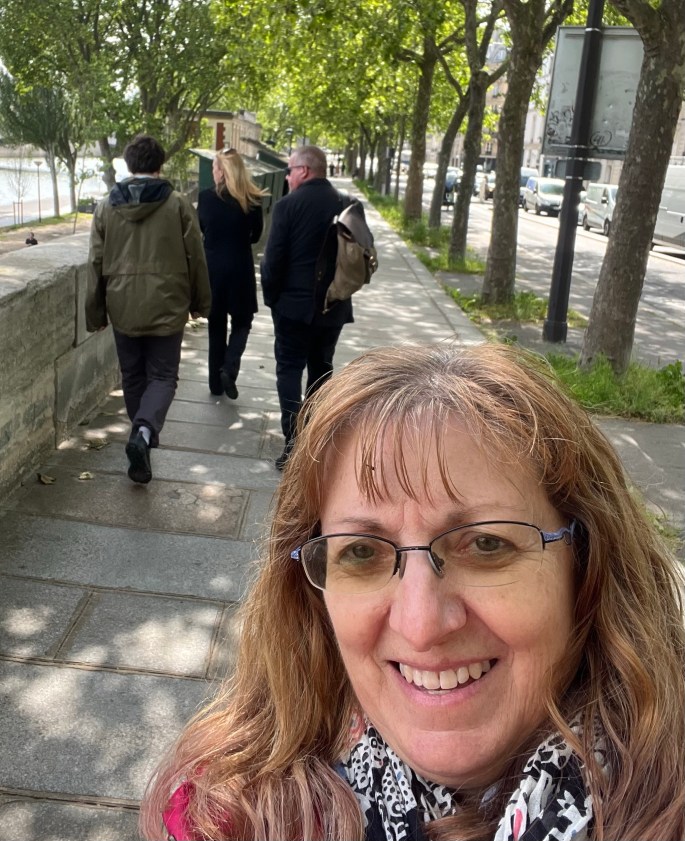
Walking along the Seine is a favorite pastime, while also giving me a chance for a bit of shopping in the bouquinistes – which you can just barely see the green boxes ahead of them. Yep, they have no idea a photo was taken.

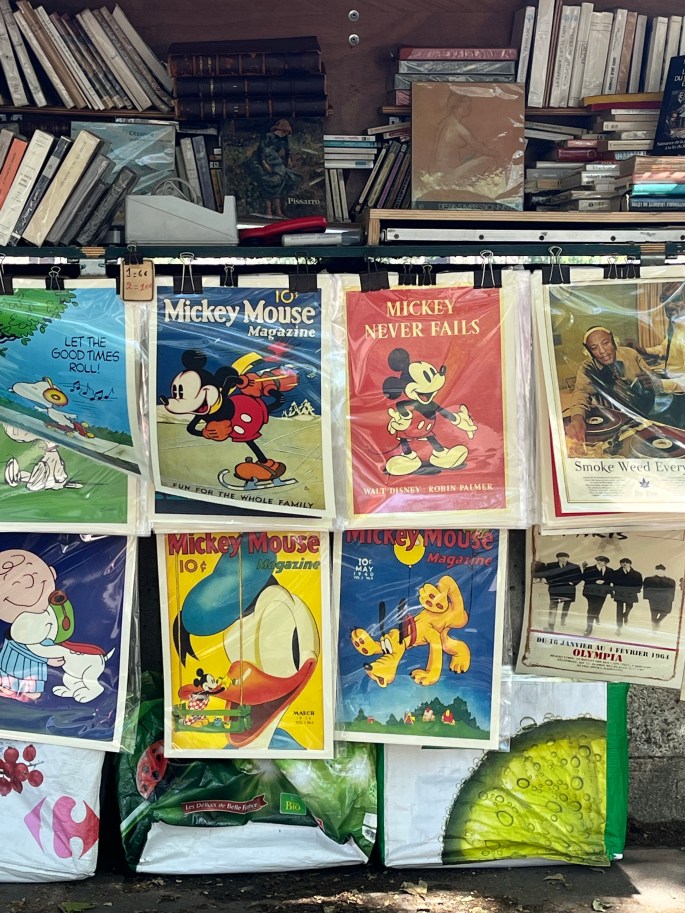
The bouquinistes, or used booksellers was a part of the second-hand book tradition begun around the 16th century. Now declared a UNESCO World Heritage site, over 240 bouquinistes make use of 900 of these green boxes to house some 300,000 old books and a number of other paper items. Rules and a waiting list (as long as 8 years) dictates minimums days of operation (4) and upkeep. Couldn’t resist this snapshot. And yes, the items are kept inside the boxes and secured overnight. Hence, most items are wrapped individually in plastic.

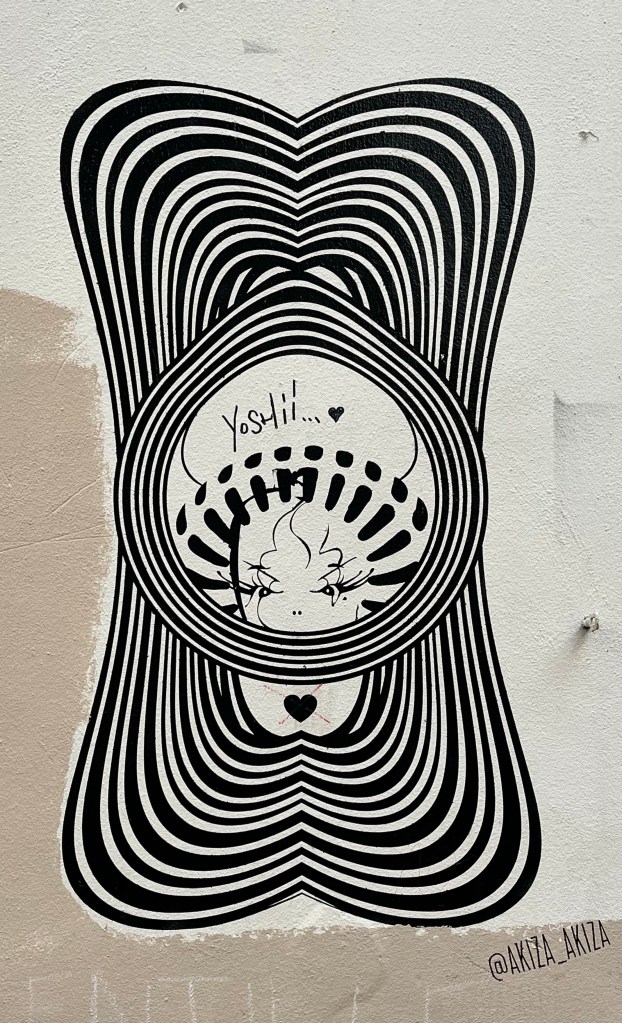
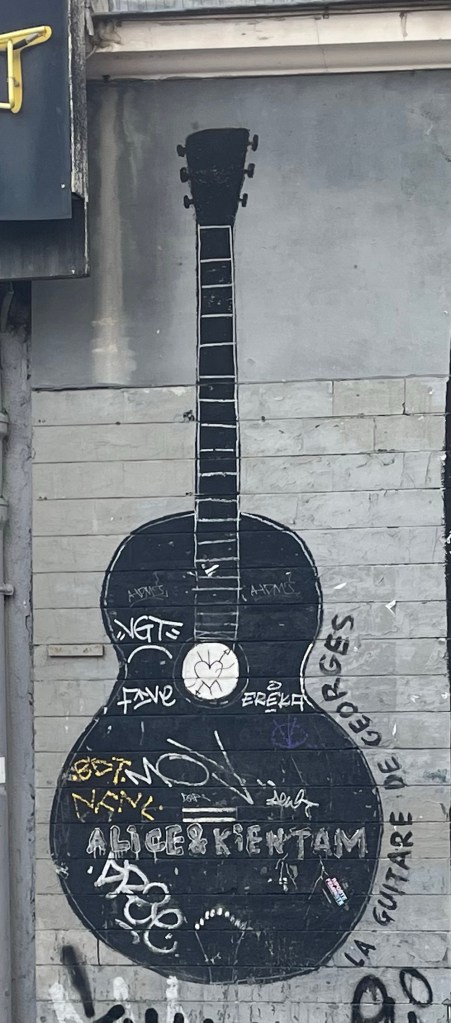
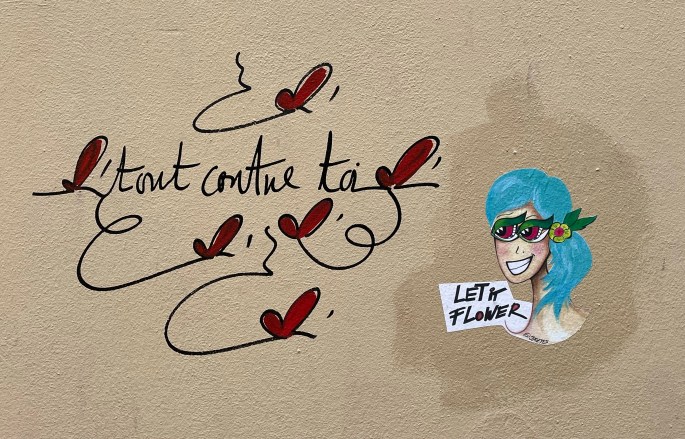
Artwork abounds along most of our walks, usually unnoticed by most. Captured a few things that caught my eye.

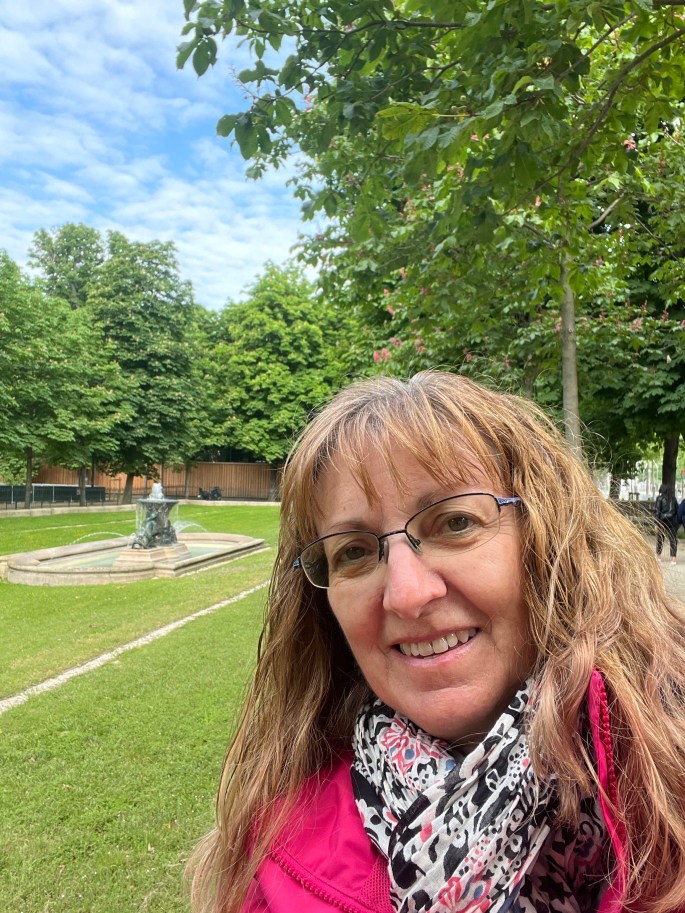
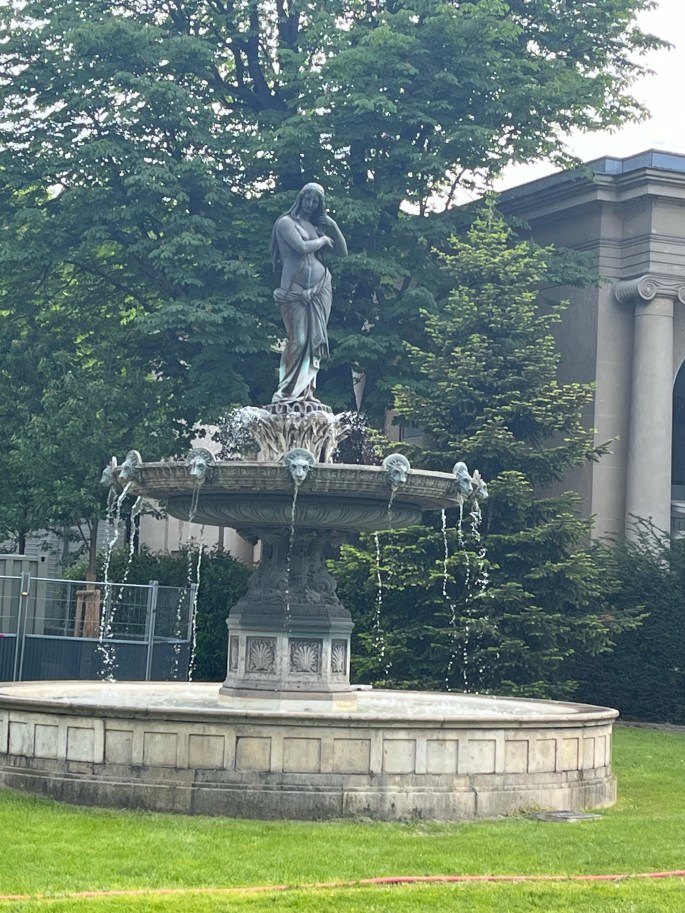
Always loved fountains and found this park during one of our walks.

I got the group to walk through the nearby park and guess what? Found another fountain 🙂

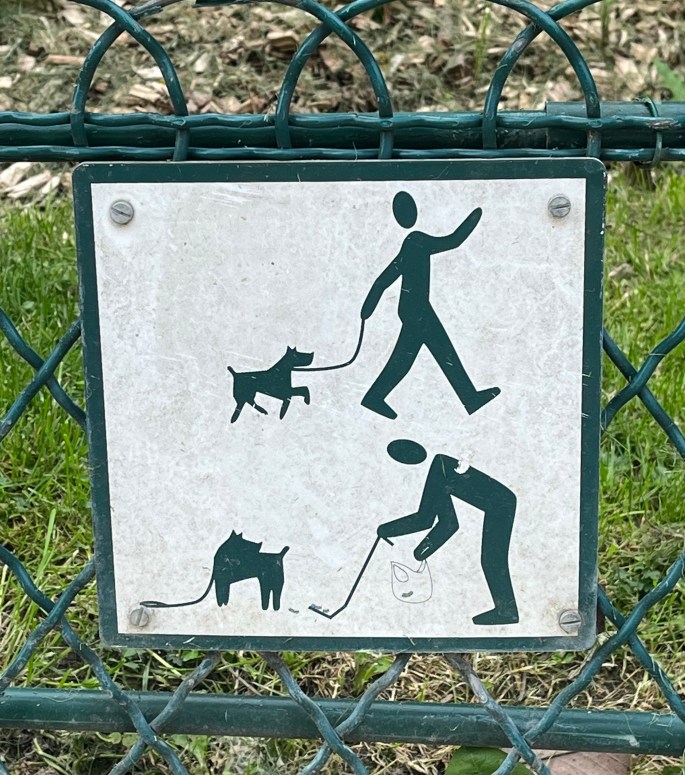
Cute sign………………..unfortunately always needed as a reminder.

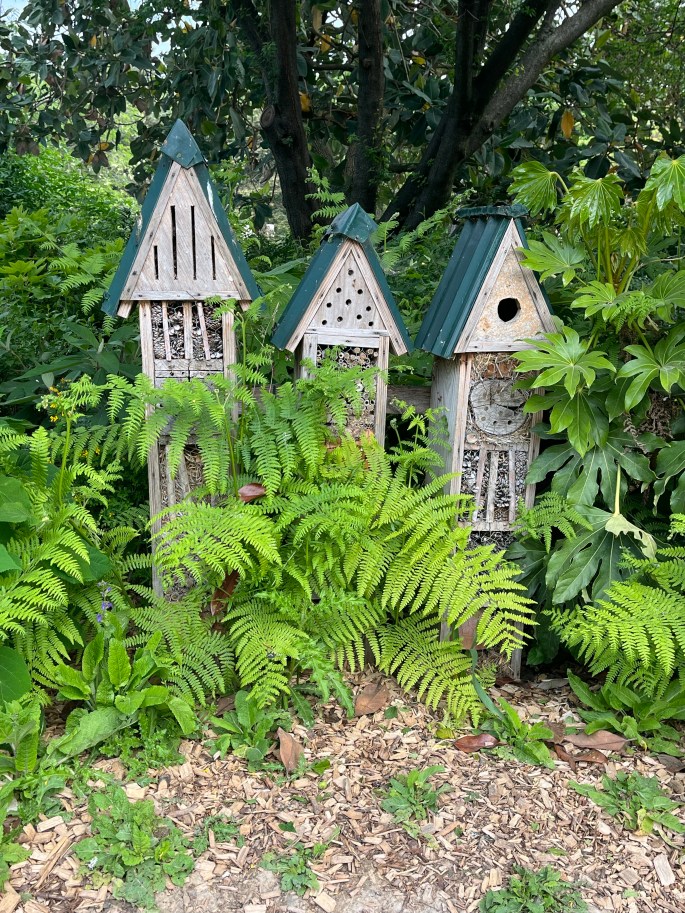
While my ‘insect house’ is much, much smaller………….one day I’m going to have something similar to this. Eric?

More to come. Up next, our visits to the traditional Paris ‘tourist’ sites.

Ginny

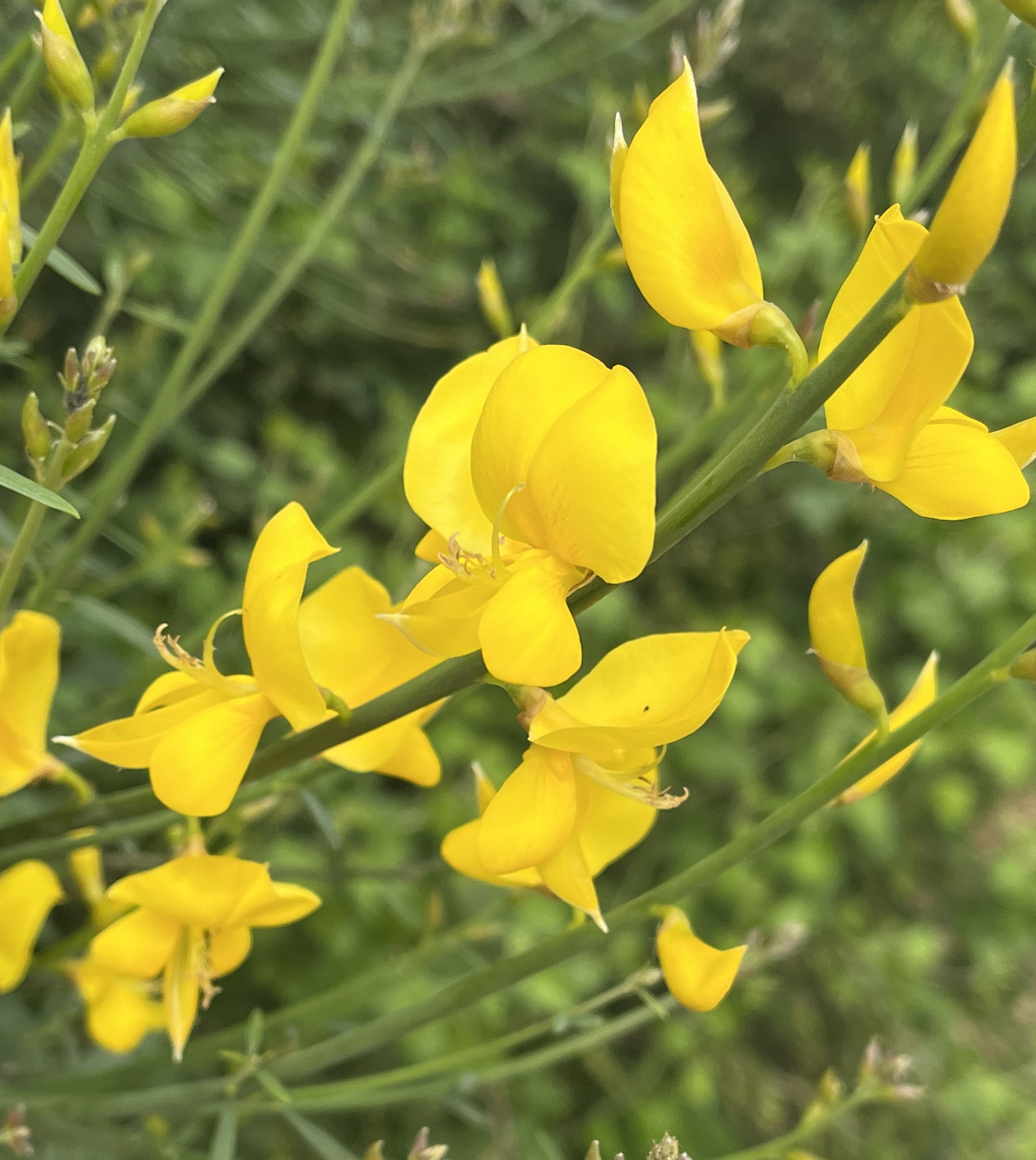
P.S. – got to throw in a few flowers I found in this park.

WWI Our final stops before Paris

Our godson Connor was interested in WWI so we easily included a number of stops as we explored the northern coast of France. I was not as familiar with some of the details I’ve described in my previous posts (along with this post) concerning WWI but I’m glad we made all of these stops. I’m by no means an expert, but the sacrifices made for WWI were great and we were able to honor those during our visit.

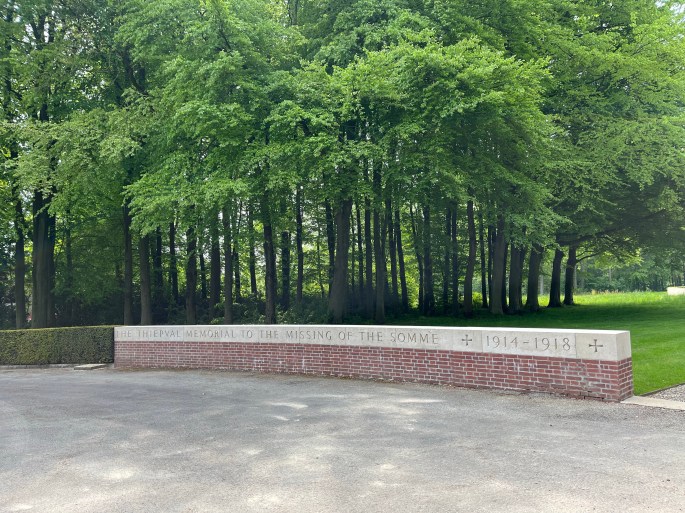
Thiepval Memorial

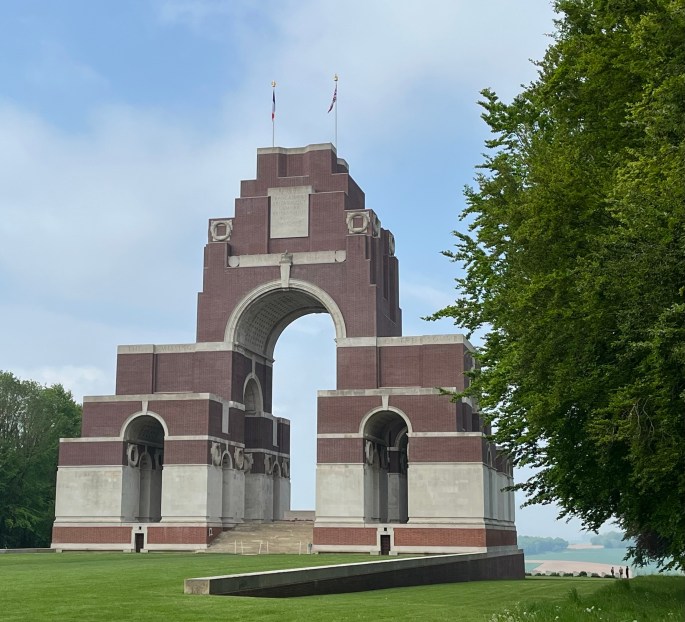
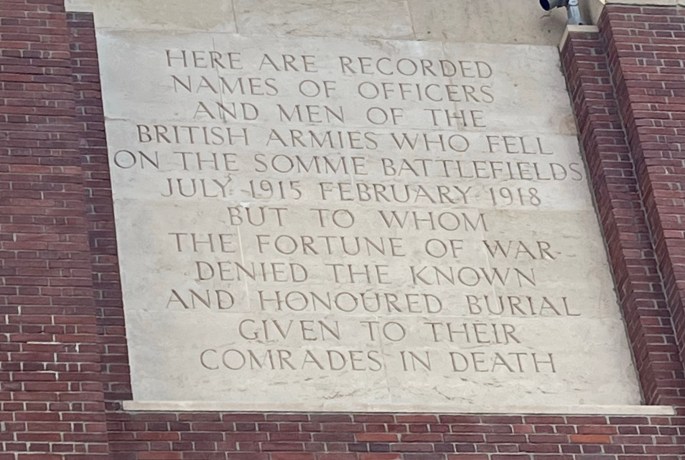
This is a war memorial to the 72,337 missing British and South African servicemen who died in the Battle of the Somme in the first WW between 1915 – 1918 with no known grave. It has been described as “the greatest executed British work of monumental architecture of the 20th century”.

It dominates the rural scene and has 16 laurel wreaths inscribed with the names of the sub-battles that made up the Battle of the Somme and subsequent actions.

It is the largest of the Commonwealth Memorial to the Missing in the world. As seen in several of my photos, it is in a rural area, overlooking a valley. Parking is below and there is a wooded, peaceful walk to the memorial, not truly seen in it’s splendor until the trees part. This memorial is huge and awe inspiring.

Just reading about the architecture and the symbolism was amazing to me. Way more information that I could include. Check it out!

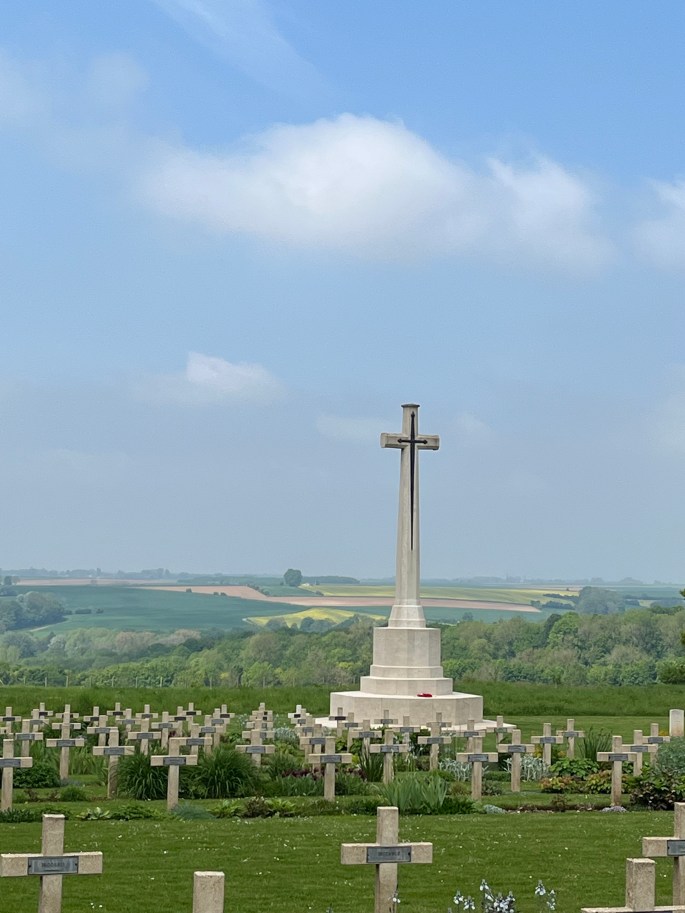
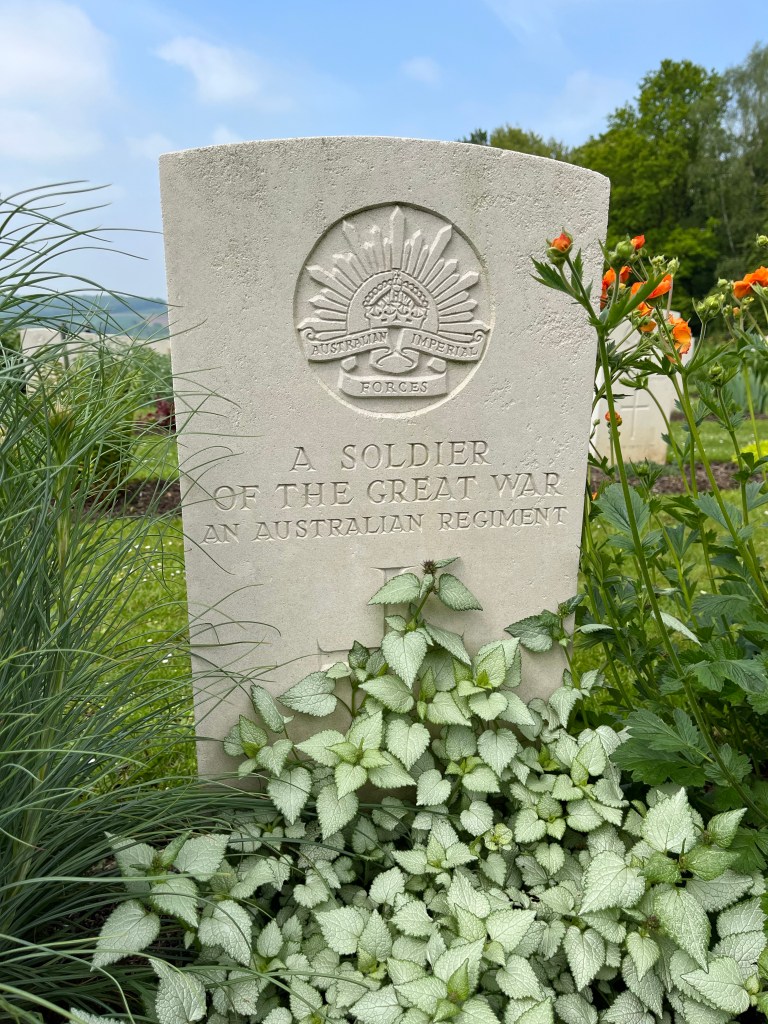
An Anglo-French cemetery containing 300 British Commonwealth and 300 French graves lies at the foot of the memorial – most are unknown.

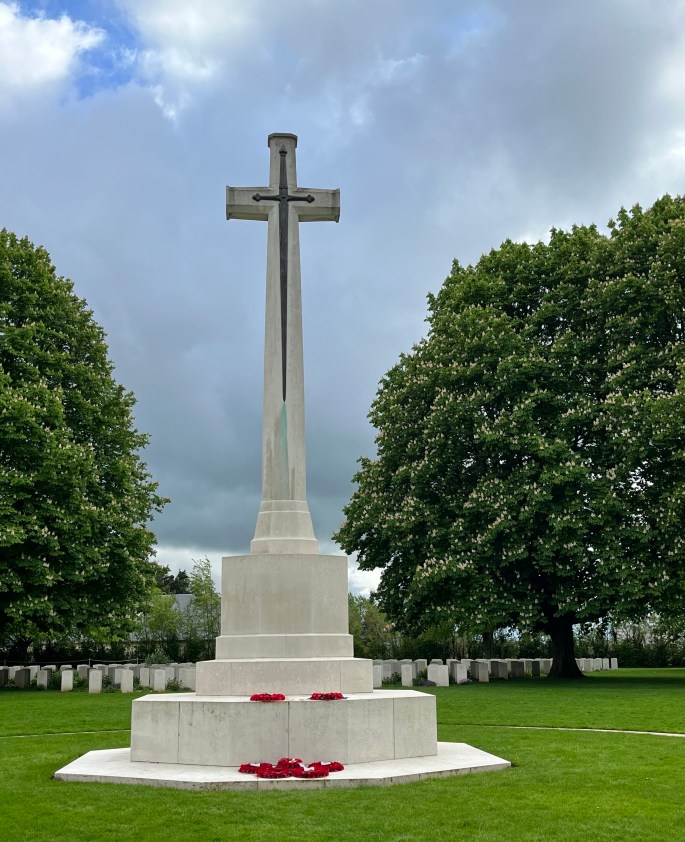
The Cross of Sacrifice bears an inscription.

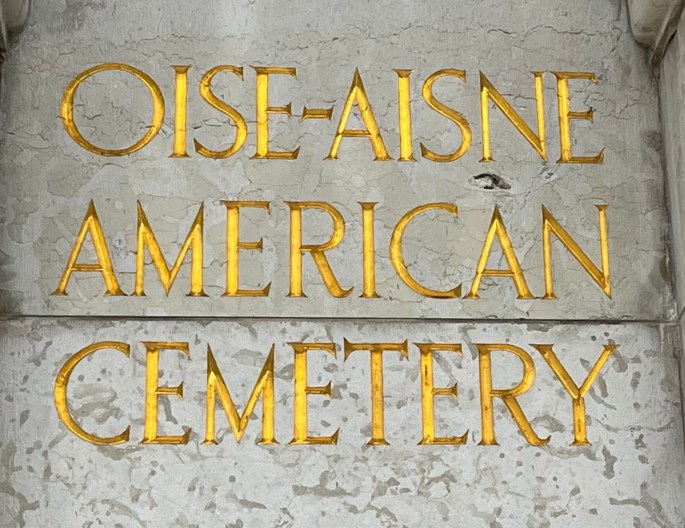
Oise-Aisne American Cemetery

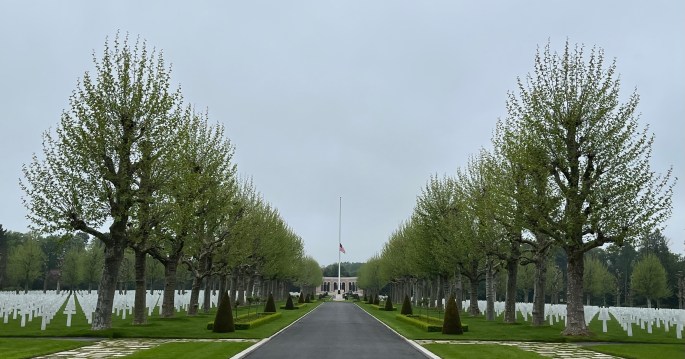
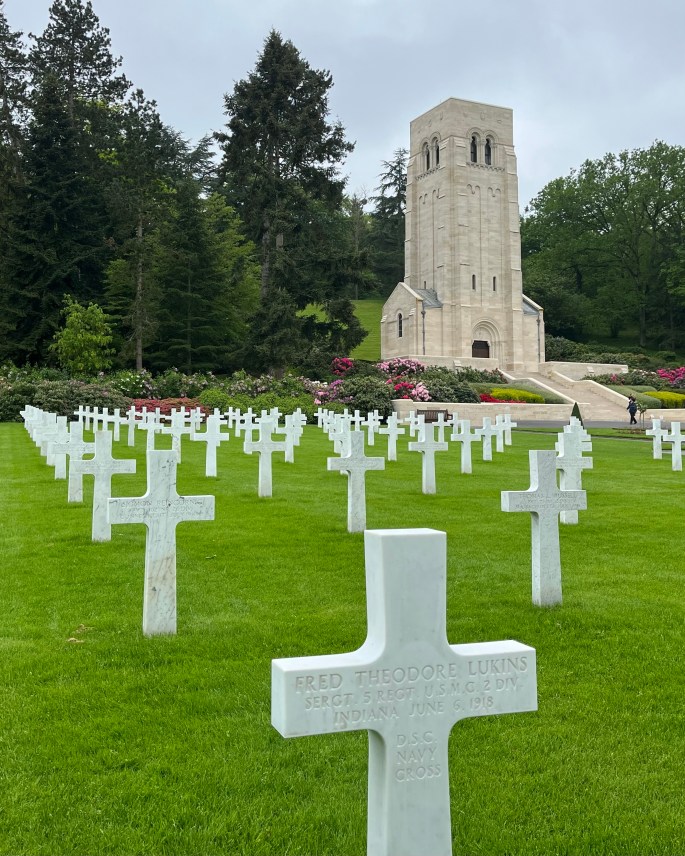
This is the second of eight WWI military cemeteries on foreign soil and actually was the second visit for Eric and me. We happened upon it a number of years ago as we were driving through the countryside heading towards Paris.

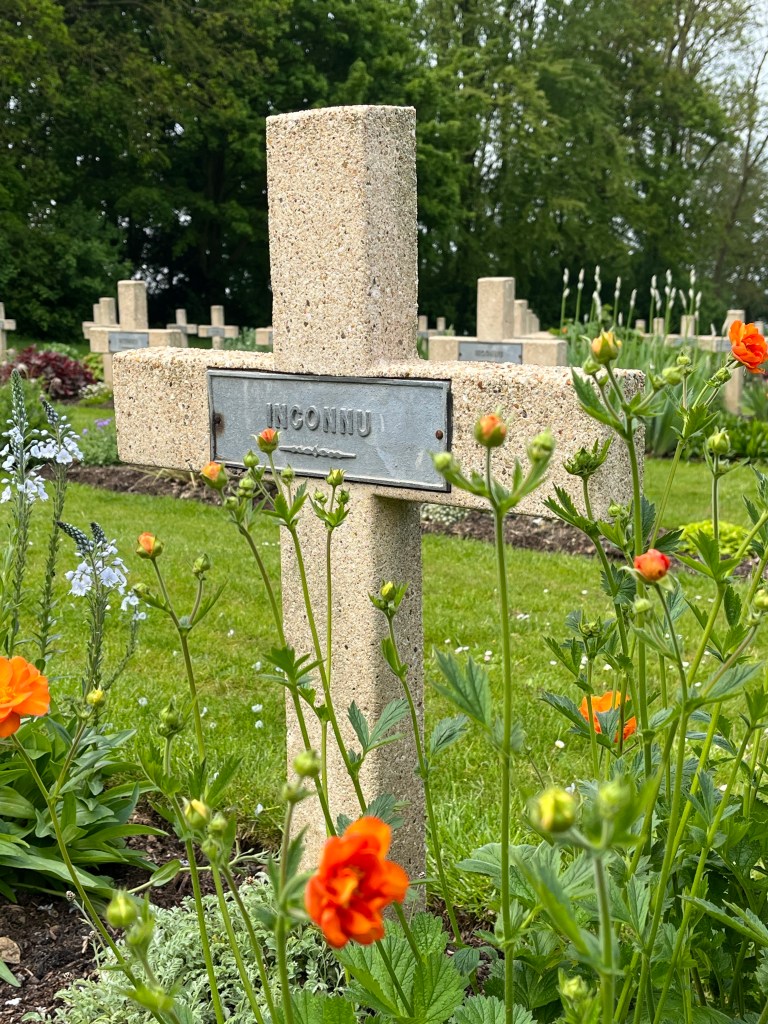
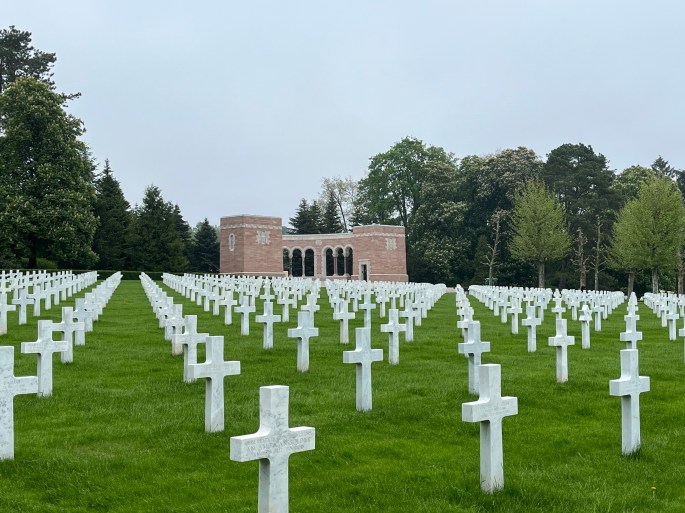
It contains the graves of 6012 American soldiers who died while fighting in this vicinity, of which approx. 10% were not identified. Interestingly enough, we talked with the serviceman in charge and remains in the area were found recently and identified. Arrangements are being organized for a full military burial later this year into this cemetery.

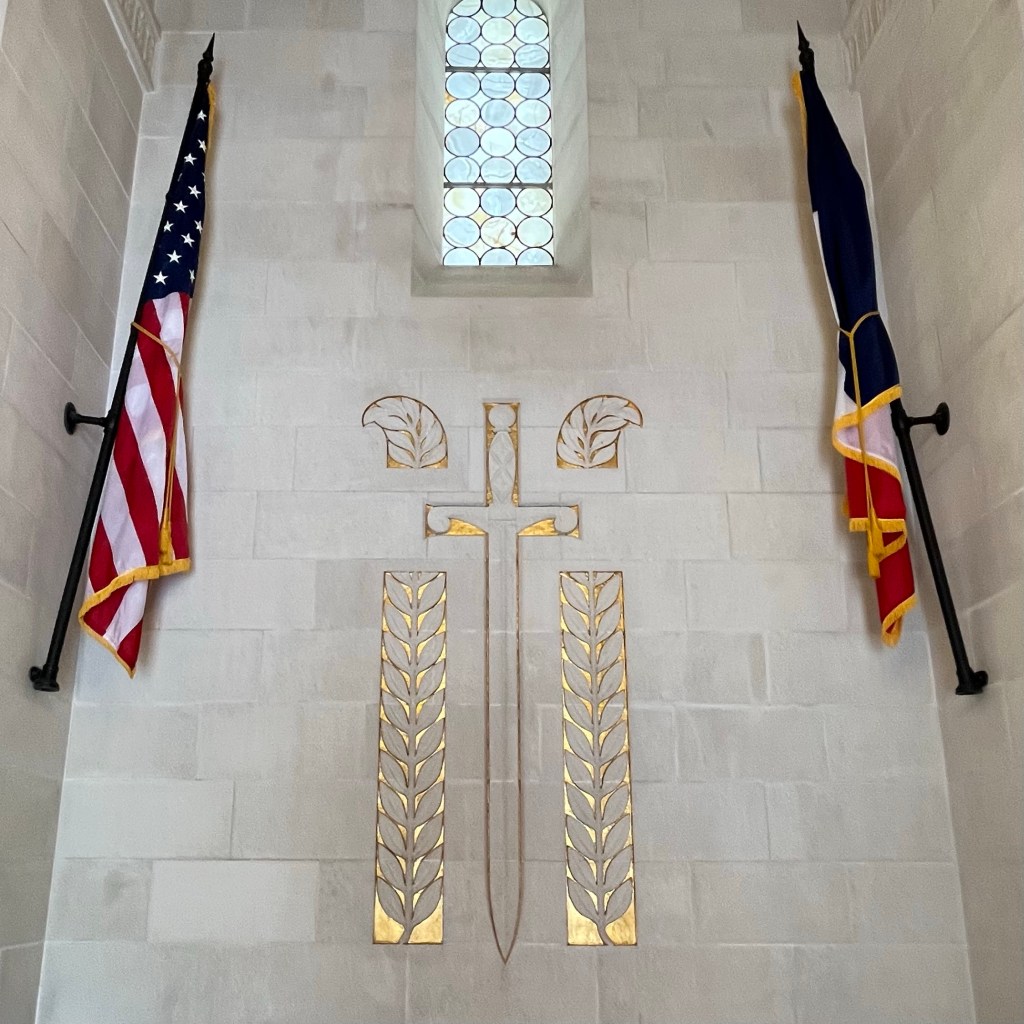
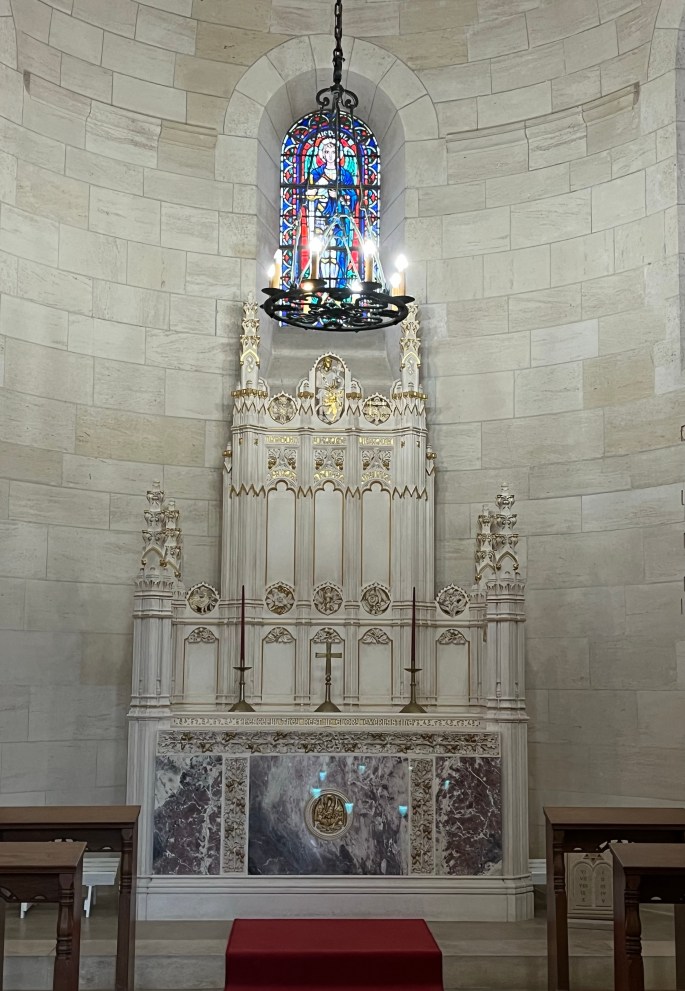
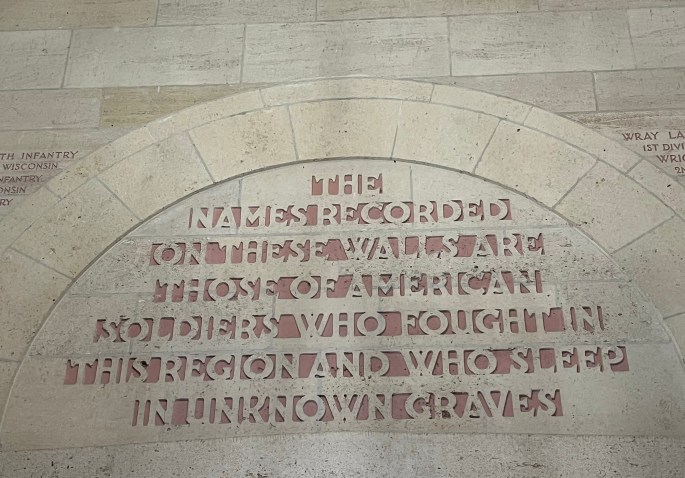
At either end of the brick memorial are small rooms containing a chapel and museum. All 48 states (at the time) and the District of Columbia are represented here on the crosses. Here are a few shots from inside the chapel room.

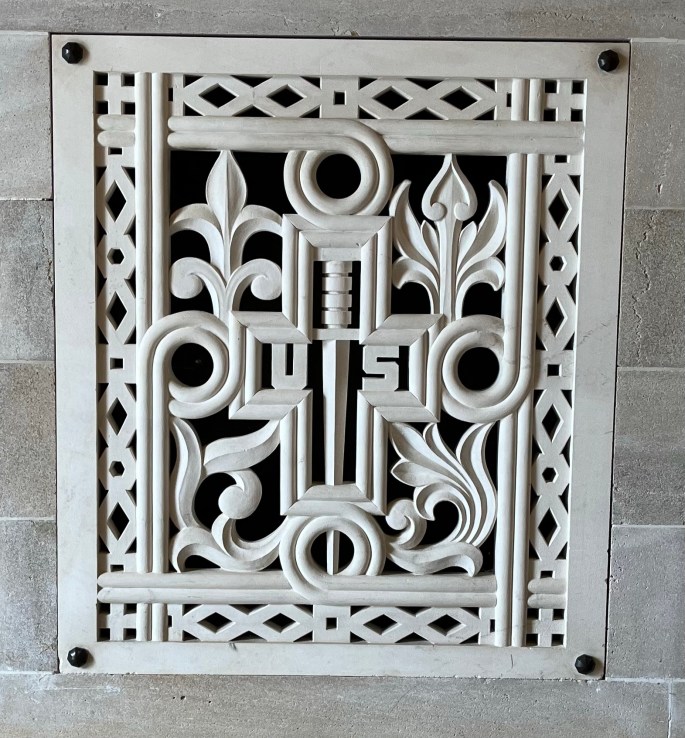
Again, a lot of symbolism. The 10 double columns along the back of the center brick monument are inscribed with the Division numbers who fought in this sector. The sides are engraved with images of contemporary images such as gas masks and artillery shells. Inscribed on the center block of the monument:

Searching for info to include in the post, I came across something that is not generally talked: Plot E. This is a graveyard for dishonorably discharged and executed sesrvicean for crimes committed during WWII. One American soldier was executed for desertion during WWII and was buried there until 1987. Plot E is separate from the main cemetery, secluded by hedges and only accessible through a door from the superintendent’s office.

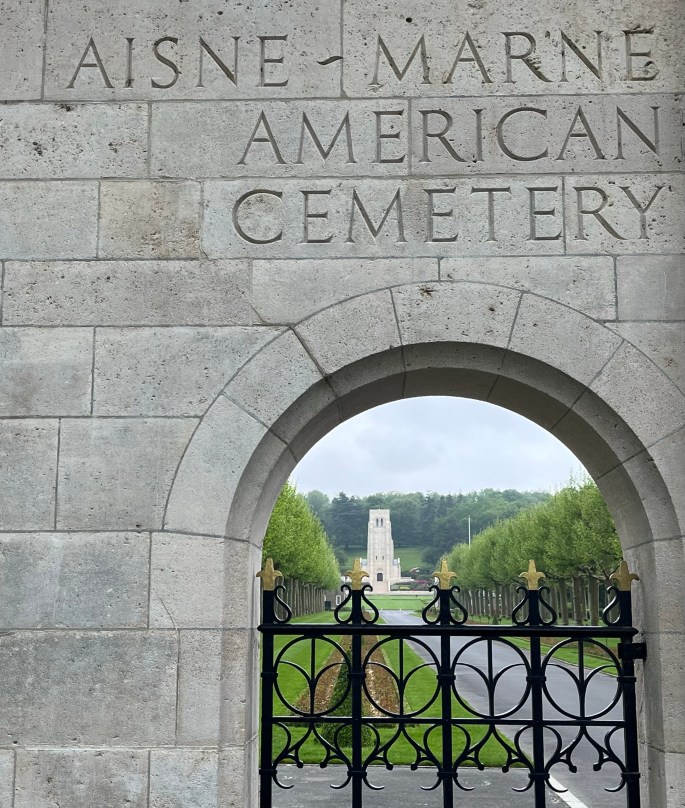
Aisne-Marne American Cemetery

The US entered WWI in April 1017. The Allies and Germans doubted the fighting capability of this young nation. The Germans sought to win the war in the Spring of 1918, before US units became operational. Germans fought through the French line, reaching the Marne River. US forces were requested and blocked the Germans on the North bank of the Marne. In June the Marines led a charge to clear out the German units, with the battle lasting 20 days. Another attempt by the Germans Mid-July was blocked by the Marines. These actions solidified the fighting capability of the US.

Within this cemetery, there are 2289 graves plus 1060 commemorated.

The cemetery itself is laid out in the form of a capital T, with the memorial chapel crowning the T shape. The memorial chapel is built over the site of the front-line battle trenches.

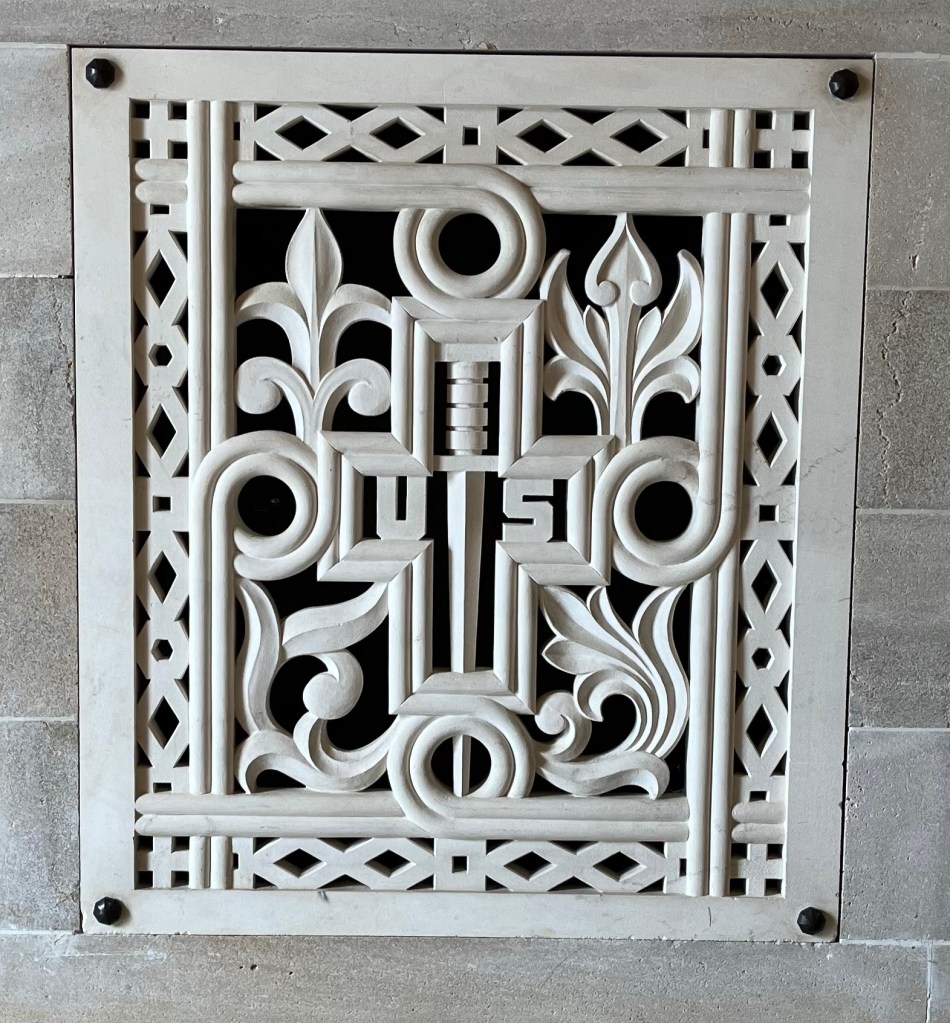
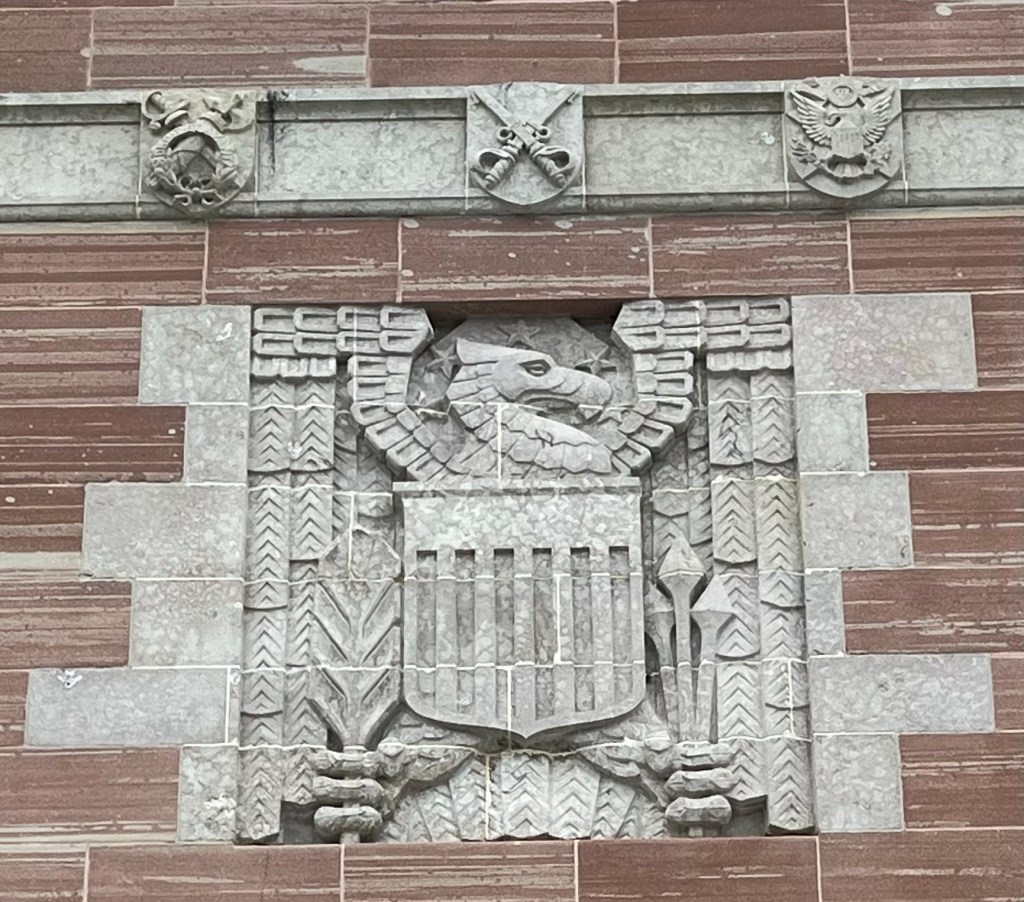
There are so many details in all of these chapels. There’s no way to see everything on one visit.

Chateau-Thierry American Monument

This monument is situated on a hillside and commands a wide view of the valley of the River Marne. It commemorates the achievements of the United States Forces that fought in the region during WWI.

This is the only place I can say it was more of a ‘drive-by’. Only two of us got out of the car and this is my only photo. The two sculptured figures seen above represent the United States and France. The inscription reads:

This monument has been erected by the United States of America to commemorate the services of her troops and those of France who fought in the region during the World War. It stands as a lasting symbol of the friendship and cooperations between the French and American Armies.

It wasn’t until I started listing all of the places we visited I truly realized we accomplished a lot in our short time. Without Connor, I’m not sure we would have seen these places – and I thank him for that.

Ginny

WWI Vimy Ridge & Memorial

The Vimy ridge provided a natural unobstructed view for tens of kilometers in all directions.

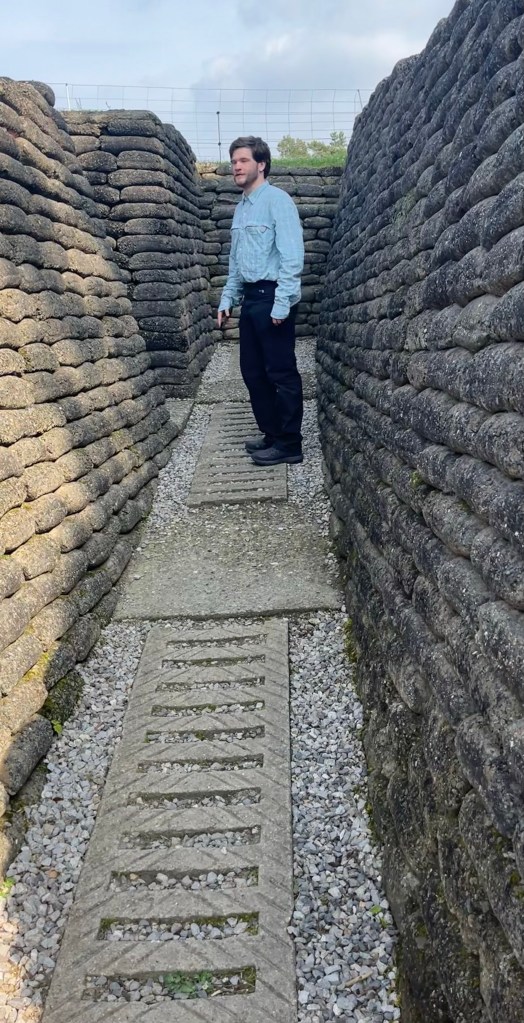
It changed hands several times in 1914 before the Germans had a solid stronghold on the ridge. The Germans had taken advantage of the relative calm to build an extensive network of tunnels and deep mines. Some of these had been preserved to allow today’s visitors to understand trench warfare.

Living in the trenches was no piece of cake.

Prior to the Battle of Vimy Ridge, British tunneling companies secretly laid 13 mines under German positions to destroy fortifications before the assault.

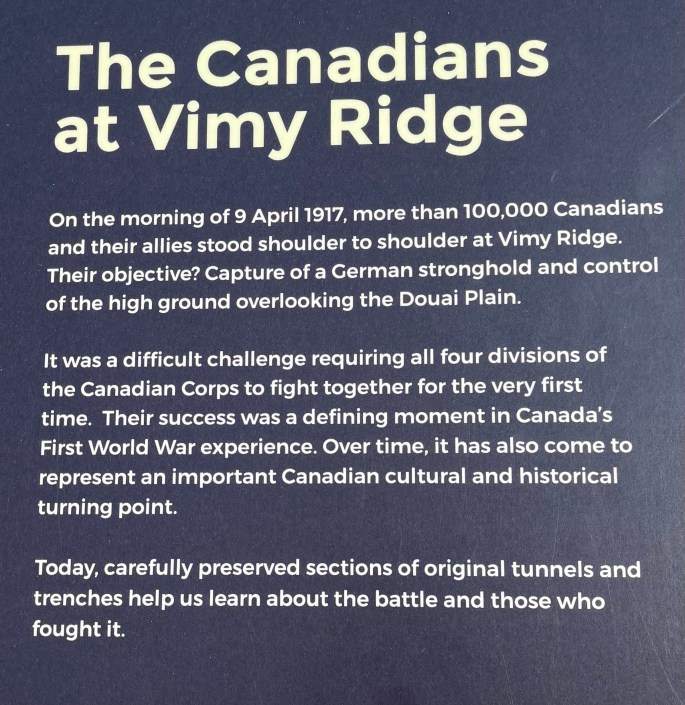
The main combatants were four divisions of Canadian Corps against three divisions of the German army. The battle took place in April 1917. The Canadian Corps captured most of the ridge the first day. The final objective was achieved on April 12, falling to the Canadians. Historians attribute the success of the Canadian Corps to technical and tactical innovation, meticulous planning, powerful artillery support and extensive training.

It is a symbol of Canadian national achievement and sacrifice.

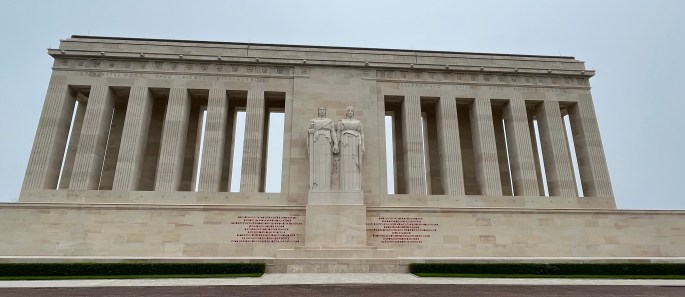
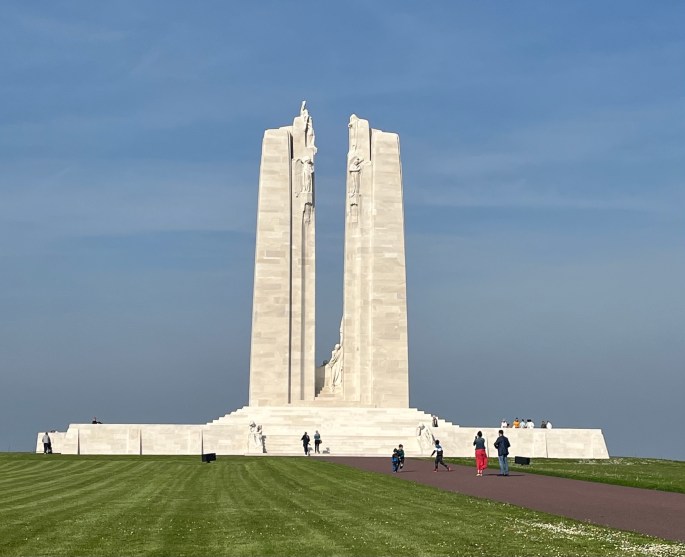
Nearby is the Canadian National Vimy Memorial. It is startling white and impactful. The Vimy Memorial is one of only two National historic sites of Canada located outside of the country. The other was my prior post.

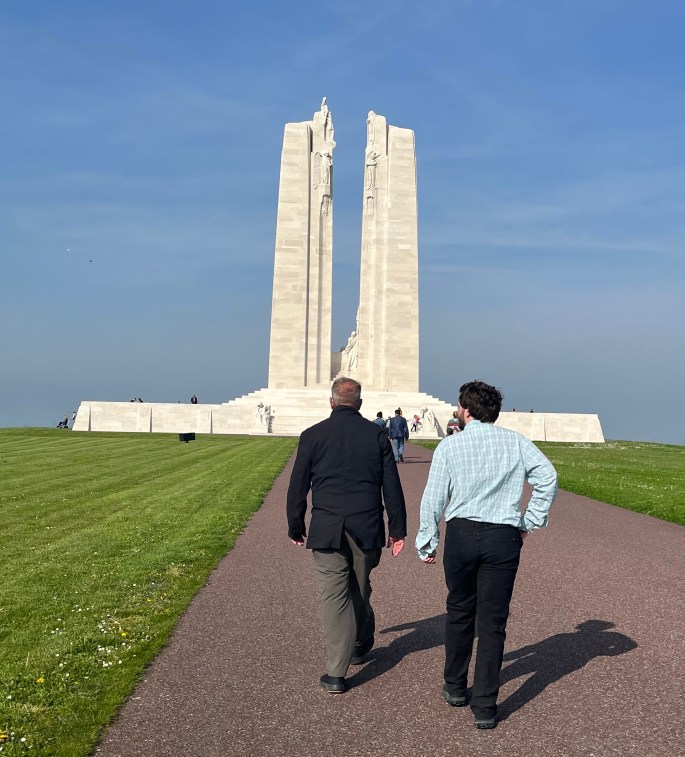
The memorial is the centerpiece of 250 acres of preserved battlefields. Wartime tunnels, trenches, craters and unexploded munitions still honeycomb the grounds of the site. Canadian identify and nationhood were born out of the battle. Below, Eric and Connor were approaching the memorial. Notice one sculpture at the very top.

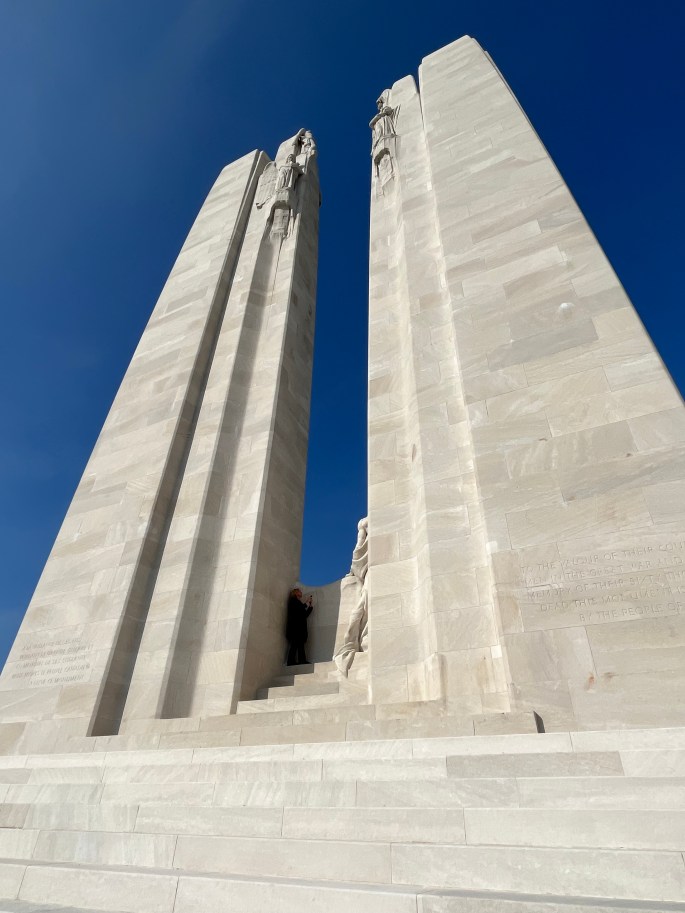
The stone came from an ancient Roman quarry in Croatia. The twin pylons are engraved with two emblems: one bears a maple leaf for Canada and the other a fleur-de-lis for France, symbolizing their unity and sacrifice of the two countries. BTW – that is Adrienne in my photo below.

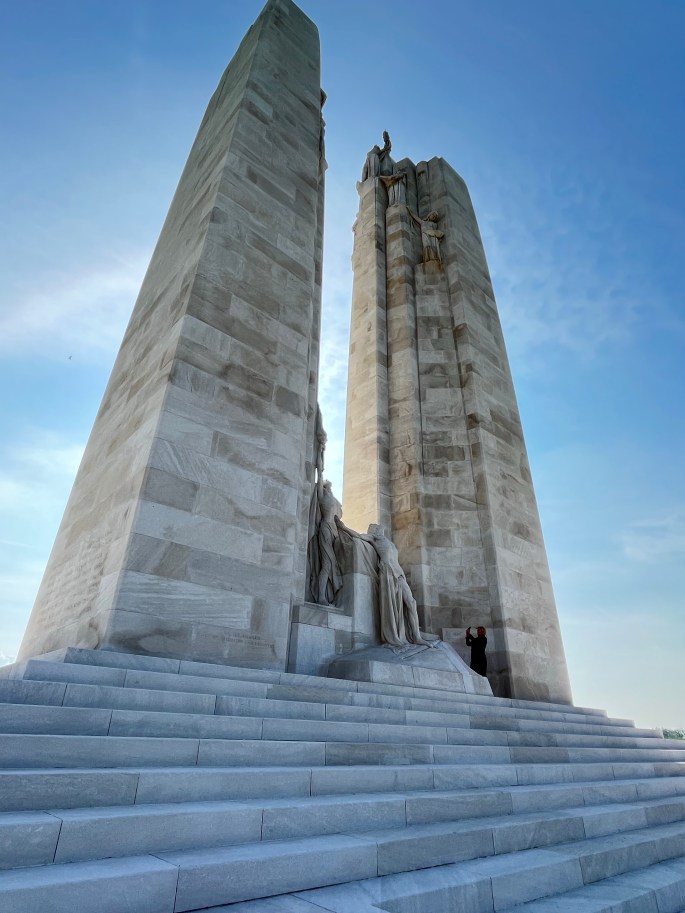
Sculptors carved ~20 double life-sized human figures on site from large blocks of stone.

The top most statue is called Peace, with figures below representing Justice, Truth, Knowledge, Gallantry and Sympathy.

This particular statue was striking and is the largest figure. It is called Canada Bereft. Head bowed in sorrow, she provides a powerful representation of Canada, a young nature grieving her dead. She gazes down at a symbolic tomb draped in laurel branches (sorry – no photo).

Carved on the wall are the names of 11285 Canadian soldiers who died in France and whose final resting place is unknown. At the base of the monument these words appear in French and English:

This monument is a tribute to all Canadians who served during the First World War. It was built to inspire all to work towards lasting peace, for which those commemorated here gave their lives.

Ginny

WWI Deville Wood Memorial & Cemetery

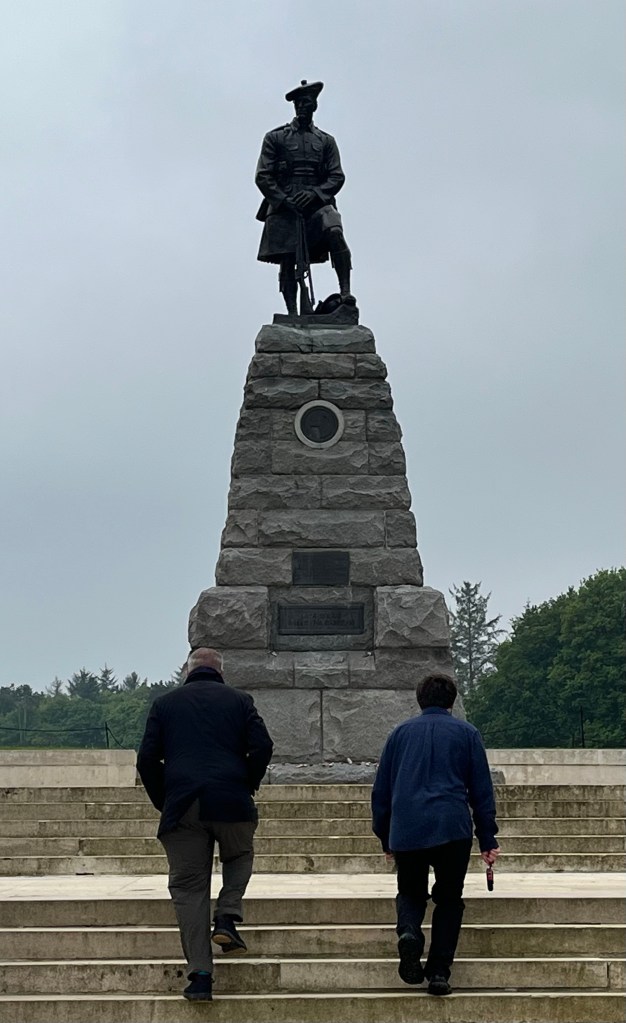
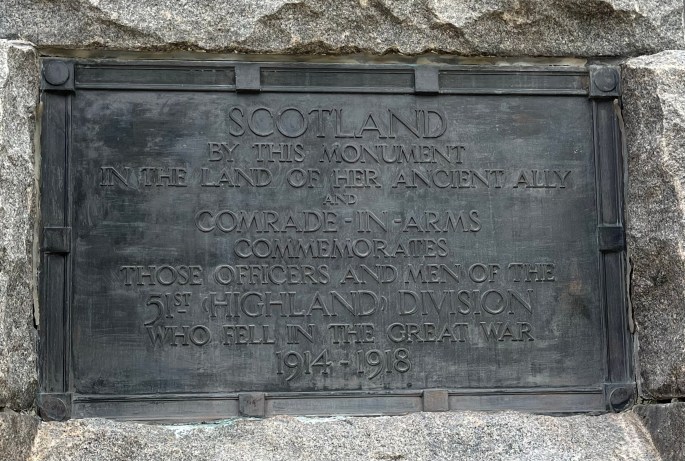
Deville Wood was a tract of woodland on the western edge of Longueval. It was taken by a Scottish Division and South African Brigade in 1916 and cleared of Germans. The wood was held until April 1918 when it was lost to the Germans but retaken within 4 months.

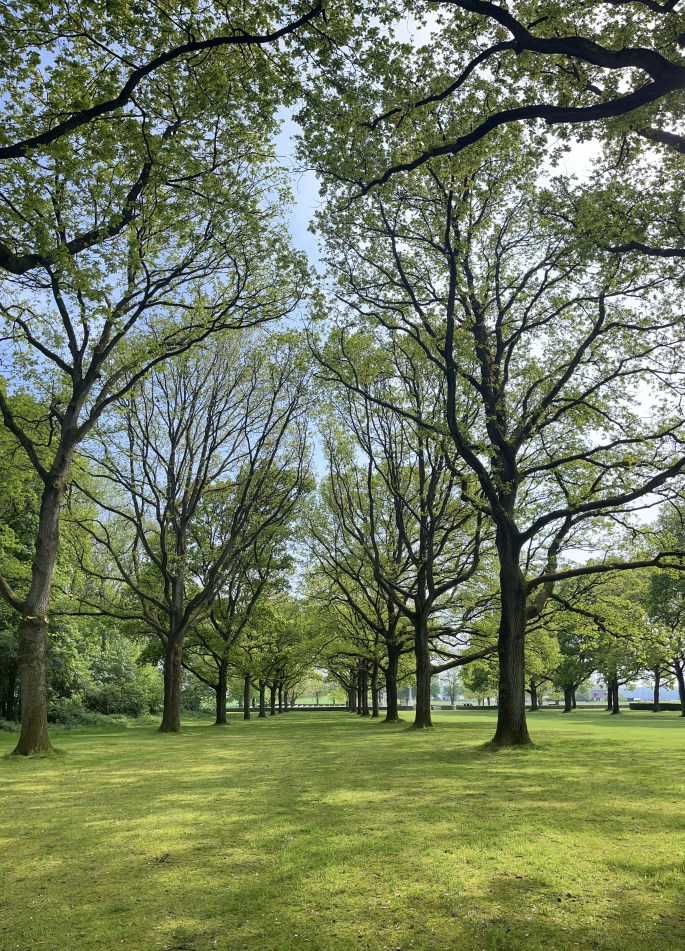
Before reaching the memorial there is an alleyway of trees that leads you to the reverent and peaceful spot.

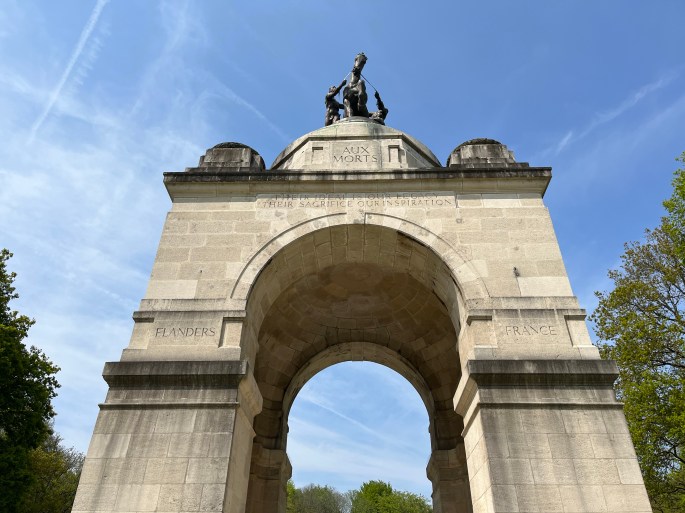
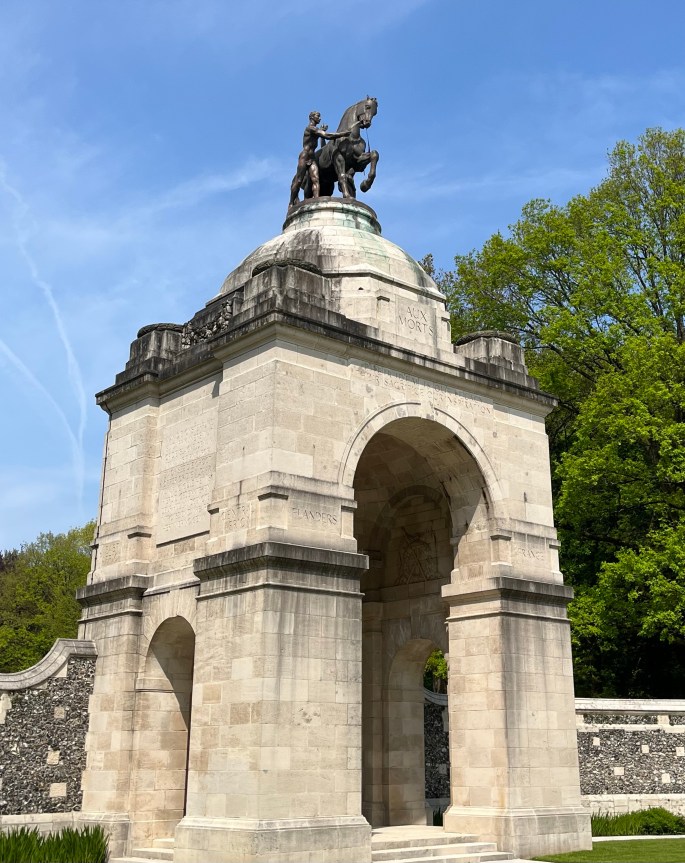
This memorial serves as the National monument to all of the South African Overseas Expeditionary Forces that died in WWI and was unveiled in 1926.

In one of the numerous archways I found these words………

Their ideal is our legacy.

Their Sacrifice our inspiration.

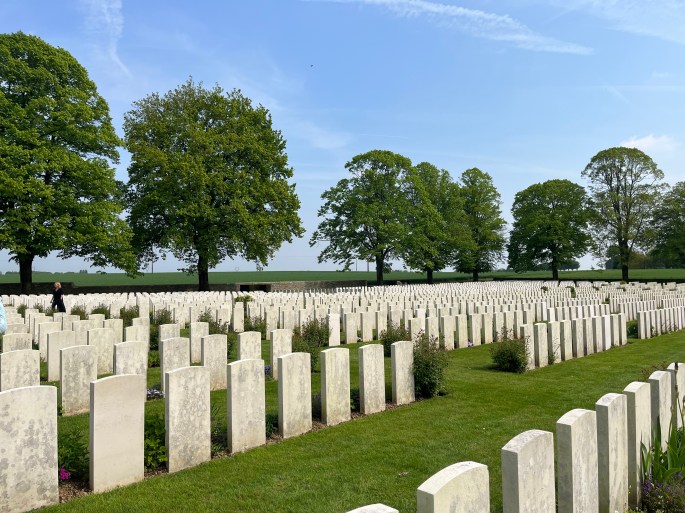
A total of 220,000 officers and men served in the forces of South Africa. A total of 5523 burials are here with 3593 considered unknown.

The high percentage of unknown probably reflects the lengthy period which elapsed before the bodies were removed from the battlefield.

Almost all causalities within this cemetery were from July – September in 1916.

In 1952 a Stone of Remembrance was added to honor those from WWII and the Korean War.

While not planned, this post is going out on Memorial Day – a fitting tribute to those that made the ultimate sacrifice for us.

Ginny

Beaumont-Hamel Newfoundland Memorial WWI

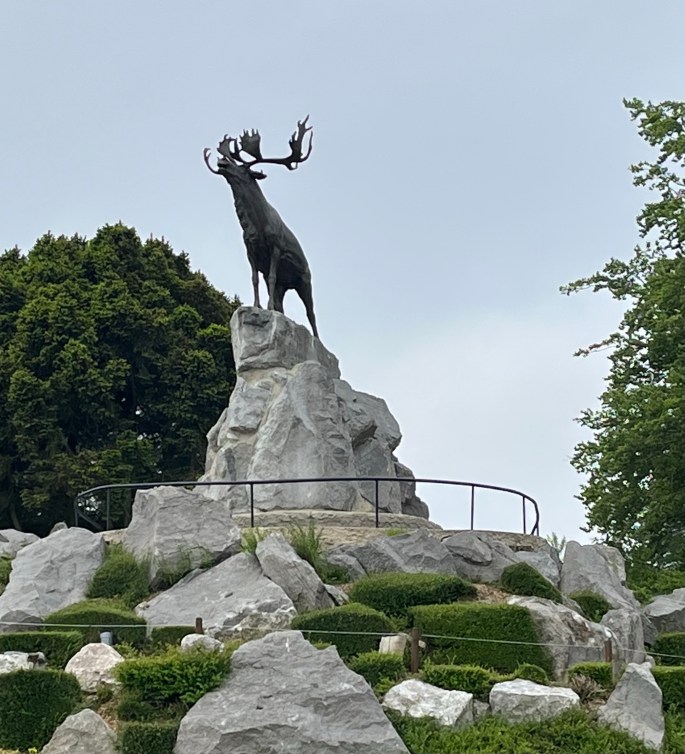
Five memorials in Europe recognize Newfoundlanders who served in WWI – this is the largest. At its heart stands a bronze caribou – the emblem of the Royal Newfoundland Regiment. It watches over where many have fallen and there is no known resting place for their soldiers.

There are 6 of these bronze statues – 1 for each European site and the last one in St. Johns Newfoundland. The rocks and shrubs that surround the mound are native to Newfoundland. Information can be found to visit all of the European sites which is called the Trail of The Caribou.

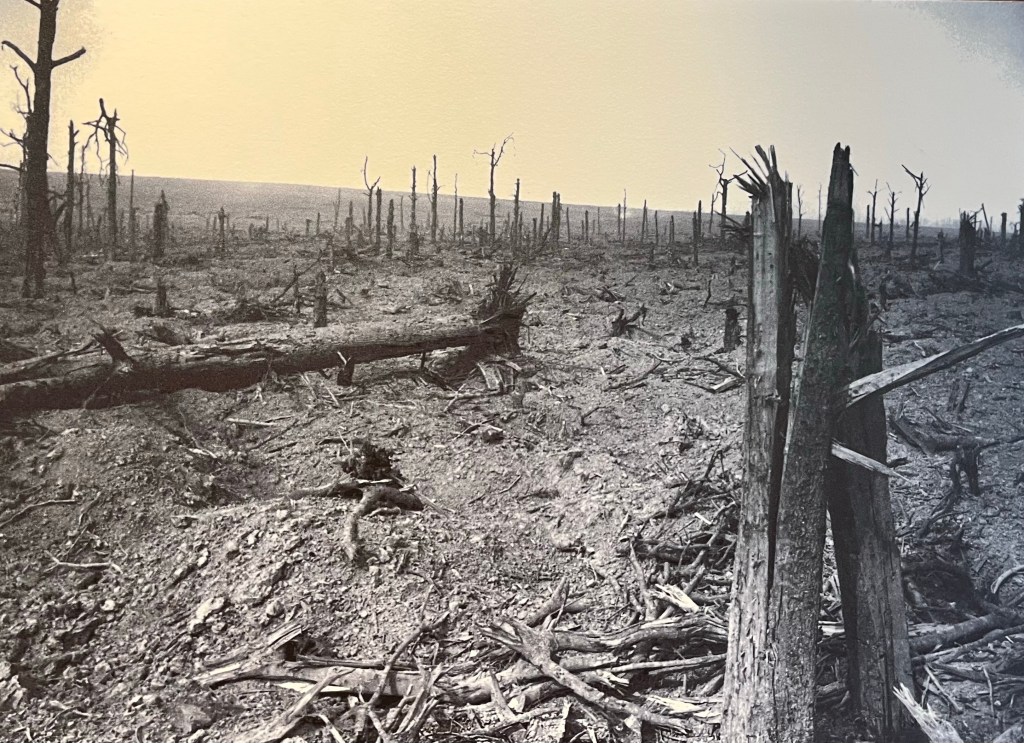
There was an informative visitor center and I’m including the two photos below. It really shows all the damage with the artillery bombardment and war. When the war was over, people were coming back to this.

After leaving the visitor center to walk around the property, this is one of the first plaques that I came across, even before the bronze caribou. The day we visited it was peaceful and the only sounds were the birds singing. The memorial is situated in the countryside. It’s not something you will just drive past unless that is your intent.

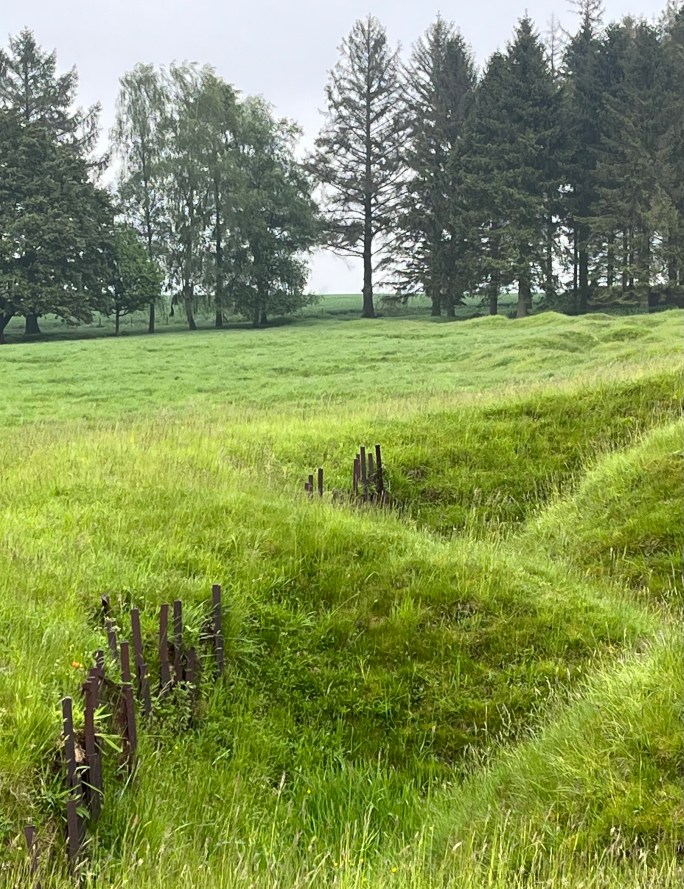
This was one of the first WWI memorials we visited and I learned more about trench warfare – it was brutal. Yes, had read about it in history books, but this brought everything to life. The land was still pock-marked with craters and trenches and 100+ years have passed.

At the time of WWI, Newfoundland was part of the British Empire and not Canadien. Yet, they still maintained their own unit. When this part of the action was activated, unfortunately it lacked the element of surprise. They suffered the highest casualty rate for a battalion that day with 700+ killed, wounded or missing – 86% casualty rate.

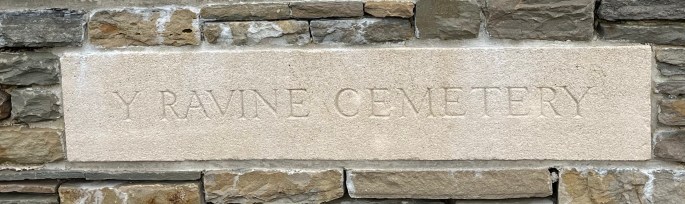
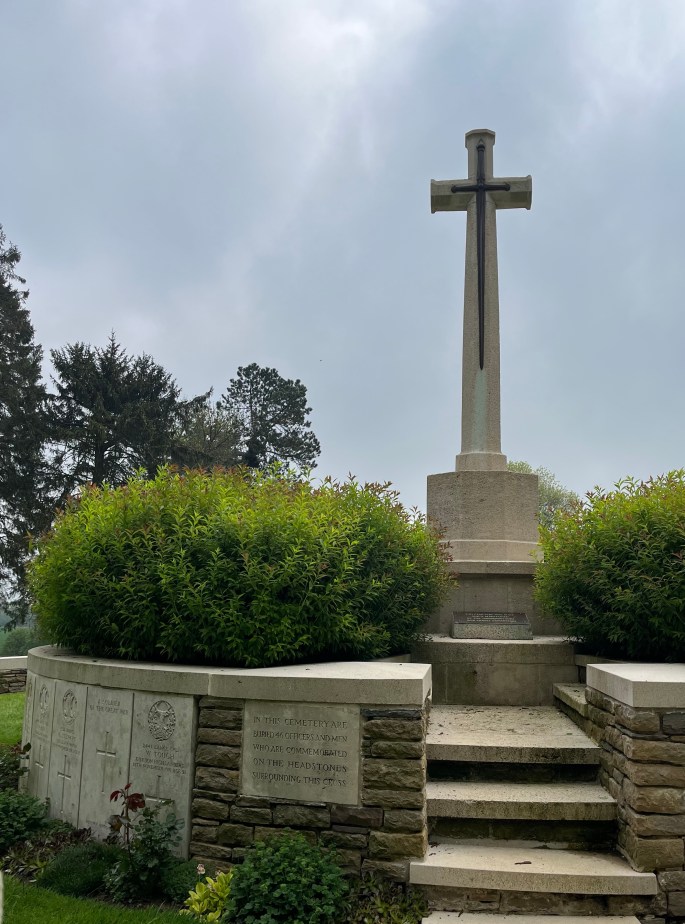
There were four separate cemeteries on site, the largest being the Y Ravine cemetery.

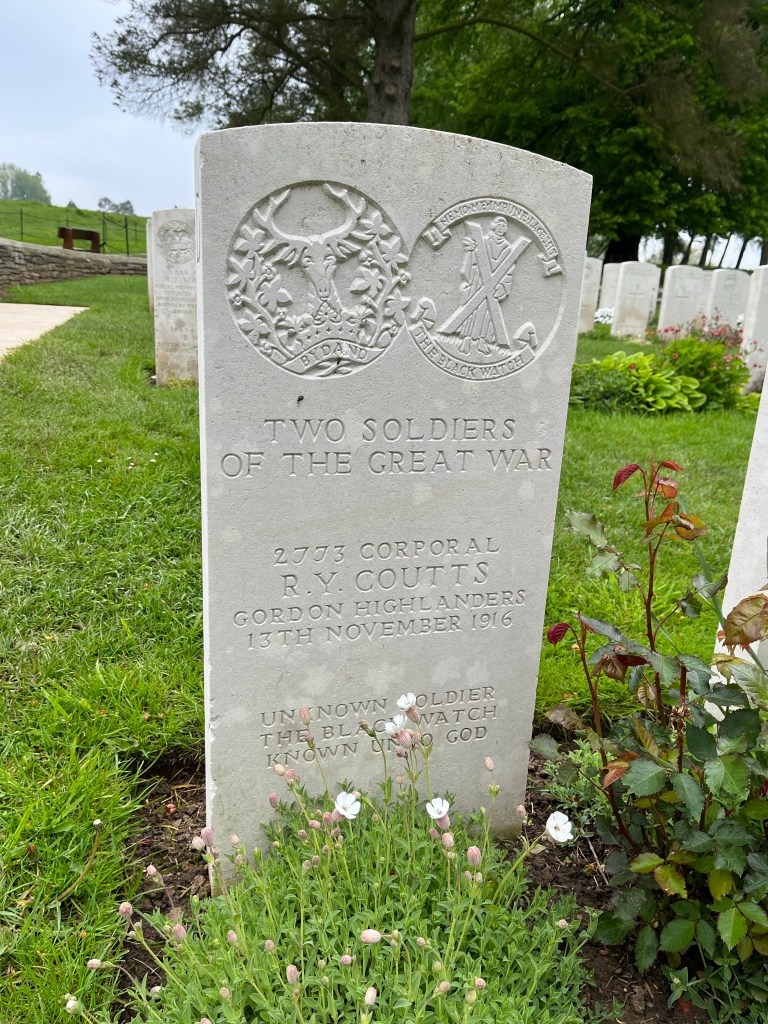
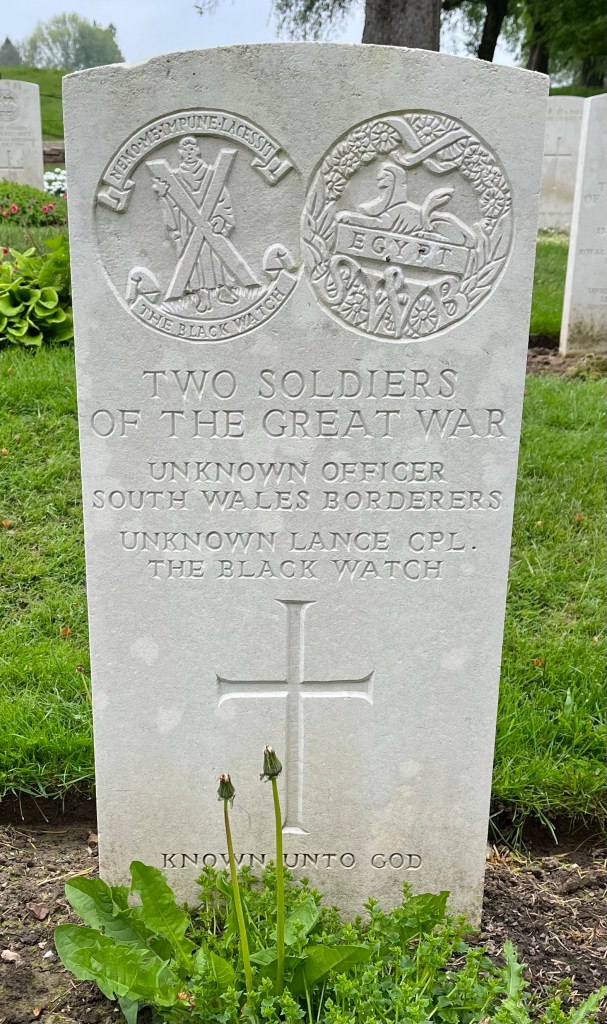
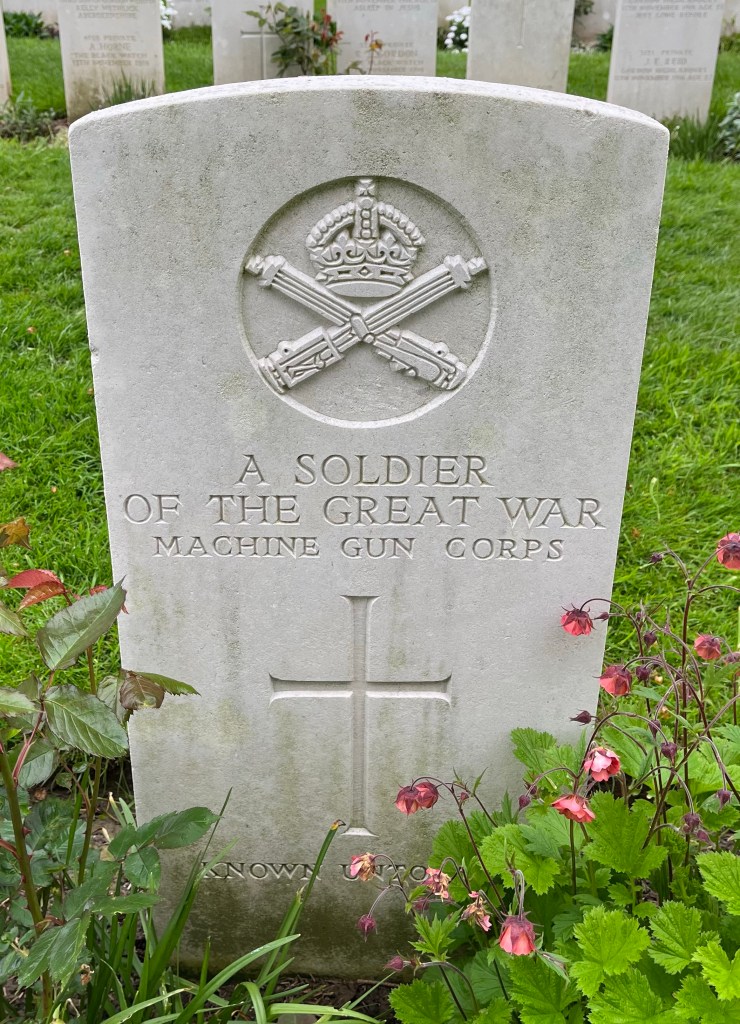
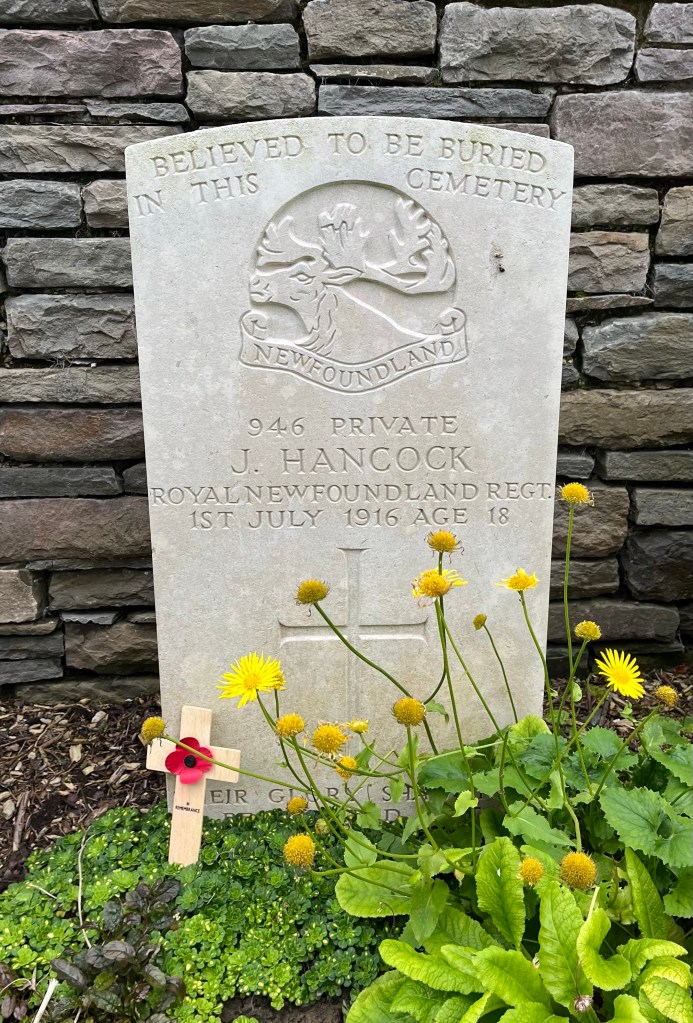
This was the first place I’ve seen this on headstones with many being double graves. Also their coat of arms were intriguing to me. Identification was helped with the gear and clothing they wore if names were unknown.

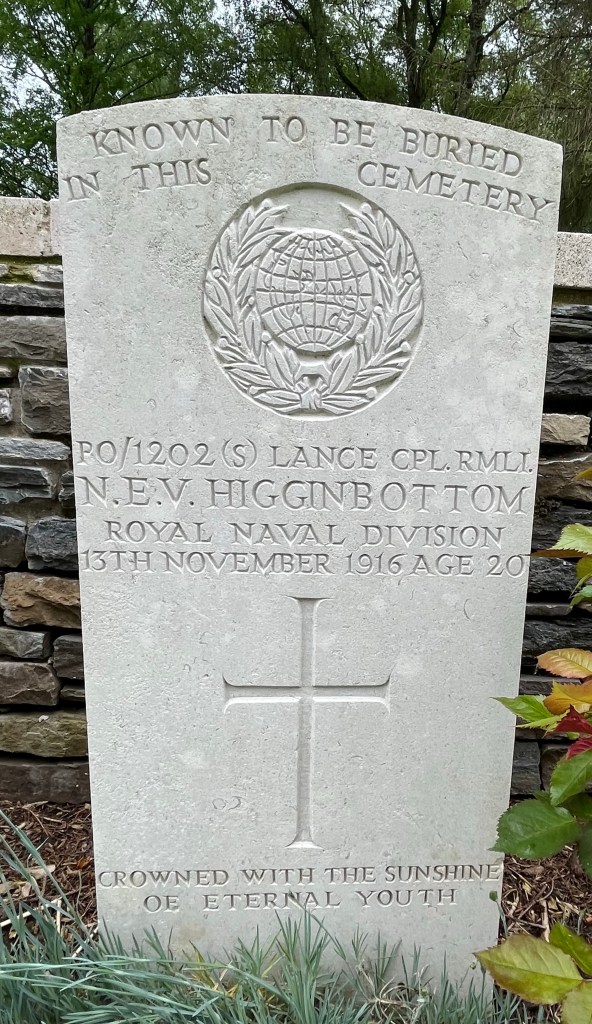
Then I ran across these stones. It really put death and burials into perspective. Notice the one in the middle – a member of the navy.

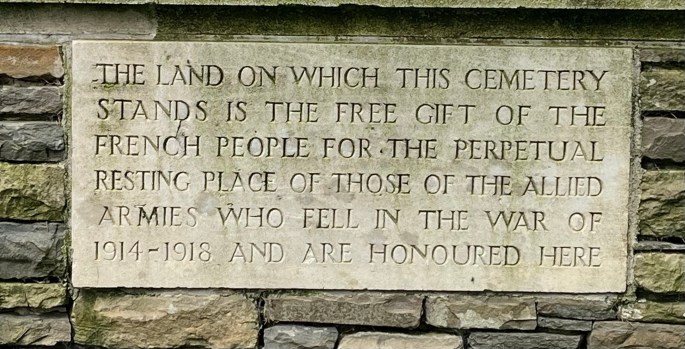
Walking towards the back of the site, we came across three other burial sites, the first being Scottish.

Two other cemeteries were nearby, each having their own cross and walled boundary.

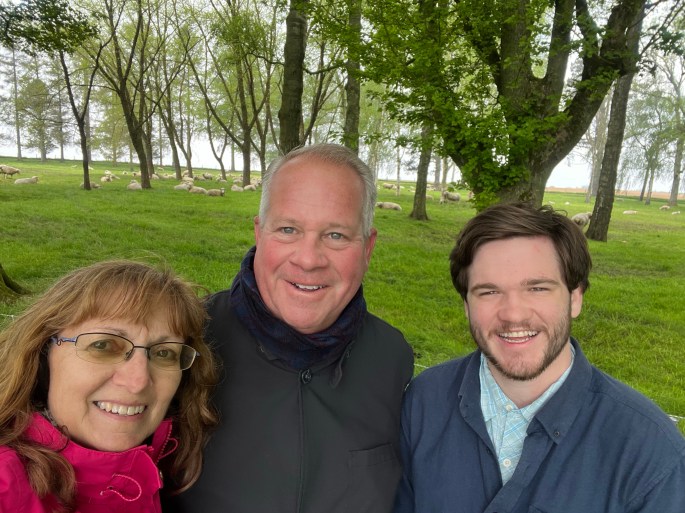
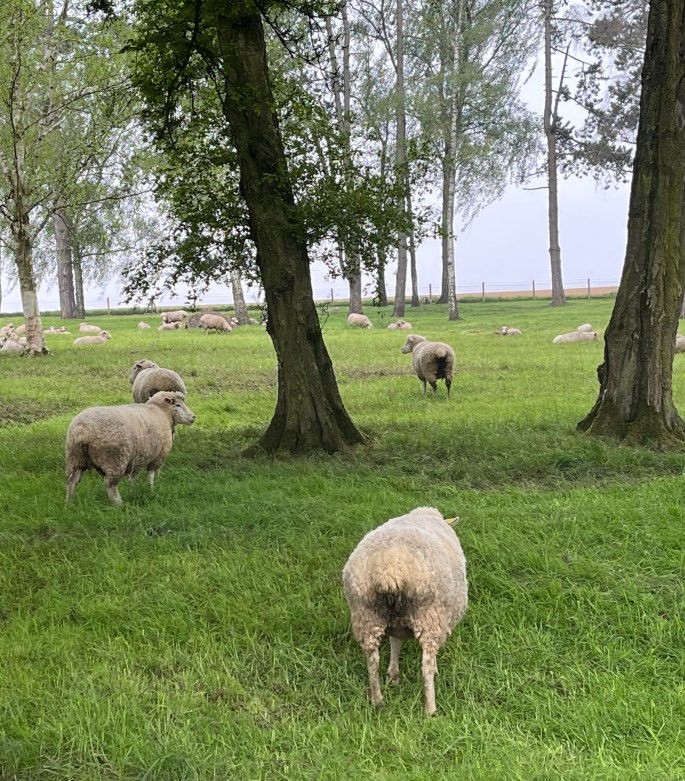
There was one other sound we heard that morning – the sound of sheep. I assumed they were helping to keep the grass under control – a natural way to preserve the serenity of the site.

In keeping with true form, when I tried to get a closer shot of the sheep, this was all I got.

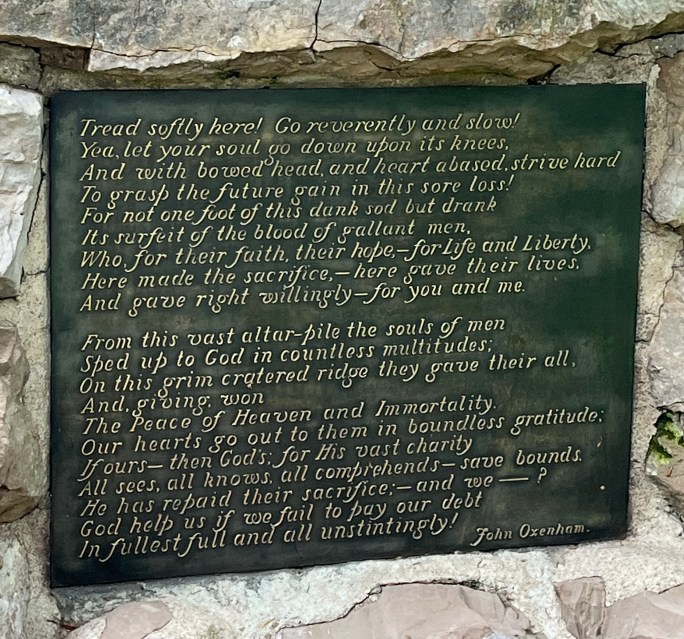
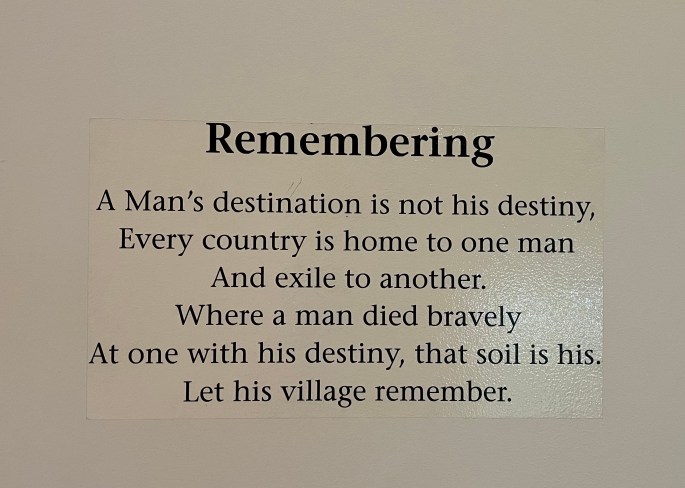
While this was a moment of levity during our visit, this quote below found in the visitor center remained with me.

If you’re interested in WWI or traveling in the northern part of France, this should be a place on your list to visit.

Ginny

France WWII Cemeteries British and Canadian

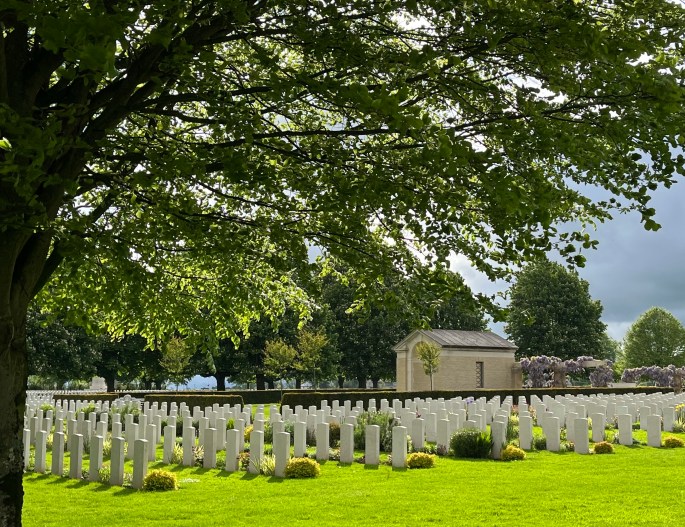
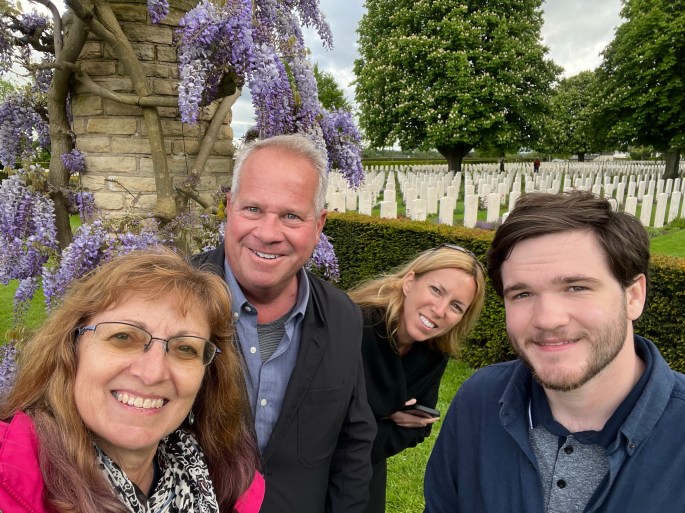
The British cemetery we visited was in Bayeux. We stopped after touring the Bayeux Tapestry.

While little actual fighting was in Bayeux, those buried here were brought in from surrounding villages and hospitals nearby.

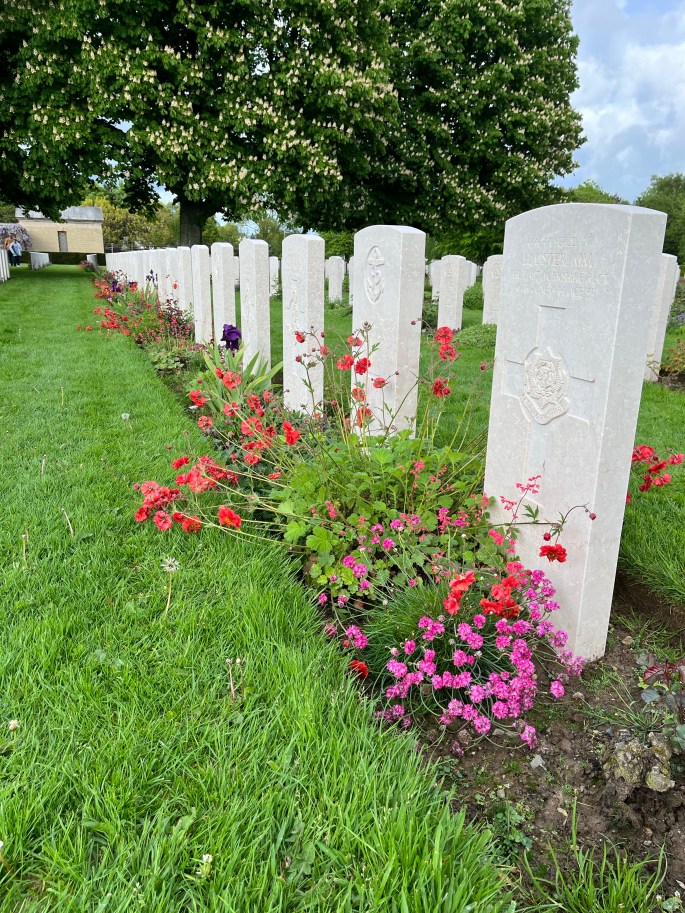
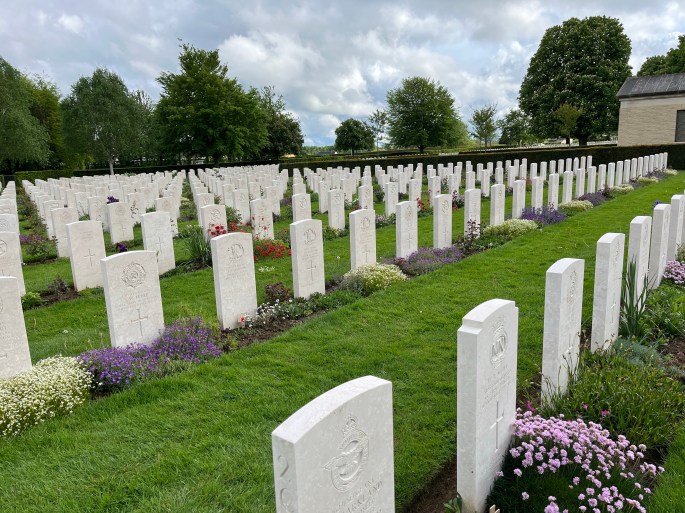
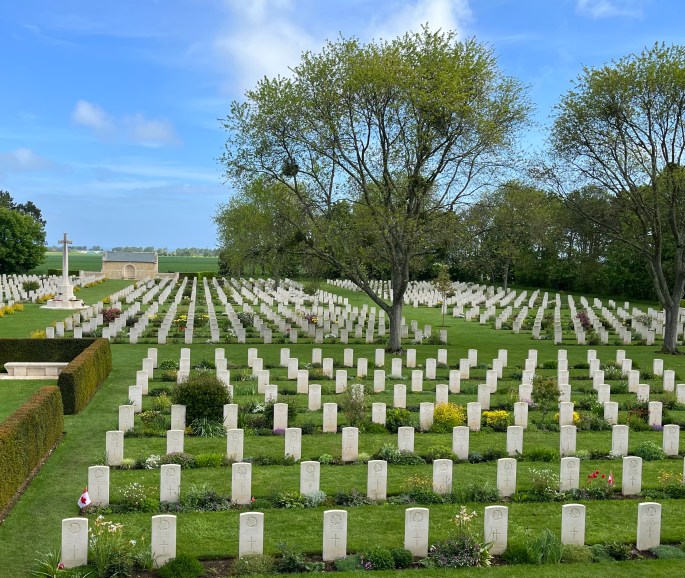
This cemetery is the largest Commonwealth cemetery, having 4648 burials, 338 unknown.

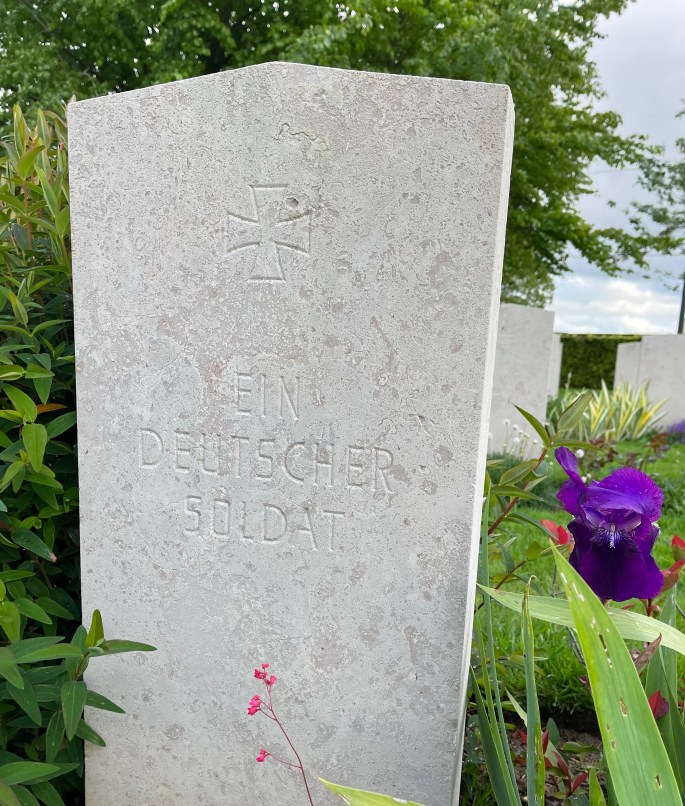
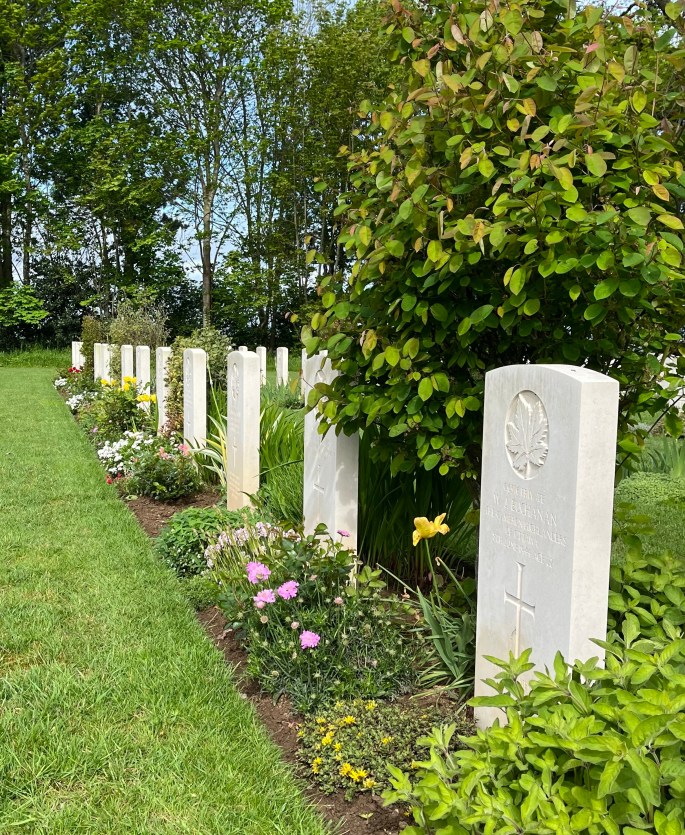
Within this number are 500+ graves of other nationalities. It was the first time I’d seen a German headstone, which is the majority of the 500 at this site. Other nationalities included Poland, Australia, New Zealand, Russia, Czech Republic, Italy and South Africa.

At the back of the cemetery was the ‘Cross of Sacrifice’ which I saw in a number of cemeteries as we continued our travels.

There was one marker that indicated a gentleman that had been awarded the Victorian Cross – the highest and most prestigious award of the British honours system.

Before leaving we got one photo in front of this gorgeous wisteria vine.

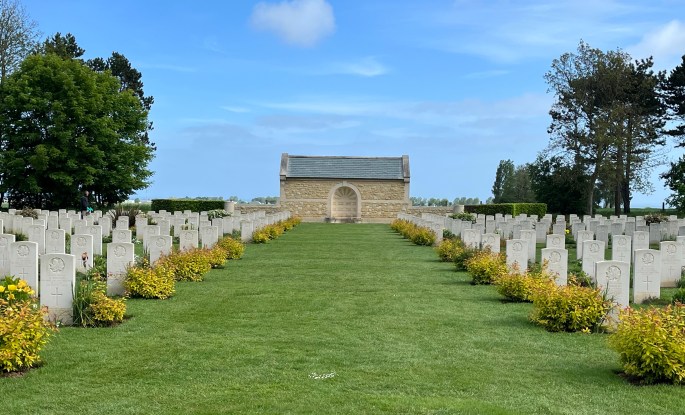
This Canadian cemetery had not been on our list of stops, but driving through the country-side we came upon it, circled around and stopped to honor those soldiers.

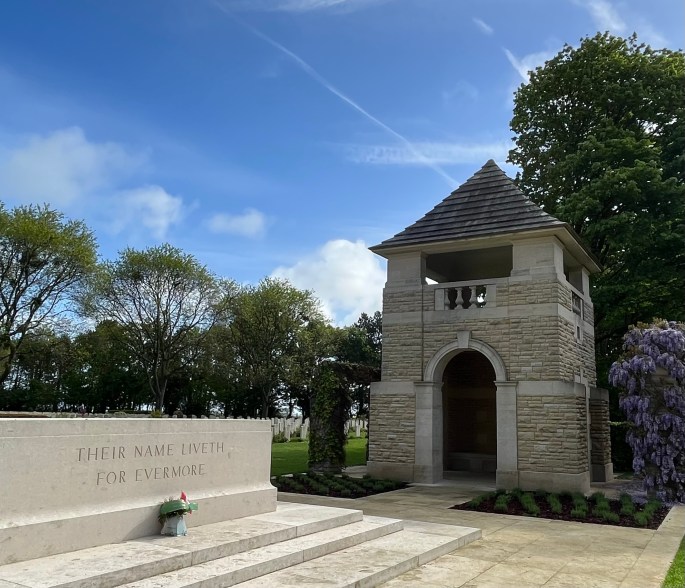
It was the only place during our travels that had (2) towers within the site.

Within this cemetery there are 2048 markers and 9 sets of brothers. Most were killed in early July 1944 in the Battle for Caen.

The cemetery also contains 3 British graves and 1 French grave – he was part of the French Resistance group who fought and died alongside the Canadien soldiers. He had no known relatives and was thus buried here.

Within this cemetery is also a Chaplan that was killed in cold blood by a German Panzer regiment on D-Day. His body was not found until July.

Researching this site after our visit, I found one interesting fact…….The Amazing Race – Canada had the contestants arrive at the cemetery and pay their respects before retrieving their clue ‘Les we Forget’ card.
It was a lucky find as we were traveling that day. There were quite a few visitors at this location, and we saw notes left from family members put with the gravestones, photocopies of a soldier in his youth along with his story of those he left behind in Canada.

Ginny

France WWII Cemeteries -American

When visiting the D-Day beaches, a natural next step (in my opinion) should be the cemeteries to honor those fallen. We visited two on our recent visit.

Normandy American Cemetery

This cemetery is the most heavily visited site, sitting on a cliff overlooking Omaha Beach and the English Channel. In 2007 it was the first Visitor Center opened by the organization that oversees all of our sites. Visitors first learn about French life under the occupation of German forces and then the focus shifts to the planning of the invasion of Europe and why Normandy was chosen. Exhibits explain the roles of the many different specialists in the U.S. forces required to successfully breach the Atlantic Wall defenses.

This engraving was seen upon arrival to the visitor’s center.

The letter below was distributed on the eve of the invasion. It was only one page.

There is a moving film, a number of exhibits and personal stories told before you walk through a final hallway hearing the names of those that were lost.

After a short distance, you can see the shoreline from the cliff above. Eric and Connor were talking about the events that occurred in 1944.

The memorial consists of this semi-circular colonnade with a loggia at each end containing large maps and narratives of the military operations.

The sculpture in the center is called ‘The Spirit of American Youth Rising from the Waves’.

Behind this sculpture are tablets with the names of the missing in action, lost or buried at sea. 1557 names are listed along the panels. A few have a brown rosette next to a name on the wall to indicate they have been found.

The cemetery contains 9388 gravestones of white marble. Those of the Jewish faith are marked by Stars of David. Latin crosses mark all others.
Most of those buried here lost their lives in the D-Day landings and subsequent hedgerow fighting.

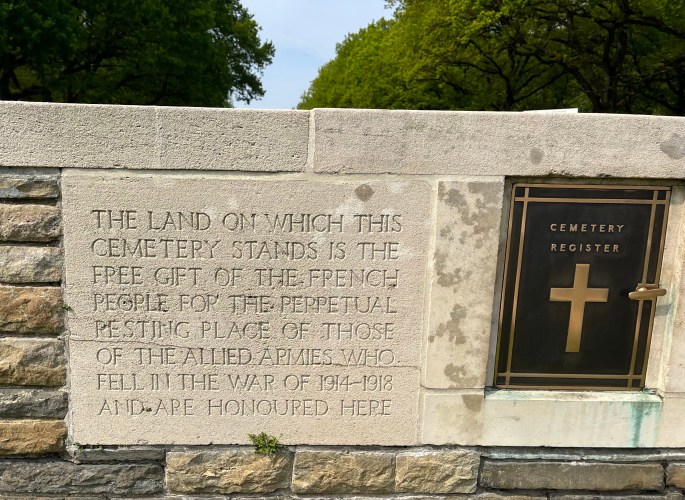
France granted the U.S. a special perpetual concession to the land free of any charge or taxation, but it is still French soil. There was a pathway with the headstones on the right as seen below.

On the left is a serene look at the landing beach that were so very different on 6.6.1944.

As we walked around there are a number of languages that can be heard – not only English. It is a place for contemplation and respect for what happened in history and hopefully a lesson learned.

As we were leaving, I grabbed one last shot.

Brittany American Cemetery

This site is named in honor of the battle to secure the Brittany peninsula and its ports. The greater number of those lost their lives during the German counterattack at Mortain in early July 1944. Others fell on the field of battle up to the liberation of Paris in August 1044.

The statue is called ‘Youth Triumphing Over Evil’.

The chapel is built of granite typical of Brittany. Inside the memorial contains two large operations maps, and military corps flags hung from its walls. Eight stained glass windows depict some of the town liberated between Normandy and Paris.

The cemetery contains 4405 American war dead. Inscribed along the retaining wall of the memorial terrace are the names of 500 of the missing whose remains were not recovered.

VE Day or Victory in Europe Day was May 8 and we saw a number of floral arrangements marking the day during our travels. This is the day celebrating the formal acceptance by the Allies of WWII of German’s unconditional surrender of its armed forces, marking the official end of World War II in Europe.

Like many other places, there was a peaceful reverence while we walked. I would guess that visitation is minimal as there is no public transportation to this location and a taxi would be needed after taking a train to Rennes. We saw one other couple during our time. Viewed from the air the cemetery forms the shoulder sleeve insignia of General Dwight D. Eisenhower’s Supreme Headquarters Allied Expeditionary Forces.

The grounds were immaculate and well kept. There was a noticeable difference. I stopped back at the Visitors center and passed along my observations and thanks.

My last photo is from a plaque inside of the chapel.

Ginny